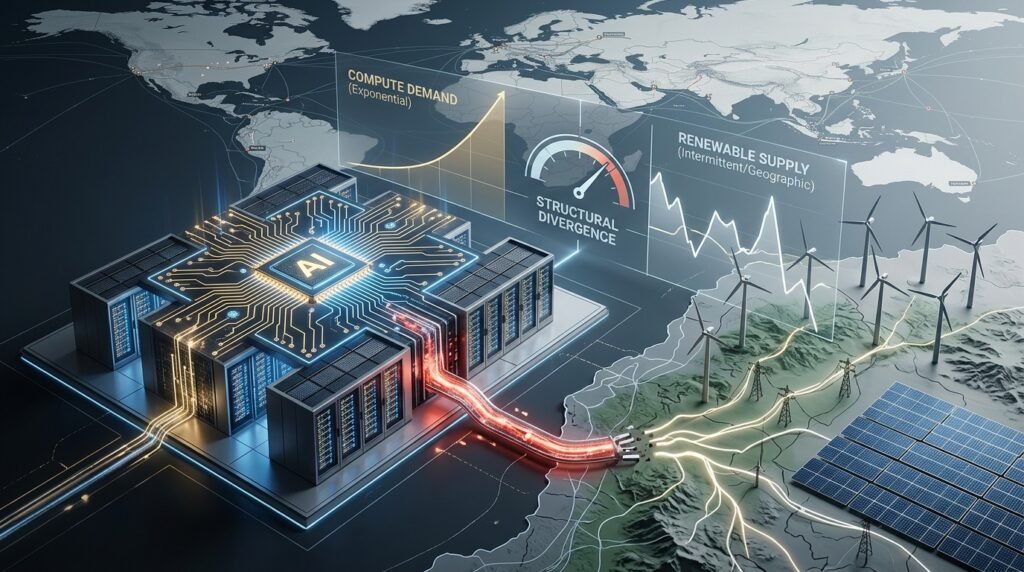
Artificial Intelligence’s Incompatibility with Renewable Energy Sources: A Structural Assessment of the Compute-Power Divergence
A strategic assessment of why AI data center growth is outpacing renewable energy's ability to deliver firm, 24/7 power — and what it means for grids, markets, and climate goals.
Executive Summary
The rapid expansion of artificial intelligence compute infrastructure has exposed a structural mismatch between the operating requirements of AI data centers and the physical characteristics of variable renewable energy (VRE) sources such as solar and wind. This is not an ideological or political incompatibility but an engineering and economic one: AI training and inference workloads demand continuous, high-density, weather-independent electricity, while solar and wind generation is intermittent by nature and requires storage, overbuilding, or firm backup to approximate 24/7 reliability. The result, observable across 2025–2026 data, is a hyperscaler pivot toward nuclear power, natural gas, and other dispatchable sources, even as renewable procurement continues to grow in absolute terms. This report assesses the technical drivers of the mismatch, its military, political, economic, technological, and legal-diplomatic dimensions, and the probable trajectories through 2030.
The term “incompatibility” should be read precisely. Renewables are not incompatible with AI in an absolute sense — hyperscalers continue to sign large solar and wind power purchase agreements (PPAs) — but they are incompatible with AI’s specific load profile when deployed alone, without storage or firm complements at gigawatt scale. This distinction is central to every judgment that follows.
Key Judgments
- High confidence: AI data center electricity demand is growing faster than renewable generation capacity can be matched to it on a firm, dispatchable basis, creating a widening “reliability gap” rather than a simple supply shortfall.
- High confidence: Solar and wind capacity factors (roughly 23% and 34% respectively in the United States) are structurally incompatible with the near-100% uptime requirements of continuous AI training and inference workloads absent large-scale storage or firm backup.
- Moderate-to-high confidence: Hyperscalers are responding by diversifying toward nuclear power, including small modular reactors (SMRs) and restarted legacy plants, alongside continued renewable PPAs, rather than abandoning renewables outright.
- Moderate confidence: Grid interconnection queues and transmission bottlenecks — not generation technology choice alone — are now the single largest constraint on AI infrastructure buildout timelines in the United States and parts of Europe.
- Moderate confidence: The divergence between AI power demand and renewable-only supply strategies risks slowing decarbonization trajectories in AI-hosting regions, as natural gas is increasingly used as a bridging fuel.
- Low-to-moderate confidence: Absent major breakthroughs in grid-scale storage or transmission expansion, several U.S. states and European countries (Ireland, Virginia, and others) face a genuine risk of local moratoria on new data center construction by the end of the decade.
Introduction
Artificial intelligence has moved, within a few years, from a software-centric industry to one whose primary bottleneck is physical infrastructure — specifically, electricity. This has collided with a parallel, decades-long global effort to decarbonize electricity generation through wind, solar, and storage. The intersection of these two trends is the subject of this assessment: not whether renewable energy is desirable (a normative question outside this report’s scope) but whether it is technically and economically fit to power the specific, unforgiving load profile of modern AI infrastructure at the pace the industry demands.
This question matters beyond the technology sector. Electricity markets, climate policy, industrial competitiveness, and — increasingly — great-power technological rivalry are all shaped by how this mismatch is resolved. Analysts, policymakers, and investors require a clear-eyed assessment that separates observed engineering facts from contested policy choices and speculative forecasts.
Historical Background
Data centers have consumed steadily growing shares of electricity for two decades, but the AI-driven inflection is recent. In 2024, global data center electricity consumption was approximately 415 terawatt-hours, representing about 1.5% of the world’s total electricity use, a figure that had been growing at a compound annual growth rate of 12% since 2017 — more than four times faster than total global electricity consumption. Between 2021 and 2024, industry attention centered on improving power usage effectiveness and securing renewable energy through conventional PPAs, treating rising demand as a manageable, forward-looking issue rather than an acute constraint.
That assumption broke down beginning in 2025. The power density of AI-optimized server racks, which can demand 30 to over 100 kilowatts compared to 5–15 kilowatts for traditional racks, began overwhelming local grid capacity, with reports of wholesale electricity costs rising by as much as 267% near some U.S. data centers. What had been a theoretical risk in earlier Department of Energy projections — which had forecast a potential tripling of U.S. data center electricity consumption by 2028 — materialized into an acute commercial constraint, with new AI data center clusters pushing local power grids to their operational limits and turning “speed to power” into the most critical factor for project viability. Belfer Center for Science and International AffairsPresenc AI
Strategic Context
Three converging trends define the current environment. First, AI compute demand — driven overwhelmingly by inference rather than training — has become continuous rather than episodic. Continuous inference load now accounts for 80–90% of total AI compute consumption, and unlike training workloads, inference runs 24/7 at low latency, requiring firm, sustained power rather than burst capacity. Second, renewable generation, while expanding rapidly in absolute terms, remains fundamentally variable. U.S. nuclear plants ran at a 92% capacity factor in 2024, compared with 23.4% for utility-scale solar and 34.3% for wind — meaning a 100-megawatt solar array produces its nameplate output for roughly 23 out of every 100 hours, against roughly 92 for an equivalent nuclear plant. Third, grid infrastructure — transmission lines, interconnection processes, and storage — has not kept pace with either AI demand or renewable buildout, creating a bottleneck that affects all generation sources but disproportionately penalizes intermittent ones, which require additional balancing infrastructure to deliver firm power. Energy-solutionsIntrol
This is the strategic core of the “incompatibility” thesis: it is not that solar and wind cannot generate electricity for AI, but that they cannot, on their own, generate the right kind of electricity — continuous, dispatchable, weather-independent — at the scale and speed the industry now requires.
Detailed Analysis
Military Dimension
The military relevance of this issue is indirect but significant. AI compute capacity is increasingly treated as strategic infrastructure by major powers, given its centrality to intelligence analysis, autonomous systems, cyber operations, and defense-industrial modeling. Energy security for AI infrastructure is therefore beginning to intersect with broader energy security doctrine. States that can guarantee firm, resilient power to AI and defense-adjacent computing clusters — whether through nuclear, domestic gas, or hardened grid infrastructure — gain a strategic advantage over states dependent on imported fuel or externally financed renewable buildouts. Conversely, AI data centers reliant on fragile or import-dependent power grids represent potential vulnerabilities, both to conventional supply disruption and, in a permissive threat environment, to deliberate targeting of transmission infrastructure. This dimension remains underdeveloped in open-source literature and warrants closer monitoring as AI infrastructure is increasingly designated critical national infrastructure in the United States, China, and the European Union.
Political Dimension
Domestically, the politics of this mismatch are becoming contentious. Local communities near major data center clusters — Northern Virginia, Ireland, parts of Texas and Arizona — face rising electricity costs and grid strain attributable in part to AI buildout. In 2023, data centers in Virginia consumed as much as 26% of all electricity in the state, and Ireland’s data centers accounted for 21% of national electricity consumption in 2022, with forecasts of a 32% share by 2026. EPRI’s 2026 projections suggest Virginia’s data center share of electricity could rise to between 41% and 59% by 2030, with seven additional U.S. states potentially exceeding a 20% share. This concentration is generating political pressure for regulatory intervention, including possible construction moratoria in regions where the grid cannot absorb further load. Some jurisdictions are already debating requirements for data centers to rely partially on renewable sources or to report carbon and water footprints, alongside proposed local moratoria on new server farm construction where grids cannot support them. DataCenterKnowledge + 2
At the same time, a competing political dynamic favors continued data center growth: state and national governments are competing for AI infrastructure investment through incentives and expedited permitting, creating tension between economic development goals and grid or environmental constraints. This produces a fragmented political landscape in which different jurisdictions adopt divergent postures depending on local grid headroom, industrial policy priorities, and public tolerance for rate increases.
Economic Dimension
The economic stakes are substantial and rising. Goldman Sachs Research forecasts a 165% increase in global data center power demand by 2030 compared with 2023 levels, with capacity expanding to 92 gigawatts by 2027 at a 17% compound annual growth rate, while the International Energy Agency projects global data center electricity consumption roughly doubling from about 415 terawatt-hours in 2024 to around 945 terawatt-hours by 2030 in its base case. Utilities are responding with major capital commitments: a PowerLines analysis of 51 U.S. investor-owned utilities published in April 2026 found planned capital expenditure of at least $1.4 trillion through 2030, a more than 21% increase over plans the same utilities held a year earlier, with more than 30 citing data centers as a top growth driver. Axis IntelligenceAxis Intelligence
The renewables-versus-firm-power economics are contested but increasingly clear on one point: intermittent sources alone cannot meet hyperscaler reliability requirements without substantial additional investment. A Goldman Sachs research note assessed that wind and solar could serve roughly 80% of a data center’s power demand if paired with storage, but that some form of baseload generation is still needed to meet continuous demand. This has driven capital toward nuclear at a striking pace: as of May 2026, thirteen announced projects had committed over 9.8 gigawatts of nuclear capacity to AI data center infrastructure, with every major U.S. hyperscaler having signed at least one deal. Microsoft’s Three Mile Island restart, Amazon’s Susquehanna and X-energy SMR agreements, Google’s Kairos Power deal, and Meta’s commitments of up to 6.6 gigawatts across multiple nuclear developers illustrate the scale of this shift, occurring against a backdrop in which the U.S. interconnection queue has grown to over 2,600 gigawatts of projects awaiting grid connection, with average wait times around five years and withdrawal rates near 80%. tech plus trendstech plus trends
Importantly, this is not a wholesale abandonment of renewables. Worldwide, renewables currently supply about 27% of the electricity consumed by data centers, mostly through wind, solar, and hydropower, and total renewable generation is projected to grow 22% annually through 2030, meeting nearly half of the anticipated growth in data center electricity demand. The economic logic is therefore additive rather than substitutive: hyperscalers are pursuing renewables for volume and cost, while separately procuring firm capacity for reliability — an acknowledgment that firm baseload power is a distinct procurement category that intermittent renewables cannot fulfill on their own. EnkiAIIntrol
Technological Dimension
The technical basis of the incompatibility rests on three factors: capacity factor, dispatchability, and power density. Capacity factor differences (nuclear near 90–95% versus solar and wind in the 23–35% range) mean that matching nameplate renewable capacity to AI load requires several multiples of overbuild plus storage to achieve equivalent firm output. Data centers run continuously and cannot absorb the intermittency of wind and solar without battery backup that scales poorly above a few hundred megawatts, a limitation that becomes more binding as individual campuses approach gigawatt scale. IAEA
Emerging technological responses include SMRs, geothermal, and hybrid storage architectures. SMRs, compact reactors producing up to 300 megawatts each, offer capacity factors above 95% compared with 25–35% for solar and wind, along with a smaller land footprint, though commercial deployment timelines extend toward the end of the decade. Utility interconnection queues stretching toward 2035 in some markets, against AI compute demand that some estimates suggest is doubling roughly every 18 months, illustrate the widening gap between infrastructure delivery timelines and compute growth rates. Liquid cooling and other efficiency technologies mitigate but do not eliminate the underlying electricity demand, which remains the dominant environmental and operational cost driver of AI infrastructure. Informed ClearlyEnkiAI
Legal / Diplomatic Dimension
Regulatory frameworks are beginning to catch up with these dynamics, unevenly across jurisdictions. In the European Union, carbon reporting and energy efficiency obligations are creating direct compliance costs for gas-reliant bridging strategies, pushing operators toward renewable and nuclear procurement even where reliability considerations would favor gas. In the United States, permitting reform for both transmission and nuclear licensing has become a live policy debate, with interconnection delays cited as a primary business risk by industry analysts. Internationally, the concentration of AI infrastructure investment in a handful of countries — the United States, Ireland, and a small number of Asian and Gulf states — raises diplomatic questions about energy resource allocation, particularly where AI data centers compete with domestic consumers for scarce grid capacity or water resources in cooling-constrained regions. No binding international framework currently governs AI energy consumption, leaving the issue to be addressed through fragmented national and subnational regulation.
Scenario Analysis
Scenario 1 — Managed Diversification (renewables plus firm power coexist): Hyperscalers continue blending renewable PPAs with nuclear, gas bridging, and storage investment; grid and transmission investment gradually catches up; local moratoria remain isolated rather than widespread. This is the trajectory most consistent with current hyperscaler procurement patterns.
Scenario 2 — Grid-Constrained Fragmentation: Interconnection queues and transmission bottlenecks fail to ease meaningfully, pushing AI infrastructure growth to concentrate in a small number of regions with spare capacity, favorable permitting, or off-grid generation (behind-the-meter gas or nuclear), while other regions see stalled projects and rising local political resistance.
Scenario 3 — Renewable-Led Convergence: Breakthroughs in grid-scale storage economics, long-duration storage, or enhanced geothermal narrow the reliability gap faster than currently projected, allowing renewables to meet a substantially larger share of firm AI demand by the early 2030s without proportionate nuclear or gas buildout.
Scenario 4 — Regulatory Backlash: Rising consumer electricity costs and local opposition trigger broader legislative or regulatory intervention — mandatory renewable sourcing requirements, moratoria, or cost-allocation reforms — that materially slows AI infrastructure buildout in affected jurisdictions, independent of technological solutions.
Probability Assessment
| Scenario | Likelihood (2026–2030) | Key Uncertainty |
|---|---|---|
| Managed Diversification | High | Pace of nuclear and storage deployment relative to demand growth |
| Grid-Constrained Fragmentation | Moderate-to-High | Speed of transmission and interconnection reform |
| Renewable-Led Convergence | Low-to-Moderate | Storage cost curves; enhanced geothermal maturation |
| Regulatory Backlash | Moderate | Public tolerance for rate increases; political cycle timing |
These assessments reflect current trend lines and are subject to revision as interconnection reform, nuclear licensing outcomes, and storage cost trajectories become clearer over the next 18–24 months.
Strategic Outlook
The near-term trajectory (through 2027–2028) will likely be defined by continued hyperscaler diversification: expanding renewable PPAs alongside accelerating nuclear, SMR, and gas-bridging investment, with transmission and interconnection bottlenecks — rather than generation technology choice per se — acting as the binding constraint on growth. The medium-term outlook (2028–2030) hinges substantially on whether nuclear commitments, currently concentrated in the announcement and early-construction phase, convert into operational capacity on schedule; historical nuclear project delivery has frequently slipped by one to three years from initial timelines, a risk factor that could sustain gas as a bridging fuel longer than current hyperscaler messaging suggests. Climate policy implications are ambiguous: absolute carbon emissions from the sector are likely to keep rising even as carbon intensity per unit of compute falls, since growth in demand is outpacing the rate of clean-energy procurement.
Conclusion
The relationship between artificial intelligence and renewable energy is best characterized not as outright incompatibility but as a reliability mismatch that current renewable technologies, deployed alone, cannot resolve at the speed and scale AI infrastructure now demands. This has produced an observable industry response — diversification toward nuclear and other firm power sources — rather than abandonment of renewable procurement. The strategic significance lies less in the technology debate itself than in its downstream effects: rising electricity costs, contested land and grid access, emerging critical-infrastructure and national-security dimensions, and a genuine risk that decarbonization timelines slip as gas remains a necessary bridge. Policymakers, investors, and defense planners should treat the AI-power nexus as a distinct and fast-moving strategic variable rather than a subset of conventional energy or technology policy.
Sources
- International Energy Agency, Energy and AI (2025 report and subsequent data center electricity projections)
- U.S. Energy Information Administration, Short-Term Energy Outlook, December 2025
- Belfer Center for Science and International Affairs, “AI, Data Centers, and the U.S. Electric Grid: A Watershed Moment,” February 2026
- Brookings Institution, “Global energy demands within the AI regulatory landscape,” 2026
- Goldman Sachs Research, data center power demand and nuclear procurement analysis, 2025–2026
- BloombergNEF, U.S. nuclear power purchase agreement tracking
- EPRI, 2026 update on state-level data center electricity share projections
- U.S. Department of Energy, nuclear and renewable capacity factor data (2024)
- International Atomic Energy Agency, “Data Centres, Artificial Intelligence and Cryptocurrencies Eye Advanced Nuclear to Meet Growing Power Needs”
- PowerLines analysis of U.S. investor-owned utility capital expenditure, April 2026
Frequently Asked Questions
Is AI truly “incompatible” with renewable energy, or can solar and wind eventually power data centers?
Solar and wind can supply a substantial share of AI data center electricity — currently around 27% globally and growing — but cannot alone meet the continuous, weather-independent demand of AI workloads without large-scale storage or firm backup. The incompatibility is about reliability profile, not total energy potential.
Why are tech companies turning to nuclear power instead of just building more solar and wind?
Nuclear offers capacity factors near 90–95%, compared with roughly 23–35% for solar and wind, meaning it delivers firm, continuous power without the multiplied overbuild and storage costs required to approximate the same reliability from intermittent sources.
Does this trend threaten global decarbonization goals?
It creates tension. While renewable capacity is still expanding rapidly, natural gas is increasingly used as a bridging fuel for AI infrastructure, which risks slowing the reduction of absolute emissions even as emissions per unit of compute decline.
What is the biggest bottleneck for AI data center power right now?
Grid interconnection and transmission capacity, not generation technology choice, is currently the primary constraint, with U.S. interconnection queues exceeding 2,600 gigawatts of pending projects and multi-year wait times.
Could local opposition or regulation actually halt AI data center growth?
Yes, in specific jurisdictions. Regions with the highest data center concentration, such as Virginia and Ireland, already face political pressure over electricity costs and grid strain, and local moratoria on new construction have been proposed where grid capacity cannot keep pace.