Military Affairs, Regional Analysis
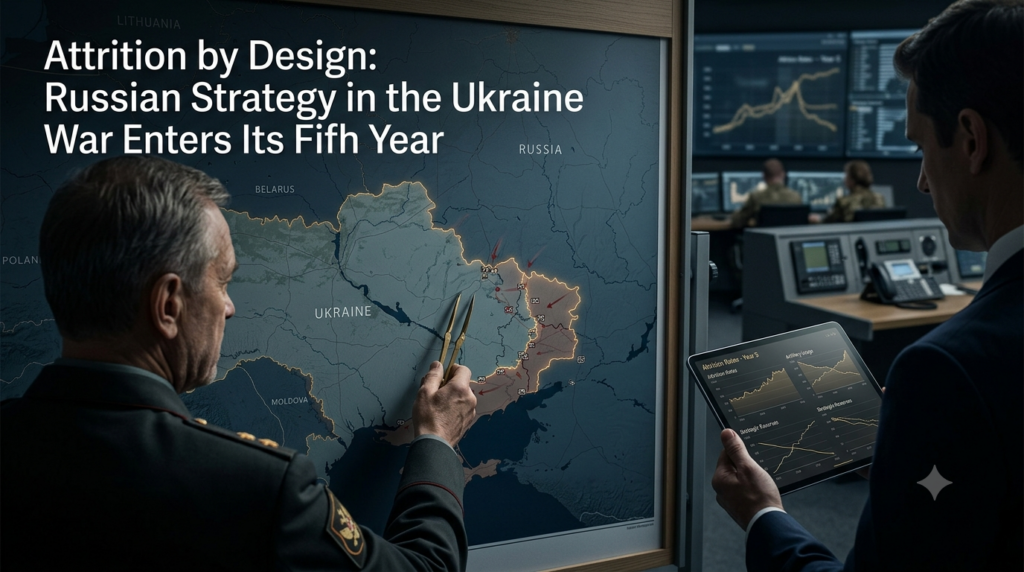
Attrition by Design: Russian Strategy in the Ukraine War Enters Its Fifth Year
A strategic intelligence assessment of Russian military, political, and economic strategy in Ukraine, with probability-weighted scenarios through 2027. Suggested URL Slug: /russia-strategy-ukraine-war-2026-assessment
Executive Summary
More than four and a half years into its full-scale invasion of Ukraine, Russia has settled into a strategy that prioritizes attrition over maneuver, endurance over speed, and the erosion of Western and Ukrainian will over decisive battlefield victory. This assessment examines the military, political, economic, technological, and diplomatic dimensions of that strategy as of August 2026. Observed facts indicate that Russia’s 2026 “spring-summer offensive” has produced only marginal territorial gains despite historic casualty levels, that Russian recruitment is now failing to keep pace with losses in several months of 2026, and that sanctions pressure has meaningfully degraded Russian oil and gas revenue even as Chinese dual-use trade sustains the defense-industrial base. Assessed judgments suggest the Kremlin calculates that time favors Moscow more than it favors Kyiv or the West, a calculation that is being tested by mounting internal strain. Forecasts point toward continued attritional stalemate as the most probable near-term trajectory, with a negotiated freeze along current lines as a plausible but not dominant alternative, and both renewed Russian mobilization and a comprehensive peace settlement assessed as less likely outcomes over the next 12–18 months.
Key Judgments
- (High confidence) Russia has deliberately shifted from maneuver warfare to a positional, attrition-centric approach, betting that its capacity to absorb losses in manpower and materiel exceeds Ukraine’s capacity to resist and the West’s collective willingness to keep funding that resistance.
- (High confidence) The rate of Russian territorial advance has slowed to near-negligible levels in 2026. Even Moscow’s own inflated claims describe an advance measured in tens of square kilometers per day across an active front exceeding 1,000 kilometers, and independent trackers describe rates as low as tens of meters per day in contested sectors.
- (Moderate-to-high confidence) Russian personnel losses have outpaced recruitment in multiple months of 2026, a structural sustainability problem the Kremlin is managing through incentivized contract enlistment, “shadow mobilization,” and foreign auxiliaries rather than a politically costly formal mobilization wave.
- (Moderate confidence) Russia’s war economy is under genuine but not yet critical strain. Sanctions and Ukrainian strikes on refining and export infrastructure have cut into oil and gas revenue, forcing tax increases and off-budget financing, but Chinese trade and adaptive workarounds have so far prevented a fiscal or industrial collapse.
- (High confidence) Moscow has explicitly tied its return to substantive negotiations to the completion of its conquest of Donetsk Oblast, a timeline that Russia’s own Ministry of Defense reportedly views as optimistic.
- (Moderate confidence) A comprehensive, durable peace settlement is less probable in the near term than either continued stalemate or an unstable, informal freeze along existing lines of contact.
- (Low-to-moderate confidence) A renewed formal Russian mobilization, while politically risky for the Kremlin, cannot be excluded if operations in Donetsk continue to underperform against Moscow’s internal targets.
Introduction
The war in Ukraine has evolved substantially since Russia’s initial 2022 invasion attempted a rapid decapitation of the Ukrainian state. What began as a campaign built around speed and maneuver has become, by 2026, a grinding contest of industrial capacity, manpower replenishment, and political endurance. Understanding Russian strategy today requires moving past the framing of the war’s early months and examining what the evidence of the past two years actually shows: a Kremlin that has consciously optimized its military for positional warfare, that treats casualties as a tolerable cost of a longer war it believes it can win on aggregate terms, and that has bound its diplomatic posture to battlefield objectives it has not yet achieved. This assessment separates observed fact from analytical judgment and forecast throughout, and where interpretations diverge — as they do sharply among realist and liberal-institutionalist schools of international relations — both are presented rather than resolved in favor of one.
Historical Background
Russia’s February 2022 invasion pursued multiple axes simultaneously, including a strike toward Kyiv intended to force rapid political capitulation. That effort failed within weeks, and Russian forces withdrew from northern Ukraine by April 2022, refocusing on the eastern Donbas region and the southern land bridge to Crimea. Ukrainian counteroffensives in Kharkiv and Kherson oblasts in the second half of 2022 reversed significant Russian gains, but Ukraine’s 2023 summer counteroffensive in Zaporizhzhia failed to achieve a breakthrough against prepared Russian defensive lines, marking a turning point after which the front stabilized into what has remained a largely static, attritional contest.
From 2024 onward, Russia shifted to a slower, more methodical offensive posture centered on artillery, glide bombs, and mass infantry assaults against fortified Ukrainian positions, capturing Avdiivka in February 2024 and grinding toward Pokrovsk over the following two years. Ukraine’s August 2024 incursion into Russia’s Kursk Oblast — the largest foreign military operation on Russian soil since the Second World War — diverted Russian resources but did not alter the war’s fundamental trajectory.
Diplomatic efforts intensified substantially after the Trump administration took office in early 2025, producing multiple rounds of talks in Istanbul, the United Arab Emirates, Geneva, and Florida, alongside prisoner exchanges and periodic ceasefire proposals, including a brief three-day truce in May 2026. A August 2025 Trump-Putin summit in Alaska raised the prospect of territorial “swapping” as part of a settlement. By January 2026, a coalition of roughly three dozen mostly European states had convened in Paris to formalize post-war security guarantees for Ukraine, an initiative branded the “Coalition of the Willing.” Negotiations then stalled for several months from February 2026, as a separate U.S. military confrontation with Iran absorbed Washington’s diplomatic attention — a development that, notably, also delivered Moscow a temporary economic windfall through higher global oil prices even as core Ukraine peace talks lost momentum.
Strategic Context
As of August 2026, Russia controls approximately 18 to 19 percent of internationally recognized Ukrainian territory, including Crimea and most of Luhansk Oblast, alongside partial control of Donetsk, Zaporizhzhia, and Kherson oblasts. The front line, running roughly 1,000 kilometers from the Kharkiv area to the Dnipro River in Kherson, has been substantially static since late 2023, with monthly territorial changes typically measured in the low hundreds of square kilometers or less.
Russia’s declared 2026 spring-summer offensive has not produced an operationally significant breakthrough. Independent battlefield trackers describe the rate of Russian advance in 2026 as the slowest of the war to date, with some analyses estimating gains at only tens of meters per day in contested sectors. The Kremlin has simultaneously escalated an informational campaign — including inflated claims of settlements captured — that Western analysts assess is intended to convince both Ukraine’s Western backers and the Russian domestic public that Ukrainian resistance is collapsing, despite battlefield evidence to the contrary.
Diplomatically, the negotiating track that had shown momentum in early 2026 lost pace amid the U.S.-Iran conflict. U.S. officials indicated in early August 2026 an intent to attempt to restart talks in the coming weeks, while acknowledging that Russian and Ukrainian positions remain far apart, particularly over the status of the roughly one-quarter of Donetsk Oblast still under Ukrainian control. Reporting citing Kremlin-adjacent sources indicates Russia intends to withhold serious re-engagement in negotiations until it completes the conquest of Donetsk, a goal its own Ministry of Defense has told Putin it can achieve by the end of 2026 — an assessment that many within the Russian military reportedly consider unrealistic, with 2027 seen as more plausible.
Detailed Analysis
Military Dimension
Russian military strategy in 2026 reflects a deliberate, multi-year adaptation away from maneuver warfare. The Kremlin has optimized its force structure for positional combat: layered defensive belts, artillery- and glide-bomb-centric fire support, and mass infantry assaults intended to identify and exploit weak points in Ukrainian lines through sheer weight of attempts rather than operational surprise. This approach has proven costly. Cumulative Russian casualties — killed, severely wounded, and missing — are estimated by Western analysts to exceed 1.2 million personnel as of early 2026, among the highest losses sustained by any major power in a single conflict since the Second World War.
The manpower implications of this attrition rate are increasingly significant. Russia set a 2026 recruitment target of approximately 409,000 contract soldiers, but Ukrainian intelligence estimates suggest Russia met only around a fifth of that target in the first quarter of the year. Multiple months in 2026 have seen Russian losses exceed new recruitment, including a reported record of roughly 35,000 personnel lost in March alone. The Kremlin has so far avoided a second formal mobilization wave — a step considered politically dangerous given the backlash to the partial mobilization of September 2022 — relying instead on high financial incentives, regional recruitment quotas, tightened penalties for draft evasion, and the deployment of several thousand North Korean troops, who have shifted from costly frontal assault roles toward more specialized functions such as artillery support and mine clearance as they adapt to modern drone-saturated combat conditions.
Ukraine’s evolving strike capabilities have materially constrained Russian offensive tempo. Sustained Ukrainian counterattacks, an expanding intermediate-range strike campaign against Russian logistics and energy infrastructure, and battlefield drone dominance have combined to prevent Russia from restoring maneuver warfare or fielding mechanized formations at scale. The result, according to multiple Western defense-analytical assessments, is a Russian military that retains the capacity to grind forward slowly and at high cost, but has lost, at least for now, the capacity to achieve rapid, decisive breakthroughs.
Political Dimension
Vladimir Putin’s political strategy centers on demonstrating that Russia can outlast both Ukraine and its Western backers. Domestically, the Kremlin has insulated its core political institutions from the immediate shock of mass casualties through financial compensation, information control, and the substitution of foreign and regional volunteers for a broader cross-section of Russian society. This has allowed the war to continue without the kind of visible domestic political rupture that a general mobilization might trigger, though analysts increasingly describe underlying social and institutional strain as accumulating rather than disappearing.
Putin’s negotiating posture has remained tightly coupled to battlefield objectives, particularly the demand that Ukraine cede the portions of Donetsk Oblast it still controls — a demand Kyiv has consistently rejected. Ukrainian President Volodymyr Zelensky faces his own binding domestic constraint: polling from early 2026 indicated that a majority of Ukrainians reject withdrawing from unoccupied parts of Donbas even in exchange for security guarantees, and any formal territorial change would require a national referendum under Ukrainian law. This mutual inflexibility on Donetsk has become the central obstacle to any negotiated settlement.
The diplomatic environment has also been shaped by shifting U.S. engagement. Washington’s mediation, energetic through much of 2025 and early 2026, lost momentum amid the U.S. military confrontation with Iran, prompting a more skeptical tone from U.S. officials about the prospects for a near-term breakthrough, alongside renewed efforts in August 2026 to restart the process. European states, meanwhile, have moved to formalize security guarantees for Ukraine through the Coalition of the Willing framework agreed in Paris in January 2026, reflecting a broader — and still incomplete — European push toward strategic self-reliance in Ukraine’s defense, independent of the pace of U.S. policy.
Economic Dimension
Russia’s war economy shows clear signs of strain without evidence of imminent collapse. Oil and gas revenue, which funded roughly half of the federal budget in the mid-2010s, has fallen to around 22 percent of budget revenue by 2026, and monthly hydrocarbon tax receipts collapsed sharply in early 2026 compared with the prior year. Projected 2026 GDP growth of roughly 0.4 percent would mark a significant slowdown from the wartime expansion of 2023–2024, and the government has raised value-added and other taxes to compensate for falling energy revenue while running a budget deficit that reportedly exceeded its full-year target within the first quarter of the year alone.
Two factors have partially offset this pressure. First, the mid-2026 U.S.-Iran conflict drove a temporary spike in global oil prices that briefly boosted Russian export revenue even as Washington eased some sanctions enforcement to manage energy markets — though this proved a short-term reprieve rather than a structural fix, and Russia’s longer-term energy and infrastructure projects tied to Iran were themselves disrupted by that conflict. Second, sanctions enforcement gaps and continued European purchases of Russian energy in the war’s earlier years cumulatively offset a substantial share of the intended sanctions impact. Analysts increasingly frame Russia’s core constraint not as a shortage of money but as a shortage of people, advanced technology, and productive industrial capacity — a distinction with significant implications for how much further sanctions alone can achieve.
Ukraine has pursued its own economic strategy against Russian energy infrastructure, with a sustained drone campaign against refineries and port export terminals that Western estimates suggest has reduced Russian refining capacity and disrupted physical export volumes at several key Baltic and Black Sea facilities.
Technological Dimension
The technological character of the war has shifted markedly since 2024. Both sides have moved toward mass, low-cost strike systems as artillery has become increasingly vulnerable to drone-enabled targeting. Russia’s Geran-series loitering munitions — derived from Iran’s Shahed-136 design but now largely domestically produced — form the backbone of a saturation strategy intended to overwhelm Ukrainian air defenses through sheer volume rather than precision, employing coordinated strike packages that mix drones, decoys, cruise missiles, and ballistic missiles. Successive Geran variants have incorporated improved satellite-navigation resilience, mesh networking, and in newer jet-powered models, resistance to Ukrainian electronic-warfare jamming, reflecting an active technological contest between Russian strike innovation and Ukrainian countermeasures.
Both sides have also increasingly turned to glide bombs as artillery’s battlefield role has narrowed, reflecting a shared fire-centric doctrine adapting to a drone-saturated environment where traditional massed artillery fire has become harder to sustain safely.
China’s role as a technological enabler has become increasingly central to Russian capability. Chinese dual-use exports — including semiconductors, machine tools, optical equipment, and specialized components for missile and drone production — now account for a large majority of Russia’s sanctioned technology imports, with some Western estimates placing China’s share of components in Russian weapons systems at roughly four-fifths by 2025. This support has drawn G7 criticism but has not been matched by sanctions severe enough to meaningfully disrupt the flow, and Chinese analysts and firms are widely assessed to be studying battlefield lessons from the conflict for their own military modernization, including in the context of a potential Taiwan contingency.
Legal / Diplomatic Dimension
The legal architecture surrounding the war remains largely unresolved. No Western government recognizes Russia’s annexation of Crimea or the four additional oblasts it claims, and any territorial settlement would raise complex questions about international recognition, sanctions relief sequencing, and reparations that go well beyond the battlefield. The International Criminal Court’s 2023 arrest warrant against Putin over the unlawful deportation of Ukrainian children remains in effect and continues to complicate any scenario involving direct Russian-Western diplomatic normalization.
Security guarantees for Ukraine have become the central diplomatic innovation of the 2025–2026 period. The Coalition of the Willing framework, formalized in the January 2026 Paris Declaration, envisions a multinational reassurance force, continued long-term military support, and a ceasefire-monitoring mechanism, though as of late 2025 this force had not yet been formally mandated, and its ultimate scale and credibility remain contested. Some proposals under discussion reportedly draw on NATO’s Article 5 language for collective defense assurances without conferring full NATO membership — an approach that avoids the alliance’s consensus requirement but risks, in the assessment of some analysts, being read by Moscow as an implicit veto power over Ukraine’s future alignment.
Scenario Analysis
Scenario 1 — Continued Attritional Stalemate. Russia and Ukraine continue fighting largely along current lines through 2027, with neither side achieving a decisive breakthrough. Russia continues slow, costly advances in Donetsk without completing its conquest of the oblast; Ukraine sustains its defense through continued Western support and its own strike campaign against Russian logistics and energy infrastructure. Negotiations remain intermittent and largely unproductive. This scenario is consistent with the trajectory observed over the past two years and does not require any actor to change its core strategic calculus.
Scenario 2 — Negotiated Freeze Along Current Lines. Accumulating Russian manpower and economic strain, combined with sustained Ukrainian resistance and reinvigorated U.S. diplomatic engagement once Washington’s attention returns fully to the Ukraine file, produce an informal or formal ceasefire that locks in something close to the current territorial division without full Ukrainian withdrawal from Donetsk. This would resemble a Korea-style armistice more than a comprehensive peace treaty, leaving core disputes over sovereignty, sanctions, and security guarantees unresolved.
Scenario 3 — Renewed Russian Mobilization and Escalation. If Russian operations continue to underperform against the Kremlin’s internal Donetsk timeline and manpower losses continue to outpace recruitment, Moscow could be compelled toward a further mobilization wave despite the domestic political risk, potentially accompanied by expanded strikes on Ukrainian infrastructure or heightened hybrid pressure against NATO’s eastern flank as a demonstration of resolve. This scenario carries the highest escalation risk of the four but would represent a significant and politically costly departure from the Kremlin’s current management of the war’s domestic footprint.
Scenario 4 — U.S.-Brokered Comprehensive Settlement. A revived American mediation effort, building on the reported framework that Ukrainian officials described in early 2026 as roughly 90 percent agreed on security-guarantee provisions, produces a formal settlement involving territorial trade-offs, sanctions relief sequencing, and an international security guarantee mechanism. This would require both a Russian willingness to lock in gains before its economic and manpower constraints deepen further and a Ukrainian political consensus — currently absent according to available polling — to accept some form of territorial compromise.
Probability Assessment
| Scenario | Probability | Time Horizon |
|---|---|---|
| Continued attritional stalemate | High | 12–18 months |
| Negotiated freeze along current lines | Moderate | 12–24 months |
| Renewed mobilization and escalation | Low-to-moderate | 6–18 months |
| Comprehensive U.S.-brokered settlement | Low | 12–24 months |
These assessments reflect a realist reading of the incentive structure facing both belligerents: neither Moscow nor Kyiv currently faces a cost of continued fighting severe enough to force capitulation on the other’s core terms, and both retain external patrons — China and North Korea for Russia, the collective West for Ukraine — willing to sustain the war rather than see their partner defeated. A liberal-institutionalist reading would place somewhat greater weight on the cumulative effect of sanctions, international legal isolation, and coalition-based security guarantees in eventually constraining Russian behavior, and correspondingly greater probability on Scenario 2 or 4. Historical precedent from other post-Soviet frozen conflicts — Transnistria, and Abkhazia and South Ossetia — suggests that unresolved territorial disputes of this kind can persist for decades without either full resolution or renewed full-scale conflict, lending some support to Scenario 1 and 2 as durable rather than transitional states.
Strategic Outlook
Several second-order implications extend beyond the immediate battlefield. First, the war has become a significant data set for Chinese military planners studying drone saturation, electronic warfare, and mass-precision strike integration, with direct relevance to Beijing’s own contingency planning around Taiwan; this represents an underappreciated strategic cost of the conflict’s prolongation for the wider Indo-Pacific balance. Second, European rearmament — still developing largely within NATO structures rather than as a fully autonomous capability — has been substantially accelerated by the war, though its long-term trajectory will depend on whether European states can sustain funding and industrial mobilization independent of shifting U.S. political priorities. Third, the war has demonstrated the practical limits of energy sanctions against a large, adaptable economy with willing alternative trading partners, a lesson likely to inform future sanctions design against other targets. Finally, the persistence of Chinese and North Korean support for Russia’s war effort, alongside Iranian drone technology transfers, illustrates a deepening pattern of alignment among revisionist and sanctioned states that many analysts now describe as a loose but consequential axis, with implications well beyond the Ukrainian theater.
Conclusion
Russian strategy in Ukraine as of mid-2026 is best understood as a calculated bet on endurance rather than a plan for rapid victory. That bet has produced enormous costs — in personnel, in economic capacity, and in diplomatic isolation — without yet delivering the decisive military or political outcome the Kremlin seeks. Whether this strategy ultimately succeeds will depend less on any single battle than on the relative capacity of Russia, Ukraine, and their respective external backers to sustain their current trajectories through 2027 and beyond. The most probable near-term outcome remains continuation of the grinding status quo, with a negotiated freeze the most plausible alternative and both renewed escalation and comprehensive peace assessed as less likely, though neither can be ruled out.
Frequently Asked Questions
What is Russia’s core strategic objective in Ukraine as of 2026?
Moscow’s stated near-term objective is the completion of its conquest of Donetsk Oblast, which it has tied to any return to substantive peace negotiations, alongside the broader goal of outlasting Ukrainian and Western resolve through a prolonged war of attrition.
Why has Russia’s 2026 offensive made so little territorial progress?
Sustained Ukrainian drone dominance, an expanding Ukrainian strike campaign against Russian logistics, and Russia’s own shift toward positional rather than maneuver warfare have combined to slow Russian advances to some of the lowest rates of the war, despite continued heavy Russian casualties.
Could Russia’s manpower shortage force it to negotiate?
It is a plausible contributing pressure rather than a determinative one. Russian losses have outpaced recruitment in several 2026 months, but the Kremlin has so far managed this through financial incentives and foreign auxiliaries rather than concessions at the negotiating table.
What role does China play in sustaining Russia’s war effort?
China supplies a large majority of Russia’s sanctioned dual-use technology imports, including semiconductors, machine tools, and components used in missile and drone production, making it the single most important external enabler of Russia’s defense-industrial base.
How likely is a ceasefire or peace deal in 2026–2027?
Assessed as less likely than continued stalemate or an informal freeze along current lines, given the unresolved dispute over Donetsk Oblast and the absence, on available polling, of Ukrainian public consensus for territorial concessions.
Sources
- Institute for the Study of War / Critical Threats Project, Russian Offensive Campaign Assessment, August 2026
- Council on Foreign Relations, Global Conflict Tracker: War in Ukraine
- Center for Strategic and International Studies, Drone Saturation: Russia’s Shahed Campaign
- Chatham House, The Time Is Ripe for Russia-Ukraine Peace Talks, But Putin Could Escalate Conflict; Europe Is Helping Ukraine Resist a US Push for Peace at Any Price; The Iran War Has Been an Economic Gift for Putin
- Foreign Policy Research Institute, Russia’s War of Self-Destruction
- Kiel Institute for the World Economy, Endgame: Russia’s War Economy Hits Its Limits
- The Moscow Times, Russia’s Economy in 2026: More War, Slower Growth and Higher Taxes
- New Eurasian Strategies Centre, A Budget Without a Future; Russia, War, and Oil
- International Centre for Defence and Security, Draining Fuel from the Russian War Machine
- Congressional Research Service, Russian Military Performance and Outlook
- Australian Strategic Policy Institute, The Strategist: The West Indulges China in Its Backing for Russia
- Small Wars Journal, How Russia Leveraged Asian Partnerships in the Ukraine War
- Council of the EU, Paris Declaration: Robust Security Guarantees for a Solid and Lasting Peace in Ukraine, January 2026
- Reuters, Al Jazeera, Euronews, NPR reporting on 2026 ceasefire and negotiation developments
- Russia Matters, The Russia-Ukraine War Report Card (territorial control data)
Suggested internal links: /ukraine-drone-warfare-doctrine-2026, /nato-eastern-flank-deterrence-posture, /china-taiwan-contingency-lessons-from-ukraine, /russia-war-economy-sanctions-tracker