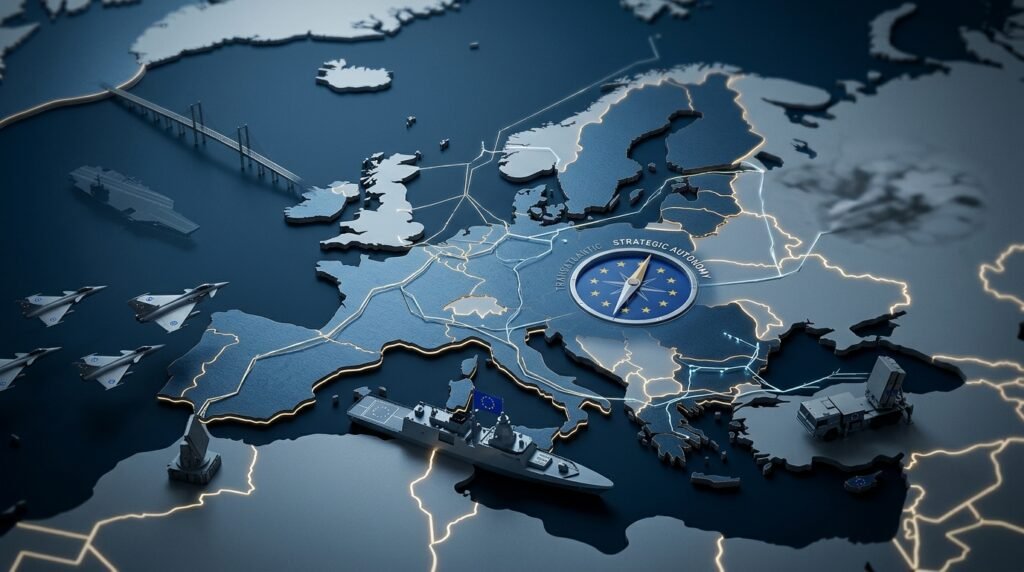
Regional Analysis, Strategic Forecasting
Europe’s Strategic Autonomy: Can Europe Defend Itself Without the United States?
Europe's Strategic Autonomy: Can It Defend Itself? Meta Description: A strategic intelligence assessment of Europe's capacity for autonomous defense amid U.S. force posture reviews, NATO's 5% pledge, and Russia's war
Executive Summary
Since 2025, the security architecture that has underwritten Western Europe’s defense for eight decades has entered a period of structural stress. The second Trump administration has combined public demands that European allies fund their own defense with concrete measures that reduce the reliability of the American security guarantee: a formal Pentagon review of U.S. force posture in Europe launched in July 2026, a unilateral withdrawal of roughly 5,000 troops from Germany, threats of deeper cuts, and — in a episode without precedent in the alliance’s history — a months-long confrontation in which Washington threatened to annex Greenland, an autonomous territory of NATO ally Denmark, before European states deployed a deterrent military presence and Washington ultimately ruled out the use of force. These developments have converged with Russia’s continuing war against Ukraine, now in its fifth year with no ceasefire in sight, and with a parallel U.S.-Israeli war against Iran that has further strained transatlantic cohesion, to produce the most serious reassessment of European strategic dependence since the end of the Cold War.
This assessment examines whether Europe — defined here as the EU-27 plus the United Kingdom, Norway, and other European NATO members — could realistically defend itself without the United States, and on what timeline. The evidence is mixed and directional rather than conclusive. Europe has mobilized financial resources at a pace without recent precedent: NATO’s European members raised defense spending by nearly 20 percent in 2025 alone, the EU has authorized up to €800 billion in prospective defense investment under its Readiness 2030 framework, and Germany has abandoned decades of fiscal orthodoxy to fund what Chancellor Friedrich Merz has called an ambition to build “Europe’s strongest conventional army.” France has taken the unprecedented step of offering to extend its nuclear deterrent to willing European partners. Yet money and political declarations have not yet translated into the specific military capabilities — integrated air and missile defense, space-based intelligence, strategic command and control, long-range strike, and airborne surveillance — on which credible deterrence against a peer adversary depends. Independent assessments converge on a five-to-ten-year timeline before Europe could field these enablers at scale, and the continent’s defense-industrial base remains fragmented across more than 170 distinct weapons systems, a condition that a high-profile failure — the June 2026 collapse of the Franco-German-Spanish FCAS fighter program — has thrown into sharp relief.
The realist conclusion is that Europe is undergoing a structurally driven shift toward self-help, consistent with balance-of-power theory’s expectation that states compensate for a weakening external guarantee by building indigenous capability or new alliances. Whether that shift culminates in a coherent European deterrent or in a fragmented, unevenly capable continent depends on variables this assessment treats as open: the pace and scope of the ongoing U.S. posture review, the cohesion of the “coalition of the willing” supporting Ukraine, the durability of France’s nuclear outreach, and the capacity of EU institutions to overcome the political resistance that populist parties in the Netherlands, France, Italy, and Hungary have already demonstrated toward joint rearmament.
Key Judgments
- Europe cannot substitute for the United States’ strategic enablers within the next five years, and possibly not within ten. Independent surveys of defense researchers assess that integrated air and missile defense and space-based intelligence, surveillance, and reconnaissance (ISR) will take Europe five to ten years to field at a militarily meaningful scale, while strategic airlift and aerial refueling are closer to European reach (moderate confidence).
- European financial commitment to defense is real and historically unprecedented, but disbursement lags pledges. The EU’s SAFE loan instrument and national fiscal escape clauses have mobilized hundreds of billions of euros in prospective spending, yet the European Commission’s own capability assessment finds current investment insufficient to meet 2030 targets even before accounting for implementation delays (high confidence).
- The U.S. security guarantee is weakening but has not been withdrawn, and Congress has constrained its pace. The Pentagon’s 2026 force posture review, unilateral troop reductions in Germany, and the Greenland crisis have visibly eroded confidence in Washington’s commitment, but the FY2026 National Defense Authorization Act sets a statutory floor of 76,000 U.S. troops in Europe absent Congressional certification, indicating that a full American withdrawal remains politically constrained even under an assertively transactional administration (high confidence).
- Europe’s defense-industrial fragmentation is a binding constraint, not a solvable footnote. The collapse of the €100 billion Franco-German-Spanish FCAS next-generation fighter program in June 2026, driven by an unresolved industrial leadership dispute between Airbus and Dassault, illustrates that political will for “European” defense projects does not reliably survive contact with national industrial interests (high confidence).
- France’s extension of nuclear “forward deterrence” to nine European states marks a genuine shift in European security architecture, but remains far short of a collective deterrent. France retains sole authority over any use of its roughly 290-plus warheads; the arrangement is best understood as a hedge against U.S. unreliability rather than a substitute for NATO’s nuclear umbrella (moderate confidence).
- Populist and Euroskeptic political forces represent a durable constraint on EU-level defense integration. Opposition from the Dutch PVV, France’s Rassemblement National, Italy’s Five Star Movement, and Hungary’s government has already blocked or delayed rearmament measures at the national and EU level, and electoral calendars through 2027 (including the French presidential election) create further points of vulnerability (moderate confidence).
- The security guarantees extended to Ukraine remain conditional and largely unimplemented. The Multinational Force for Ukraine, built around the “coalition of the willing,” has been described by its co-chairs as “ready to operate” but had not been mandated or deployed as of mid-2026, and any activation depends on a ceasefire that Russia has shown no readiness to accept (high confidence).
- A sudden, non-linear shock — a further deterioration in the Ukraine war, a serious Article 5 test on NATO’s eastern or northern flank, or an accelerated U.S. drawdown — is more likely to determine Europe’s trajectory than the steady accumulation of White Papers and spending pledges. Repeated Russian drone and missile incursions into Polish, Baltic, and Romanian airspace since September 2025 illustrate the live character of this risk (moderate confidence).
Introduction
For nearly eight decades, European security has rested on an asymmetric bargain: the United States provided the nuclear umbrella, the preponderance of conventional combat power, and — critically — the “strategic enablers” that make modern warfare possible, from satellite intelligence to long-range strike to command-and-control architecture, while European states funded comparatively modest conventional forces and, after the Cold War, redirected fiscal resources toward domestic priorities. This arrangement was never merely charitable; it reflected Washington’s own Cold War and post-Cold War calculation that a stable, allied Europe served core U.S. interests. But the bargain always contained an implicit assumption that could not be permanently guaranteed: that successive U.S. administrations would continue to value the arrangement enough to sustain it.
That assumption is now openly in question. This is not solely, or even primarily, a matter of rhetoric. Concrete steps — a formal Pentagon posture review, unilateral troop withdrawals, and, in the Greenland crisis, a direct threat to the territorial integrity of a NATO ally — have moved the debate over European “strategic autonomy” from an academic and policy-seminar preoccupation, one with a lineage stretching back to Charles de Gaulle’s mid-twentieth-century skepticism of American reliability, into a live operational question with budgetary, industrial, and doctrinal consequences unfolding in real time.
This assessment evaluates the question in five analytical dimensions — military, political, economic, technological, and legal-diplomatic — before presenting scenario analysis and a strategic outlook. Consistent with realist international relations theory, the analysis treats the redistribution of relative capabilities and the credibility of external guarantees, rather than institutional design alone, as the primary drivers of state behavior; where liberal-institutionalist and European-federalist interpretations offer a materially different reading of the evidence, they are presented for balance.
Historical Background
Europe’s dependence on U.S. military power was designed, not accidental. NATO’s founding in 1949 formalized an American commitment to European defense that, from the outset, was intended to be operationally load-bearing rather than merely political — the Alliance’s integrated command structure, established during the Korean War-era buildup of the early 1950s, placed a U.S. general in command of NATO’s military forces, a practice that continues today. Successive U.S. administrations maintained large standing forces in Western Europe throughout the Cold War, backed by a nuclear guarantee that substituted for the independent deterrents most European states never built (France and the United Kingdom being the exceptions).
The end of the Cold War produced what is commonly termed the “peace dividend”: a sustained, multi-decade decline in European defense spending as a share of GDP, from levels above 3 percent during the Cold War to below 2 percent for most European NATO members by the 2010s. NATO’s 2014 Wales Summit, convened in response to Russia’s annexation of Crimea, established a formal pledge that members would “move towards” spending 2 percent of GDP on defense within a decade; as of 2021, only seven of twenty-one relevant EU member states had reached that threshold, illustrating how shallow the post-Crimea policy response initially was.
Russia’s full-scale invasion of Ukraine in February 2022 marked the genuine inflection point. European defense spending began a sustained climb, EU institutions launched a series of financial instruments intended to support joint procurement, and Germany’s government declared a Zeitenwende — a historic turning point — in its security policy. Yet through 2024, this shift remained gradual and was still measured against the pre-existing 2 percent benchmark. The developments chronicled in this assessment — the 2025 NATO Hague Summit’s 5 percent pledge, the EU’s Readiness 2030 package, France’s nuclear outreach, and the deterioration of confidence in the U.S. commitment itself — represent a second, more consequential phase of adjustment that began in earnest only in 2025 and accelerated through 2026.
Strategic Context
Three concurrent developments define the current strategic environment and must be read together rather than in isolation.
First, the war in Ukraine remains active and unresolved. As of late August 2026, trilateral negotiations involving the United States, Ukraine, and Russia have been suspended since February 2026, following the outbreak of the separate U.S.-Israeli war against Iran, which diverted American diplomatic attention. Several short-lived, holiday-linked truces — around Orthodox Easter in April 2026 and Russia’s Victory Day in May 2026 — collapsed within days amid mutual accusations of violations. Russian forces continue to press an offensive in Donetsk, and Ukrainian intelligence officials publicly assessed in August 2026 that Moscow shows no genuine readiness for a negotiated ceasefire, with some Western analysts assessing that President Vladimir Putin is unlikely to engage in serious peace talks before 2027. The war’s continuation sustains the immediate threat perception driving European rearmament, even as it strains the industrial and financial resources available for longer-term capability investment.
Second, the credibility of the U.S. security guarantee has been tested by a succession of episodes without recent precedent. The Pentagon initiated a formal, wide-ranging review of American force posture in Europe in July 2026, described by Defense Department officials as the most consequential reassessment of the U.S. military presence on the continent in decades. Washington maintains approximately 80,000 military and civilian personnel in Europe, down from roughly 100,000 in the immediate aftermath of Russia’s 2022 invasion; the administration has already withdrawn roughly 5,000 troops from Germany — a move that followed German Chancellor Friedrich Merz’s public criticism of U.S. conduct in the Iran war — and President Trump has stated publicly that further reductions could go well beyond that figure. Congress has pushed back: the FY2026 National Defense Authorization Act, through a provision associated with Senator Jeanne Shaheen, bars the Pentagon from reducing permanently stationed and deployed troop levels below 76,000 for more than 45 days without formal certification to Congress that the reduction serves U.S. interests and that allies have been consulted. This legislative constraint indicates that further drawdowns, while plausible, face institutional friction that a purely unilateral executive decision would not.
More strikingly, the period from December 2025 through January 2026 saw an unprecedented diplomatic crisis in which the Trump administration repeatedly threatened to annex Greenland — an autonomous Danish territory and, by extension, part of a NATO and EU member state’s sovereign domain — including reported preparation of military contingency planning and threats of tariffs against Denmark and other European states absent a “sale” of the territory. The European response was notable: Denmark, joined by Belgium, Estonia, Finland, France, Germany, Iceland, the Netherlands, Norway, Slovenia, Sweden, and the United Kingdom, mounted a sustained deterrent military presence in Greenland (Operation Arctic Endurance) beginning in January 2026. Washington subsequently ruled out the use of military force. The episode, however brief its most acute phase, demonstrated to European capitals in the starkest possible terms that the assumption of automatic American restraint toward allied territory could no longer be taken for granted — a psychological and doctrinal shock whose influence on European threat perception arguably exceeds its narrow strategic significance.
Third, Russian hybrid and grey-zone activity against NATO’s eastern flank has intensified, testing alliance cohesion even as European capitals debate long-term rearmament. A mass Russian drone incursion into Polish airspace on the night of September 9–10, 2025 — involving an estimated nineteen to twenty-three drones, several shot down by NATO aircraft — prompted Poland’s invocation of Article 4 consultations and the launch of Operation Eastern Sentry. Similar incidents have recurred since: stray Ukrainian and Russian-attributed drones entering Baltic states’ and Finland’s airspace in 2026, a Russian cruise missile impacting roughly 100 kilometers inside Polish territory in July 2026, and a documented pattern of dozens of airspace violations across the alliance, with Romania alone recording 33 incursions since 2022. NATO has responded by shifting shoot-down engagement authority from national capitals into its own command structure — a militarily significant but politically muted adjustment, given that no ally has requested formal Article 4 consultations since the September 2025 Polish incident, an outcome analysts read as evidence both of adaptation and of a reluctance to escalate collective alarm.
Detailed Analysis
Military Dimension
The core military question is not whether Europe can field more soldiers, tanks, or artillery pieces — in aggregate, European NATO members already maintain larger active personnel numbers than Russia deploys in-theater — but whether Europe can generate and sustain the “strategic enablers” that allow modern armed forces to fight effectively at scale: command and control, satellite-based intelligence, long-range precision strike, integrated air and missile defense, strategic airlift, and aerial refueling.
The evidence here is asymmetric across capability areas. Independent assessments compiled by defense-industry researchers in early 2026 find European forces comparatively well-positioned in strategic airlift and aerial refueling, where existing capacity is judged sufficient to stand alone or close remaining gaps within a few years. Integrated air and missile defense presents a starker picture: European governments have ordered roughly $18 billion in short- and very-short-range air defense systems since 2022 — more than double the $7.5 billion spent on all categories of ground-based air defense in the preceding four years — yet analysts consulted by defense-sector publications judge that establishing genuinely robust, theater-wide air and missile defense will require five to ten years, with a full continental Integrated Air and Missile Defence architecture assessed by French strategic researchers as effectively unachievable in the near term given the scale of investment required. Space-based ISR represents the area of greatest pessimism: European aerial ISR assets number in the dozens compared to roughly 150 comparable U.S. platforms, and European unmanned aerial reconnaissance assets number roughly 200 against more than 900 for the United States, disparities that persist despite several years of European recognition of the gap.
Long-range strike capability, historically a near-total European dependency on U.S. systems, is beginning to close through the multinational European Long-range Strike Approach (ELSA), involving France, Germany, Italy, Poland, Sweden, and the United Kingdom, alongside a separate UK-German program targeting a strike range exceeding 2,000 kilometers. The United Kingdom’s 2025 Strategic Defence Review — which secured government commitment to all 62 of its recommendations — separately commits to up to 7,000 new long-range weapons, continuous nuclear-armed submarine production, and up to twelve SSN-AUKUS attack submarines, alongside a “10x more lethal” army modernization built around AI-enabled targeting and drone swarms; independent analysis notes that the Review’s investment emphasis favors the Royal Navy and long-range strike considerably more than British land forces, whose relative readiness continues to lag NATO peers.
Table: Assessed Timeline to Close Priority European Capability Gaps (synthesis of expert survey data, early 2026)
| Capability Area | Assessed Closure Timeline | Confidence |
|---|---|---|
| Strategic airlift / aerial refueling | Near-term (1–3 years) | Moderate-High |
| Long-range precision strike | Medium-term (3–7 years), via ELSA and bilateral programs | Moderate |
| Integrated air and missile defense | Long-term (5–10 years); full continental coverage assessed as not achievable in the foreseeable term | Moderate |
| Space-based / airborne ISR | Long-term (5–10+ years) | Low-Moderate |
| Command and control (C2) | Long-term; dependent on ISR and space progress | Low-Moderate |
Russia’s demonstrated grey-zone campaign — drone incursions, suspected sabotage of undersea infrastructure, and the disputed November 2025 rail sabotage incident on the Polish-Ukrainian border — adds urgency without materially altering the underlying capability arithmetic. NATO’s Baltic Air Policing mission, reconfigured at the July 2026 Ankara summit into more of an active air-defense mission with delegated engagement authority, illustrates institutional adaptation to a sustained sub-threshold threat, but does not resolve the deeper dependency on U.S.-provided enablers that a higher-intensity contingency would require.
Political Dimension
The political economy of European rearmament is considerably more contested domestically than the aggregate spending figures suggest. Eurobarometer polling has consistently found broad EU-wide support — roughly 80 percent — for the principle of a common European defense and security policy. That aggregate finding, however, coexists with national polling, including surveys by the European Council on Foreign Relations, showing that publics in several large member states, including France, Italy, and Spain, do not favor increased national defense spending specifically, revealing a gap between abstract support for “Europe” acting collectively and concrete willingness to fund it domestically.
This gap has translated into concrete political obstruction. In March 2025, the Dutch parliament narrowly voted, by 73 to 71, to oppose the European Commission’s proposed €800 billion ReArm Europe plan, driven principally by Geert Wilders’ PVV party, then the largest bloc in the Dutch governing coalition. In France, Marine Le Pen’s Rassemblement National has publicly opposed both the EU rearmament plan and President Macron’s proposal to extend France’s nuclear umbrella to European partners. Hungary’s government has used its position within EU Council decision-making to resist elements of the collective defense agenda, while in Italy, former prime minister and Five Star Movement leader Giuseppe Conte has characterized EU rearmament spending as a “waste of money” premised on an exaggerated Russian threat, and Prime Minister Giorgia Meloni has publicly cautioned that Italian public opinion may not sustain the pace of spending increases EU institutions envision.
This pattern is analytically significant beyond its immediate policy effects. It suggests that the political constituency most skeptical of NATO’s traditional transatlantic orientation — European populist and nationalist parties, several of which have historically expressed sympathy toward the current U.S. administration or toward Russia — is simultaneously the constituency most likely to obstruct the EU-level integration that would be required to compensate for reduced U.S. commitment. This creates a structural bind: the political forces most amplified by transatlantic strain are not reliably aligned with the policy response — European self-reliance — that such strain would logically necessitate. Electoral calendars compound the uncertainty: France’s next presidential election, scheduled for 2027, occurs against a backdrop of sustained Rassemblement National strength, while German, Italian, and other national elections will periodically test the durability of current governing coalitions’ commitment to sustained defense spending increases.
Economic Dimension
The financial mobilization behind European rearmament is substantial by recent historical standards, if uneven in execution. EU-27 defense spending reached an estimated €418 billion in 2025, a 20 percent increase over 2024, according to European Defence Agency data, with a further rise to a projected €454 billion in 2026. Germany’s federal defense budget for 2026 stands at approximately €108.2 billion (including the final tranche of the post-2022 Sondervermögen special fund), following a March 2025 constitutional amendment that exempted defense spending above 1 percent of GDP from Germany’s historically rigid “debt brake” — a fiscal policy shift Deutsche Bank researchers have characterized as among the most significant since German reunification. Chancellor Merz’s government has outlined a trajectory toward roughly 3.5 percent of GDP in core defense spending by 2029, underpinned by a proposed €377 billion, twelve-year Bundeswehr investment program intended to succeed the expiring Sondervermögen. France’s 2026 defense allocation reached €68.5 billion, or roughly 2.25 percent of GDP, a more modest trajectory than Germany’s given persistent French budget deficit pressures.
At the EU institutional level, the Readiness 2030 framework (formerly branded ReArm Europe), unveiled by European Commission President Ursula von der Leyen in March 2025, seeks to mobilize up to €800 billion in defense investment through a combination of national fiscal flexibility (activation of the Stability and Growth Pact’s escape clause), a new €150 billion joint-procurement loan instrument known as SAFE, potential redirection of EU cohesion funds, and expanded European Investment Bank lending. The SAFE Regulation, adopted in May 2025, drew requests from nineteen member states seeking support exceeding the available budget; the European Commission approved a first wave of national investment plans with disbursements beginning in early 2026 and a second wave approved in January 2026. The European Parliament’s own December 2025 assessment identified an €800 billion capability investment gap requiring roughly 10 percent annual spending growth to reach approximately €575 billion, or 3.15 percent of combined EU GDP, by 2030 — a target the Parliament itself judged current investment levels insufficient to meet.
The macroeconomic costs and trade-offs are non-trivial. European Commission modeling has estimated that a sustained 1.5 percentage-point-of-GDP increase in defense spending through 2028 could raise EU real GDP by roughly 0.5 percent above baseline while increasing the debt-to-GDP ratio by approximately 2 percentage points — a favorable but modest net effect that assumes efficient spending, an assumption complicated by industrial fragmentation (discussed below). Southern European members face a starker adjustment burden: independent economic analysis finds Italy would need to increase its defense burden by roughly 211 percent and Spain by roughly 249 percent to meet NATO’s new 5 percent target, prompting Madrid to negotiate a partial exemption premised on achieving equivalent capability outcomes at a lower, roughly 2.1 percent of GDP, spending level — an arrangement that has itself become a point of intra-alliance friction. Poland, by contrast, already spends approximately 4.7 percent of GDP on defense, reflecting front-line threat perception rather than alliance-wide burden-sharing formulas.
Technological Dimension
Europe’s technological position is defined less by an absence of innovation than by a persistent inability to convert national technological capacity into scaled, interoperable, continent-wide systems — a pattern the collapse of the Future Combat Air System (FCAS) program illustrates with unusual clarity. Conceived in 2017 as a Franco-German flagship project (Spain joined in 2018) to develop a sixth-generation successor to the Rafale and Eurofighter Typhoon at a projected cost exceeding €100 billion, FCAS was formally terminated in its manned-fighter component in June 2026 after nearly nine years of negotiation, following an unresolved industrial leadership dispute between France’s Dassault Aviation and the German/Spanish operations of Airbus. German Chancellor Merz’s public statement that Berlin’s operational requirements diverged fundamentally from Dassault’s insistence on a carrier-capable, nuclear-certified aircraft crystallized what officials on both sides ultimately described as an irreconcilable divergence over both requirements and industrial control. The episode prompted Belgium — a program observer — to order additional F-35A aircraft from the United States rather than await a European alternative, an outcome with clear symbolic as well as practical significance: a marquee European sovereignty project’s failure directly reinforced continued European reliance on American defense-industrial products.
FCAS’s collapse is a specific instance of a broader, well-documented structural problem. The European Union, by widely cited estimates, operates more than 170 distinct major weapons systems compared to roughly 30 in the United States — a legacy of Cold War-era treaty provisions that preserved national control over defense industries even as European economic integration deepened in nearly every other sector. Comparative studies find, for instance, that European states have historically fielded a dozen or more distinct main battle tank designs against a single standardized U.S. system, and dozens of frigate and destroyer classes against a handful of American equivalents. This fragmentation raises unit costs, complicates interoperability and logistics, and — as FCAS demonstrates — creates persistent friction even among the EU’s most capable and politically committed member states. The EU’s stated ambition, articulated in its Readiness Roadmap 2030, is to organize at least 40 percent of defense procurement jointly by the end of 2027; current data suggests roughly 80 percent of EU defense contracting still occurs at the national level, indicating substantial distance remains between ambition and practice.
Not all European technological cooperation has faltered. The UK-Italy-Japan Global Combat Air Programme (GCAP), a separate sixth-generation fighter initiative outside the FCAS framework, continues to advance and stands to benefit competitively from FCAS’s collapse, illustrating that successful cooperation appears more durable among a smaller number of partners with closely aligned industrial and operational requirements than within larger, more heterogeneous coalitions. Beyond combat aircraft, European institutions have also prioritized drone and counter-drone systems (reflecting direct lessons from the Ukraine war and the pattern of airspace incursions discussed above), space-based capabilities through initiatives such as the EU’s IRIS² satellite constellation, and cyber and electromagnetic-spectrum capabilities, though each remains at an earlier stage of development than the scale of the underlying strategic requirement.
Legal / Diplomatic Dimension
The legal architecture underpinning any European move toward strategic autonomy operates on parallel and only partially reconciled tracks. NATO’s Article 5 collective-defense guarantee remains formally intact and has not been invoked or seriously challenged at the treaty level, notwithstanding the Greenland episode’s demonstration that intra-alliance threats to a member’s territory are no longer unthinkable. The EU’s own mutual-assistance clause, Article 42.7 of the Treaty on European Union — invoked only once, by France following the 2015 Paris attacks — provides a parallel, EU-specific collective-defense mechanism whose relationship to NATO’s Article 5 remains legally under-developed and has not been tested in a state-on-state contingency.
The security guarantees under discussion for Ukraine occupy a distinct and more provisional legal category. The “coalition of the willing,” formed in March 2025 and co-chaired by the United Kingdom and France, has developed the concept of a Multinational Force for Ukraine (MNF-U) intended to provide reassurance deployments across land, sea, and air domains following any credible cessation of hostilities, alongside “politically and legally binding” bilateral security guarantees to be activated upon a ceasefire. As of the co-chairs’ July 2026 statement, the force was described as “ready to operate,” with 26 to 35 countries having pledged some form of contribution, yet the underlying legal instruments remain contingent on a ceasefire that, as noted above, showed no sign of materializing as of August 2026. Russia has explicitly rejected the deployment of European forces inside Ukraine as a monitoring or enforcement mechanism, and the Trump administration has indicated only a limited, non-boots-on-the-ground form of potential U.S. backing for the arrangement — leaving the entire framework, however diplomatically significant, without practical operational content pending a ceasefire that remains elusive. Analysts and diplomatic historians have noted the echo, not lost on Ukrainian officials, of the 1994 Budapest Memorandum’s unfulfilled security assurances, underscoring the importance of the “legally binding” character diplomats have sought to attach to the current framework.
France’s nuclear “forward deterrence” (dissuasion avancée) initiative, announced by President Macron on March 2, 2026, similarly operates within — rather than as a replacement for — existing legal and doctrinal structures. France retains, as a matter of constitutional and nuclear doctrine, sole presidential authority over the employment of its nuclear forces; the initiative, involving structured bilateral dialogue with the United Kingdom, Germany, Belgium, the Netherlands, Denmark, Poland, Sweden, Greece, and Norway, provides for consultation, observation of French nuclear exercises, and the potential temporary forward-basing of French nuclear-capable aircraft on partner territory, building on the July 2025 UK-France Northwood Declaration on nuclear cooperation. From a non-proliferation standpoint, the initiative has drawn both cautious welcome — as a mechanism that may reduce incentives for independent European nuclear proliferation — and concern, particularly given Polish Prime Minister Donald Tusk’s own public statements exploring the possibility of Poland acquiring nuclear weapons, a step that would represent a significant departure from established Nuclear Non-Proliferation Treaty norms within Europe.
Scenario Analysis
Four illustrative scenarios describe plausible trajectories for European strategic autonomy over a five-to-ten-year horizon (through approximately 2032–2036). They are not mutually exhaustive, and elements of more than one may materialize concurrently in different policy domains.
Scenario One — Orderly Adaptation (baseline trajectory). The U.S. force posture review concludes with a phased, negotiated drawdown that respects the NDAA’s statutory constraints and preserves core strategic enablers (nuclear-sharing arrangements, key command nodes, and rotational presence) while reducing routine conventional forward presence. European capability investment under Readiness 2030 and national programs proceeds largely on schedule, notwithstanding delays; NATO’s Article 5 architecture is preserved in modified form, with France’s nuclear outreach becoming institutionalized as a recognized supplementary pillar alongside (not instead of) NATO’s nuclear planning arrangements. Populist opposition to rearmament is contained at the margins rather than reversing the overall trajectory.
Scenario Two — Disorderly Rupture. The Trump administration, whether following the 2026 midterm elections or in response to a further transatlantic dispute analogous to the Iran war friction or the Greenland crisis, accelerates troop withdrawals beyond currently signaled levels, potentially testing or circumventing the NDAA’s certification requirement. Europe’s capability gaps — particularly in integrated air and missile defense and ISR — have not closed sufficiently to offset the reduction, producing a multi-year “vulnerability window,” roughly 2027 to 2032, during which deterrence credibility on NATO’s eastern and northern flanks is genuinely tested, potentially including a serious Article 5-triggering incident.
Scenario Three — Fragmented Renationalization. Populist and nationalist political gains — in France’s 2027 presidential election, in German coalition politics, in the Netherlands, Italy, or elsewhere — combined with further industrial failures on the FCAS model, prevent EU-level defense integration from advancing materially beyond current levels. European defense spending continues to rise in aggregate, but cooperation reorganizes around smaller, more cohesive groupings — a reinforced Nordic-Baltic Eight, a Weimar-plus format, UK-France bilateralism under the Lancaster House framework, or ad hoc coalitions of the willing — rather than genuine EU-wide pooling. Capability growth continues but inefficiently, leaving persistent interoperability and scale disadvantages relative to a hypothetical unified European effort.
Scenario Four — European Defense Union. The EU overcomes its structural fragmentation: SAFE and successor instruments (including the proposed European Defence Industry Programme, EDIP) achieve their joint-procurement targets, the 2028–2034 Multiannual Financial Framework’s substantially increased defense allocation is ratified and executed as planned, and France’s nuclear outreach formalizes into a broader, institutionalized European deterrence architecture. The EU develops genuinely autonomous strategic enablers in ISR, space, and integrated air and missile defense over the coming decade, reducing but not eliminating reliance on NATO’s U.S.-anchored structures.
A cross-cutting wildcard applies across all four scenarios: the pattern of Russian drone and missile incursions into NATO airspace documented since September 2025 indicates a live, ongoing risk of miscalculation or deliberate escalation that could compress any of these timelines abruptly, testing alliance cohesion and capability readiness well before the gradual scenarios above would otherwise play out.
Probability Assessment
| Scenario | Assessed Probability (5–10 year horizon) | Principal Indicators to Monitor |
|---|---|---|
| Orderly Adaptation | High | Outcome and pace of the 2026–2027 U.S. posture review; NDAA troop-floor provisions maintained; SAFE disbursement schedules met; Bundeswehr investment programme funded as planned |
| Disorderly Rupture | Moderate | Further unilateral U.S. drawdowns beyond NDAA thresholds; deterioration in Ukraine war or a serious NATO-territory incident; U.S. Congressional composition after November 2026 midterms |
| Fragmented Renationalization | Moderate-High | Further collapses of joint procurement programs; populist electoral gains in France (2027) and elsewhere; EU joint-procurement share remaining well below the 40% 2027 target |
| European Defense Union | Low | Ratification of an ambitious 2028–2034 MFF defense allocation; EDIP passage; expansion of France’s nuclear dialogue framework beyond the current nine states; sustained joint-procurement gains |
This assessment weighs Orderly Adaptation as the modal (most likely) outcome because it is most consistent with observed 2025–2026 trends: sustained but gradual European spending increases, a U.S. posture review proceeding through, rather than around, statutory channels, and continued (if strained) alliance cohesion. Fragmented Renationalization is assessed as a closely competing probability given the demonstrated fragility of flagship joint projects and the persistence of populist obstruction; it is not treated as mutually exclusive with Orderly Adaptation, since aggregate European capability could continue to grow even as integration stalls. Disorderly Rupture cannot be assigned low probability given the demonstrated unpredictability of U.S. policy under the current administration — illustrated starkly by the Greenland episode — but is judged less likely than continuity given Congressional constraints and the political costs a precipitous withdrawal would impose even on an administration disposed toward it. European Defense Union, requiring the reversal of decades of institutional and industrial path-dependency within a single decade, is judged the least probable outcome, notwithstanding the genuine momentum behind Readiness 2030.
Strategic Outlook
Over the next five years, the most probable trajectory is one of continued, uneven European capability accumulation occurring in parallel with — rather than as a clean substitute for — a gradually adjusting but not disappearing U.S. presence. The critical second-order effect to monitor is the interaction between the pace of American drawdown and the pace of European capability generation: if the former outstrips the latter, as Scenario Two envisions, Europe would face a multi-year period of genuinely reduced deterrence at precisely the moment Russia’s war-adapted defense-industrial base and force generation capacity — sustained, per U.S. and allied assessments, despite significant attrition in Ukraine — remain most active. Conversely, should the posture review conclude with a more measured adjustment, Europe’s current investment trajectory, while insufficient to achieve full autonomy, may prove adequate to sustain credible deterrence within a still-functioning, if rebalanced, NATO framework.
A longer-term implication concerns nuclear architecture. France’s forward-deterrence initiative, whatever its near-term limitations, represents the first structural change to European nuclear arrangements in over three decades and creates a precedent — a European, non-U.S. nuclear dialogue — whose long-term evolution is difficult to forecast with confidence. Should confidence in the U.S. extended deterrent continue to erode, the combination of France’s initiative and statements by Polish officials regarding independent nuclear options suggests non-proliferation dynamics within Europe deserve sustained analytical attention over the coming decade, a subject with implications extending well beyond the conventional-capability focus of most current European rearmament discourse.
Institutionally, the FCAS collapse and continued fragmentation in defense procurement suggest that European defense integration is likely to advance, if it advances significantly at all, through variable-geometry cooperation among smaller, more industrially and strategically aligned groupings rather than through EU-27-wide pooling — a pattern consistent with, though not identical to, the broader European integration experience in other policy domains, where differentiated integration has often proven more durable than uniform, bloc-wide harmonization.
From a realist theoretical perspective, the developments chronicled in this assessment are broadly consistent with balance-of-power expectations: a weakening external guarantee is producing measurable, if imperfect and unevenly distributed, self-help behavior among affected states. A liberal-institutionalist reading would emphasize instead the resilience of NATO’s formal structures — Article 5 remains unrevoked, the alliance’s Baltic Air Policing mission has adapted rather than collapsed, and EU institutions continue to generate new instruments despite setbacks — as evidence that institutionalized cooperation, once established, exhibits durability that a purely capability-based analysis may understate. A European-federalist perspective, for its part, would locate the central story not in the transatlantic relationship but in whether the crisis catalyzes the kind of functional spillover into genuine EU defense-policy competence that decades of more incremental integration have not achieved; the FCAS collapse and persistent populist obstruction represent the strongest evidence against that reading to date, while Readiness 2030’s financial scale represents the strongest evidence in its favor. Each framework illuminates a genuine dimension of the evidence; none alone offers a complete account of an unfolding and still-indeterminate transition.
Conclusion
Europe cannot, on present evidence, defend itself without the United States — not within the next five years, and on the most contested capabilities, not reliably within ten. The financial and political mobilization since 2025 is real, historically significant, and without close post-Cold War precedent; it has not yet been matched by the specific, technically demanding military capabilities — integrated air and missile defense, space-based intelligence, and strategic command architecture chief among them — on which credible deterrence against a peer or near-peer adversary ultimately depends. The trajectory of change, however, is unambiguous, and the drivers behind it — a less predictable United States, a sustained Russian threat, and an accumulating series of episodes, from the Greenland crisis to repeated NATO-airspace incursions, that have altered European elite and public threat perception — show no sign of reversing. Whether the next decade produces a genuinely more autonomous European security architecture or a partially rearmed continent still structurally dependent on American enablers will be determined less by declaratory summit communiqués than by the outcome of concrete, ongoing processes: the U.S. force posture review, the fate of the coalition supporting Ukraine, the durability of France’s nuclear outreach, and Europe’s still-unresolved struggle to convert national industrial capacity into genuinely collective military power.
Frequently Asked Questions
What is “European strategic autonomy”? It refers to the European Union’s and its member states’ capacity to conduct security and defense policy — including the ability to deter and, if necessary, fight a major conflict — without depending on non-European powers, principally the United States, for critical military capabilities.
Can Europe defend itself without the United States today? Not without significant risk. Europe retains substantial conventional forces but remains heavily dependent on U.S.-provided strategic enablers — space-based intelligence, integrated air and missile defense, and long-range strike infrastructure — that independent assessments judge will take five to ten years to replicate at scale, if current investment trends continue.
What is NATO’s 5 percent defense spending target? Agreed at the alliance’s June 2025 summit in The Hague, it commits members to invest 5 percent of GDP annually on defense and security by 2035, split between 3.5 percent on core military requirements and 1.5 percent on broader security and defense-industrial resilience spending.
Why did France extend its nuclear deterrent to other European countries? President Macron’s March 2026 “forward deterrence” initiative reflects growing French and European concern over the reliability of the U.S. nuclear umbrella. It establishes structured dialogue and potential forward-basing arrangements with nine European states while leaving French nuclear command authority exclusively with the French president.
What happened to Europe’s FCAS fighter jet program? The Franco-German-Spanish Future Combat Air System, intended to produce a sixth-generation fighter by 2040 at a cost exceeding €100 billion, was effectively terminated in June 2026 after an unresolved industrial dispute between France’s Dassault Aviation and Germany’s Airbus over program leadership — a widely cited illustration of the structural fragmentation constraining European defense-industrial integration.
Sources
- North Atlantic Treaty Organization, “Defence investment and NATO’s 5% commitment” and “Funding NATO,” 2026.
- Atlantic Council, “NATO defense spending tracker,” updated April 2026.
- European Parliament (EPRS), “EU Member States’ Defence Budgets,” March 2026; “European Defence Readiness 2030: assessment of needs,” December 2025.
- European Commission, Defence Industry and Space, “Readiness Roadmap 2030” and SAFE Regulation materials, 2025–2026.
- International Institute for Strategic Studies (IISS), “The Military Balance 2026: Fortifying NATO’s eastern flank,” February 2026; “Europe’s air of dependence,” March 2025.
- Center for Strategic and International Studies (CSIS), “Europe’s Missing Piece: The Case for Air Domain Enablers,” October 2024; “Russia’s War in Ukraine: The Next Chapter,” August 2026.
- Defense News, “The good, the bad and the ugly — Inside Europe’s race to supplant US defense enablers,” February 2026.
- Center for European Policy Analysis (CEPA), “What European NATO Lacks,” March 2025.
- Chatham House, “Macron’s nuclear weapons offer to Europe: Gaullist policy, updated for a more unstable world,” March 2026.
- European Union Institute for Security Studies (EUISS), “France’s nuclear initiative: A step toward Europeanising deterrence,” March 2026.
- ETH Zürich Center for Security Studies (CSS), “Europe’s Changing Nuclear Landscape: French Forward Deterrence,” July 2026.
- Bruegel, “Europe should build on France’s nuclear deterrent extension offer,” April 2026.
- Foreign Policy Research Institute, “Reading Germany’s Rearmament: The 2026 Military Strategy Between Ambition and Accountability,” August 2026.
- Atlantic Council, “Germany wants to double its defense spending. Where should the money go?,” August 2025.
- Council on Foreign Relations, “War in Ukraine,” Global Conflict Tracker, updated through 2026.
- House of Commons Library and House of Lords Library (UK Parliament), “Strategic Defence Review 2025” briefing series; “Proposals for a Coalition of the Willing in Ukraine,” 2026.
- GOV.UK, “The Strategic Defence Review 2025 – Making Britain Safer”; “Statement of the co-chairs of the Coalition of the Willing,” July 2026.
- French Ministry of the Armed Forces / Consilium, “Paris Declaration – Robust Security Guarantees for a Solid and Lasting Peace in Ukraine,” January 2026.
- The Aviationist and Breaking Defense, reporting on the collapse of the Future Combat Air System program, June 2026.
- War on the Rocks, “Europe at a Strategic Disadvantage: A Fragmented Defense Industry,” 2024; “Misguided and Misunderstood: Trump’s Approach to U.S. Troops in Europe,” July 2026.
- American Enterprise Institute, “Why Europe Needs Its Defense Industry—and How the United States Can Help,” November 2025.
- Intereconomics, “Can Europe Deliver NATO’s Five Percent?,” 2026.
- European Council on Foreign Relations (ECFR), “The trouble with FCAS,” December 2025; polling on European public attitudes toward defense spending.
- Foreign Policy, “Colby’s Europe Force Posture Review Might Not End in Major U.S. Troop Reductions,” August 2026.
- Wikipedia contributor articles (cross-checked against primary reporting), “Greenland crisis,” “Operation Arctic Endurance,” “2020s European rearmament,” and related entries on 2026 developments.