Military Affairs, Strategic Forecasting
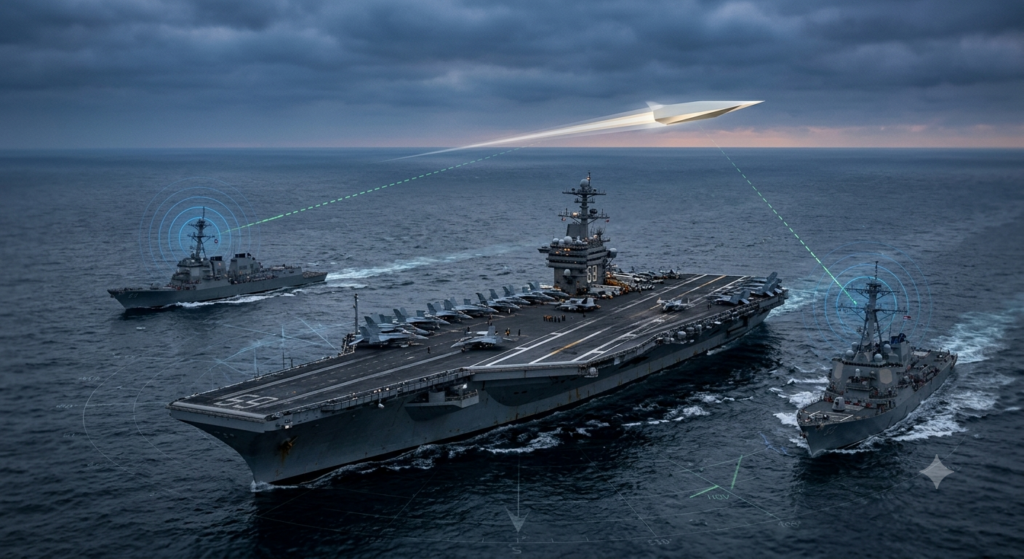
Hypersonic Missiles vs. Aircraft Carriers: Has Naval Warfare Become Obsolete?
trategic assessment of hypersonic anti-ship missiles threatening aircraft carriers. Analysis of kill chains, missile defense, distributed operations, and the future of naval power projection.
Executive Summary
The proliferation of hypersonic and anti-ship ballistic missiles has catalyzed an intense debate over the continued viability of aircraft carriers as the centerpiece of naval power projection. China’s operational DF-21D and DF-26 “carrier killers,” combined with newer hypersonic systems such as the DF-17, DF-27, and YJ-21, present a qualitatively new threat environment. Russia’s Zircon and Avangard systems, alongside emerging programs in Iran and North Korea, compound the challenge. However, the question of carrier obsolescence is analytically premature. Sinking a carrier strike group (CSG) requires more than fielding a fast missile; it demands sustaining a complex kill chain—detection, tracking, targeting, and terminal guidance—against a maneuvering, defended, and electronically contested target. U.S. layered defenses, including the SM-6 family, Aegis Baseline 9/10, and emerging space-based tracking architectures, provide meaningful though incomplete protection. Moreover, the U.S. Navy’s shift toward Distributed Maritime Operations (DMO), unmanned carrier aviation, and long-range strike suggests adaptation rather than abandonment. This assessment concludes that carriers are not obsolete, but their operational paradigm is undergoing a forced evolution. The platform that dominated the Pacific War and the Cold War must now operate within a contested environment where survivability depends on dispersion, deception, and integration with joint and allied forces.
Key Judgments
- China’s anti-ship ballistic missile (ASBM) arsenal is operationally fielded and expanding. The DF-21D (~1,500–2,000 km), DF-26 (3,000–4,000 km), and DF-27 (5,000–8,000 km) form a layered threat envelope that can hold U.S. carriers at risk across the First and Second Island Chains. The YJ-21 hypersonic anti-ship missile adds a naval-launch dimension.
- The kill chain remains the critical vulnerability. Fielding a missile is not equivalent to reliably striking a carrier. Maintaining targeting custody on a maneuvering CSG amid ISR limitations, weather, electronic warfare, and maritime clutter remains a significant operational challenge for any adversary.
- U.S. missile defenses are improving but not comprehensive. The SM-6 is currently the only U.S. weapon with demonstrated capability against hypersonic glide vehicles, though primarily in the terminal phase. The Hypersonic and Ballistic Tracking Space Sensor (HBTSS) and Glide Phase Interceptor (GPI) programs aim to close the midcourse gap but remain years from operational deployment.
- Carrier economics create strategic asymmetry. A Ford-class carrier costs approximately $13 billion, while an ASBM or hypersonic missile costs orders of magnitude less. This cost-exchange ratio incentivizes adversary investment in saturation attacks and complicates defender economics.
- Distributed Maritime Operations (DMO) represents the Navy’s operational response. Dispersing forces across wider areas while concentrating effects through networked operations is intended to increase survivability and complicate adversary targeting.
- Unmanned systems will transform the carrier air wing. The Navy envisions a future air wing that is up to 60 percent unmanned, with Collaborative Combat Aircraft (CCA), MQ-25 Stingray tankers, and next-generation drones extending reach while reducing risk to manned platforms.
- Naval warfare is not obsolete; it is evolving. The carrier is transitioning from an uncontested power-projection platform to a node within a distributed, multi-domain kill web. Its value persists, but its mode of employment is changing fundamentally.
Introduction
For more than eight decades, the aircraft carrier has been the sovereign instrument of naval power projection. From the Battle of Midway to the Gulf War and beyond, the flat-top has enabled states to project airpower across vast maritime distances without reliance on fixed land bases. Yet the emergence of hypersonic weapons and advanced anti-ship ballistic missiles has prompted a fundamental strategic question: Has the offense finally outpaced the defense to the point of rendering the aircraft carrier obsolete?
This question is not merely academic. The United States has invested approximately $13 billion in the USS Gerald R. Ford alone, with a class-wide program expected to exceed $120 billion.
China, meanwhile, is constructing its fourth carrier and plans a fleet of up to nine by 2035.
If the carrier is indeed a vulnerability rather than an asset, these investments represent a catastrophic misallocation of strategic resources. If, conversely, the carrier retains unique utility, then the current wave of obsolescence rhetoric risks undermining deterrence and fleet architecture.
This assessment examines the evidence, identifies the drivers and constraints shaping the threat environment, and develops realistic scenarios for the future of naval warfare.
Historical Background
The Carrier’s Ascendancy
The aircraft carrier displaced the battleship as the capital ship of naval warfare during World War II. The Japanese attack on Pearl Harbor (1941) and the U.S. victory at Midway (1942) demonstrated that airpower delivered from mobile sea bases could decisively defeat surface fleets. In the postwar era, carriers provided the United States with continuous forward presence and crisis-response capability during the Korean War, the Vietnam War, and multiple Cold War confrontations.
The Nuclear Challenge
The advent of nuclear weapons generated the first serious carrier obsolescence debate. The newly independent U.S. Air Force argued that intercontinental nuclear bombers rendered carriers irrelevant. The Navy responded by integrating carriers into nuclear war plans, though the ballistic-missile submarine ultimately assumed the sea-based nuclear strike role because its survivability was “all but eliminated” by comparison.
This pattern—technological challenge followed by doctrinal adaptation—has recurred throughout carrier history.
The Missile Age
By the 1970s, Soviet anti-ship cruise missiles (ASCMs) posed a growing threat to carrier groups. The U.S. response was not to abandon carriers but to develop layered defenses: the Aegis combat system, the Standard missile family, and integrated air-wing combat air patrols. The carrier survived by evolving.
Strategic Context
The Return of Great-Power Competition
The 2022 National Defense Strategy identifies China as the “pacing challenge” and Russia as an “acute threat.” Both states have invested heavily in anti-access/area-denial (A2/AD) capabilities designed to prevent U.S. power projection in their respective neighborhoods. Hypersonic weapons are a central component of this strategy—not because speed alone guarantees success, but because compressing the decision timeline and complicating interception creates operational and strategic advantages.
The Geography of Containment
In the Western Pacific, China’s ASBM architecture is designed to push U.S. carriers beyond the range from which their air wings can effectively strike Chinese targets. The DF-21D covers the First Island Chain; the DF-26 extends into the Second Island Chain and can reach Guam; the DF-27 threatens Hawaii and the broader Central Pacific.
This creates a “tyranny of distance” problem for U.S. carrier aviation, where the combat radius of F/A-18E/F or F-35C aircraft (300–500 nautical miles) is significantly shorter than the standoff ranges demanded by the threat.
The Cost-Exchange Asymmetry
A single DF-21D or DF-26 missile costs a fraction of a carrier’s value. Even accounting for the full kill-chain infrastructure—satellites, over-the-horizon radars, targeting aircraft—the economic asymmetry favors the attacker. This incentivizes saturation strategies: firing enough missiles to exhaust defender magazines and overwhelm layered defenses.
Detailed Analysis
The Hypersonic Threat Portfolio
China: Beijing maintains the most diverse and operationally mature hypersonic arsenal. The DF-17, fielded with the PLA Rocket Force, carries a hypersonic glide vehicle (HGV) at Mach 5–10. The YJ-21 is a carrier-launched anti-ship hypersonic missile that directly threatens opposing carrier groups. In 2025, China unveiled the CJ-1000, a scramjet-powered cruise missile capable of sustaining approximately Mach 6 over thousands of kilometers.
China has also constructed full-scale carrier mockups in remote desert testing ranges, instrumented for electronic warfare and terminal guidance validation.
Russia: The Avangard HGV, deployed atop ICBMs, reaches Mach 20–27 and is operational with nuclear warheads. The Zircon (3M22) scramjet cruise missile, deployed on frigates and submarines, achieves Mach 8–9 and has reportedly been used in strikes against Ukrainian infrastructure.
Russia is also developing the Zmeevik anti-ship ballistic missile as a direct analog to China’s DF-21D.
United States: After the cancellation of the AGM-183A ARRW in 2023, the Army-Navy Dark Eagle (LRHW) program achieved STRATCOM authorization in April 2026. The Navy’s Conventional Prompt Strike (CPS) program, using the Common Hypersonic Glide Body (C-HGB), achieved full success in June and December 2024. Production constraints limit output to an estimated one to two missiles per month.
The HACM scramjet program and Ursa Major’s HAVOC liquid-rocket system target FY2027 deployment.
The Kill-Chain Problem
The dominant analytical error in carrier vulnerability assessments is conflating missile capability with kill-chain reliability. A missile is merely the terminal component of a system that requires:
- Detection: Persistent surveillance to locate the carrier within a vast operational area.
- Tracking: Maintaining custody of a target moving at 30+ knots while conducting evasive maneuvers.
- Targeting: Generating a firing solution and transmitting it to launch platforms.
- Terminal Guidance: Overcoming electronic countermeasures, decoys, and defensive interceptors to achieve impact.
Each link is vulnerable. U.S. electronic attack aircraft (EA-18G Growler), cyber operations, and kinetic strikes on adversary ISR nodes can degrade or sever the chain. Weather, satellite gaps, and maritime clutter further complicate adversary targeting. As one CSIS assessment noted, “successfully targeting and destroying them in wartime conditions is far more complex, resource-intensive, and uncertain than commonly portrayed.”
Military Dimension
Layered Defense Architecture
A CSG is not a passive target. Its defense is structured in depth:
- Outer Air Battle: Combat air patrols (CAP) conducted by F/A-18E/F and F-35C aircraft seek to destroy or disrupt enemy launch platforms before missile release.
- Area Air Defense: Arleigh Burke-class destroyers and Ticonderoga-class cruisers equipped with Aegis and SM-2, SM-3, and SM-6 missiles engage threats at medium to long range.
- Terminal Defense: Rolling Airframe Missiles (RAM), Evolved Sea Sparrow Missiles (ESSM), and Close-In Weapon Systems (CIWS) provide last-ditch protection.
The SM-6 is particularly significant. It is currently the only U.S. weapon with demonstrated capability against highly maneuverable hypersonic threats, albeit primarily in the terminal phase. The Block IB variant, with a redesigned body and larger motor, is under development to reach hypersonic intercept speeds.
Space-Based Tracking
The Hypersonic and Ballistic Tracking Space Sensor (HBTSS) program, integrated into the Proliferated Warfighter Space Architecture (PWSA), aims to provide continuous birth-to-death tracking of hypersonic threats. Wide Field of View (WFoV) satellites will cue Medium Field of View (MFoV) sensors to generate “fire control data” for ground-based interceptors.
The Glide Phase Interceptor (GPI) is intended to exploit this tracking capability to engage HGVs during their most vulnerable glide phase, though budget constraints and technical challenges have slowed development.
Distributed Maritime Operations
The U.S. Navy’s response to the A2/AD threat is DMO—dispersing forces across wider areas while concentrating effects through networked operations. By diversifying the “shooter portfolio” and spreading warships out, the Navy aims to increase survivability and complicate adversary targeting.
DMO is not a panacea; it introduces logistics and munitions-sustainment challenges that the Navy has yet to fully resolve.
Political Dimension
Domestic Debates
Within the United States, carrier obsolescence arguments have gained traction among fiscal conservatives and defense reformers who point to cost overruns and technical failures in the Ford class. The electromagnetic aircraft launch system (EMALS) and advanced arresting gear (AAG) experienced protracted development problems, reinforcing skepticism about large-platform programs.
Conversely, the carrier retains formidable political support from congressional delegations representing shipbuilding states, the naval aviation community, and allies who view U.S. carrier presence as a tangible security commitment.
Allied Perspectives
Japan, Australia, South Korea, and the Philippines are investing in their own anti-ship capabilities—not because they believe carriers are obsolete, but because they recognize that holding adversary carriers at risk is a necessary complement to U.S. power projection.
This creates a paradox: carriers are simultaneously threatened and essential to the alliance architecture that threatens opposing carriers.
Economic Dimension
The Cost of Carriers
The USS Gerald R. Ford cost approximately $13.3 billion in design and construction, excluding $4.7 billion in research and development.
Lifecycle costs over 50 years add tens of billions more. The Navy is reviewing the design and cost of future Ford-class carriers (CVN-82 and CVN-83) to ensure they “make sense” within budget constraints.
The Cost of Missiles
While exact figures for Chinese and Russian missiles are classified, open-source estimates suggest unit costs in the low millions to tens of millions of dollars—a fraction of carrier costs. This asymmetry is structurally favorable to the attacker in a pure cost-exchange model. However, the full cost of the kill chain (satellites, ISR aircraft, command infrastructure) narrows the gap, and the defender’s ability to regenerate interceptors and repair damage must be weighed against the attacker’s finite magazine depth.
Industrial Base Constraints
U.S. hypersonic production is constrained to an estimated one to two Dark Eagle missiles per month.
China’s industrial base appears more robust, with the JF-22 hypersonic wind tunnel in Huairou capable of simulating speeds up to Mach 30, signaling sustained investment.
Technological Dimension
Unmanned Carrier Aviation
The Navy is pursuing a fundamental transformation of the carrier air wing. The MQ-25 Stingray, the first operational carrier-based unmanned aircraft, will provide aerial refueling to extend manned aircraft range.
More significantly, the Navy envisions future air wings that are up to 60 percent unmanned, incorporating Collaborative Combat Aircraft (CCA) for strike, electronic warfare, and ISR missions.
This shift is modeled on “affordable mass”—using expendable drones to wage attrition rather than risking limited numbers of expensive manned platforms.
Next-Generation Strike Fighters
The F/A-XX sixth-generation fighter program, intended to replace the F/A-18E/F and EA-18G, emphasizes superior range, speed, and manned-unmanned teaming. The Navy’s July 2026 Request for Information solicited industry concepts for carrier-based drones capable of eight mission sets, including anti-surface warfare, air-to-air combat, and aerial refueling, with a minimum strike range of 1,000 nautical miles.
Directed Energy and Future Defenses
While not yet operationally deployed, directed-energy weapons (lasers) and electromagnetic railguns represent potential future counters to hypersonic threats. Their development timelines, however, extend beyond the current planning horizon.
Legal / Diplomatic Dimension
Arms Control Implications
Hypersonic weapons blur the line between conventional and strategic systems. Russia has claimed that some hypersonic weapons can carry nuclear warheads, creating ambiguity that complicates adversary decision-making.
The U.S. decision to place Dark Eagle under USSTRATCOM command—the same oversight framework used for nuclear systems—reflects an acknowledgment that conventional hypersonic weapons have crossed into strategic deterrence territory.
No existing arms control framework specifically addresses hypersonic weapons. The New START treaty does not cover them, and China has consistently rejected trilateral arms control negotiations.
Law of Armed Conflict
The targeting of carriers raises Law of Armed Conflict (LOAC) considerations. A carrier is a lawful military objective, but attacks must distinguish between military and civilian objects, and proportionality must be observed. In practice, the speed and confusion of hypersonic warfare may compress the time available for legal review to near zero.
Scenario Analysis
Scenario 1: Taiwan Contingency — High-Intensity Exchange (Probability: Moderate)
In a conflict over Taiwan, China employs DF-21D and DF-26 missiles in saturation attacks against U.S. carriers operating east of the First Island Chain. U.S. defenses achieve partial success, but magazine exhaustion and kill-chain saturation result in damage to one carrier and the loss of an escort destroyer. The U.S. shifts to DMO, dispersing forces and relying on submarine-launched cruise missiles and bomber strikes from Guam and Australia. Carriers remain relevant but are forced to operate at extended ranges, reducing sortie generation and lengthening response times.
Assessment: This scenario is plausible and represents the baseline concern driving current U.S. force design. It assumes Chinese ISR can sustain targeting custody, which is uncertain.
Scenario 2: Prolonged Gray-Zone Competition (Probability: High)
No kinetic exchange occurs, but the persistent threat of ASBMs constrains U.S. carrier movements during crises. China uses the threat to coerce regional states and limit U.S. alliance reassurance. The United States responds by diversifying its forward presence—more submarines, smaller surface combatants, and land-based missiles—while retaining carriers as strategic reserves. Carriers remain symbolically important but operationally constrained.
Assessment: This is the most likely near-term trajectory. The threat operates as a deterrent and coercion tool even without employment.
Scenario 3: Technological Breakthrough in Missile Defense (Probability: Low)
The U.S. successfully deploys the Glide Phase Interceptor and a proliferated HBTSS constellation, achieving reliable hypersonic defense. The cost-exchange ratio shifts back toward the defender. Carriers regain operational freedom, and the A2/AD bubble is partially punctured.
Assessment: This scenario is optimistic given current budget constraints and technical challenges. Even if achieved, adversaries would adapt with countermeasures and increased salvo sizes.
Scenario 4: Carrier Replacement by Unmanned Systems (Probability: Low to Moderate)
Unmanned surface vessels (USVs) and submarine-launched drones assume the strike and ISR roles currently performed by carrier air wings. The large-deck carrier is phased out in favor of smaller, distributed platforms. This transition takes decades and faces institutional resistance.
Assessment: Unmanned systems will complement, not replace, carriers within the 2040 planning horizon. The sortie generation, command-and-control capacity, and political signaling value of a 100,000-ton carrier are not easily replicated.
Probability Assessment
Table
| Outcome | Probability | Rationale |
|---|---|---|
| Carriers remain central to naval power projection through 2040 | High | Institutional inertia, allied dependence, and lack of viable alternatives ensure continuity. |
| A U.S. carrier is damaged or sunk in a future conflict | Moderate | The threat is real, but the kill-chain complexity and layered defenses make success uncertain for the attacker. |
| Hypersonic defenses achieve operational maturity | Moderate | SM-6 terminal defense is improving; glide-phase interception remains challenging. |
| Carriers are displaced as primary power-projection platforms by 2060 | Low to Moderate | Unmanned and distributed systems may eventually supplant the carrier, but the timeline is uncertain. |
| China achieves reliable carrier-kill capability against a defended CSG | Moderate | Progress is evident, but operational testing against realistic defenses is incomplete. |
Strategic Outlook
The aircraft carrier is not obsolete, but it is no longer uncontested. The historical pattern of technological challenge followed by doctrinal adaptation is repeating. The carrier’s future depends on three variables:
- Defense Maturation: Whether the U.S. can field space-based tracking and glide-phase interception at scale before adversaries achieve reliable kill-chain closure.
- Operational Innovation: Whether DMO, unmanned teaming, and extended-range strike can restore operational freedom without sacrificing mass or persistence.
- Alliance Architecture: Whether allies can contribute sufficient distributed fires and ISR to complicate adversary targeting and share the burden of maritime strike.
China’s own carrier program is instructive. Beijing is not abandoning carriers despite fielding the world’s most sophisticated ASBM arsenal; it is building more. This suggests that Chinese strategists recognize the enduring value of mobile airfields for power projection, even as they seek to deny that advantage to others.
The carrier will likely remain the premier forward asset for crisis response through at least 2050. Its role, however, will evolve from independent strike platform to a node within a joint, multi-domain kill web. The question is not whether carriers will exist, but how they will fight—and whether the United States and its allies can adapt faster than adversaries can refine their kill chains.
Conclusion
The hypersonic missile threat to aircraft carriers is genuine, quantifiable, and growing. China’s DF-21D, DF-26, DF-27, and YJ-21; Russia’s Zircon and Avangard; and emerging systems from other actors have created an environment where carrier strike groups must fight for access rather than assume it. The cost asymmetry between billion-dollar carriers and million-dollar missiles creates structural pressure on defender economics.
Yet obsolescence is not inevitability. The kill chain required to strike a carrier remains complex, fragile, and vulnerable to disruption. U.S. layered defenses, while imperfect, provide meaningful protection, and emerging technologies—space-based tracking, glide-phase interceptors, and unmanned aviation—offer pathways to restored advantage. The Navy’s shift toward Distributed Maritime Operations and a 60-percent unmanned air wing represents necessary adaptation.
The more accurate framing is not “hypersonic missiles versus aircraft carriers,” but “hypersonic missiles versus the carrier operating within a distributed, multi-domain, allied force.” In that contest, the outcome remains uncertain—and will be determined less by the speed of any single weapon than by the resilience of the systems that employ them.
Sources
- CSIS Missile Defense Project, “Missiles of China,” Center for Strategic and International Studies, 2026.
- CSIS, “Flipping the Script: From Carrier Killers to Carrier Targets,” 2026.
- Japan Ministry of Defense, National Institute for Defense Studies, “Hypersonic Weapons of the U.S., China, and Russia,” 2024.
- U.S. Navy, “Naval Aviation 2025,” Naval Air Forces Pacific.
- U.S. Missile Defense Agency, “Hypersonic and Ballistic Tracking Space Sensor (HBTSS) Program.”
- Congressional Research Service, “Hypersonic Missile Defense: Issues for Congress.”
- AUSA Land Warfare Paper, “Hypersonic Weapons Development in China, Russia and the United States.”
- Center for Maritime Strategy, “Sustaining the Fight: Challenges of Distributed Maritime Operations,” 2025.
- Defense News, “US Navy is reviewing cost of future Ford-class carriers,” April 2026.
- The Defense Watch, “How Hypersonic Missiles Work in 2026,” April 2026.
- StrikeOrbit, “Hypersonic Weapons in 2026: The Real Global Strike Balance,” March 2026.
- Naval War College Review, “The Future of The Future of Aircraft Carriers,” Vol. 64, No. 4.
- Navy Times, “The US Navy is eyeing next-gen carrier-based drones,” July 2026.
- The War Zone, “Navy Carrier-Based Drones Will Be Able To Be Controlled By The Air Force,” 2023.
Frequently Asked Questions
Q: Can hypersonic missiles sink a U.S. aircraft carrier? A: Theoretically, yes. Practically, doing so requires sustaining a complex kill chain—detection, tracking, targeting, and terminal guidance—against a maneuvering, defended target. U.S. layered defenses and electronic warfare capabilities make this far from certain.
Q: Why does China build carriers if it believes they are vulnerable? A: China’s carrier program suggests its strategists recognize the enduring value of mobile airfields for power projection. A2/AD capabilities are designed to deny adversaries access, not to render all carriers obsolete—including China’s own.
Q: What is Distributed Maritime Operations (DMO)? A: DMO is the U.S. Navy’s concept for dispersing forces across wider areas while concentrating effects through networked operations. It aims to increase survivability against long-range precision threats by complicating adversary targeting.
Q: What defenses exist against hypersonic missiles? A: The SM-6 missile has demonstrated limited hypersonic intercept capability, primarily in the terminal phase. Future defenses include the Glide Phase Interceptor (GPI) and the Hypersonic and Ballistic Tracking Space Sensor (HBTSS) constellation, though both remain in development.
Q: Will drones replace manned aircraft on carriers? A: The Navy envisions future air wings that are up to 60 percent unmanned, with drones performing refueling, strike, electronic warfare, and ISR. However, manned platforms will remain essential for command, complex decision-making, and strategic signaling through 2040 and beyond.
High demand. Switched to K2.6 Instant for speed. Upgrade to use K2.6 Thinking.