The Drone Revolution at Sea: How Unmanned Systems Are Reshaping Naval Power
Unmanned systems are fundamentally altering naval warfare economics, force structure, and deterrence. This strategic assessment examines the transformation of maritime power. Suggested URL Slug: naval-power-drone-age-strategic-assessment
Executive Summary
The proliferation of unmanned aerial, surface, and subsurface systems is producing the most consequential transformation in naval warfare since the advent of carrier aviation. Over the past three years, operational evidence from the Black Sea, the Red Sea, and the Indo-Pacific has demonstrated that relatively inexpensive drones can impose strategic costs on advanced navies that are orders of magnitude higher than the acquisition cost of the attacking systems. The economic asymmetry is stark: a Standard Missile-2 interceptor costing approximately $2.1 million may be expended against a one-way attack drone priced at $20,000–$50,000.
This cost-exchange ratio is not merely a procurement inconvenience. It threatens to exhaust interceptor magazines, strain industrial capacity, and compel a fundamental reconsideration of fleet architecture. In response, the United States Navy aims to field thousands of unmanned surface vessels in the Indo-Pacific by 2030, while the People’s Liberation Army is developing counter-swarm architectures integrating directed-energy weapons, hypersonic missiles, and artificial intelligence.
The central judgment of this assessment is that naval power is transitioning from a platform-centric model—measured in hulls, tonnage, and crew complement—to a capability-centric model defined by distributed sensor networks, autonomous strike systems, and human-machine teaming. The navies that adapt their doctrine, force structure, and industrial base to this reality will retain maritime superiority. Those that do not risk strategic obsolescence.
Key Judgments
- The cost-exchange asymmetry between drones and missile defenses has become strategically unsustainable. The U.S. Navy expended more than 220 Standard Missiles of various types in the Red Sea between October 2023 and January 2025, at a replacement cost exceeding $500 million, to defeat drones and missiles costing the attacker a fraction of that amount.
- Unmanned surface vessels have demonstrated lethal effectiveness against conventional naval forces. Ukrainian naval drone operations against the Russian Black Sea Fleet have validated the operational utility of low-profile, explosive-laden USVs in contested littoral environments, compelling a strategic reassessment of coastal defense and sea control.
- The U.S. Navy is betting fleet transformation on unmanned systems. The service plans to deploy over 30 Medium Unmanned Surface Vessels and thousands of small USVs in the Indo-Pacific by 2030, alongside unmanned aerial and subsurface systems, as part of Distributed Maritime Operations.
- China is pursuing both offensive drone swarms and defensive counter-swarm architectures. The PLA has tested the Jiu Tian drone mothership—capable of releasing 100–150 loitering munitions—and is simultaneously developing a multilayered “naval Great Wall” integrating lasers, high-power microwaves, and hypersonic weapons to protect surface combatants.
- Directed-energy weapons offer a potential solution to the cost-asymmetry problem but remain operationally immature. The UK’s DragonFire laser system has demonstrated a per-shot cost of approximately $12, yet atmospheric conditions, power requirements, and line-of-sight limitations constrain deployment at sea.
- The “hellscape” concept—massed autonomous systems employed to deny an adversary operational freedom—carries escalation risks. As multiple great powers field drone swarms in the same theater, the compression of decision timelines and the delegation of targeting to autonomous systems may reduce the space for human judgment during crises.
Introduction
Naval power has historically been measured by the tonnage of capital ships, the reach of carrier air wings, and the stealth of submarines. These metrics remain relevant, but they are no longer sufficient. The emergence of mass-produced, autonomous, and precision-guided unmanned systems is introducing a new variable into maritime strategy: scale at low cost. A state or non-state actor can now acquire, for a few million dollars, a capability that can threaten a carrier strike group, close a strategic chokepoint, or impose billions of dollars in economic disruption.
This development does not render traditional naval platforms obsolete. Aircraft carriers, guided-missile destroyers, and nuclear-powered submarines retain unmatched capabilities in high-end, blue-water combat. Rather, unmanned systems are expanding the competitive space, enabling smaller or less technologically advanced actors to contest sea control in ways that were previously impractical. The result is a more crowded, more lethal, and more economically complex maritime battlespace.
This assessment examines the drivers, constraints, and implications of the naval drone revolution. It draws on operational experience from three distinct theaters—the Black Sea, the Red Sea, and the Indo-Pacific—to identify trends that are likely to shape naval warfare for the next two decades.
Historical Background
The use of unmanned systems at sea is not new. The U.S. Navy has operated unmanned underwater vehicles for mine countermeasures since the 1990s and has deployed the MQ-8 Fire Scout unmanned helicopter from surface combatants since the 2000s. Early unmanned surface vessels were largely confined to mine-hunting, oceanographic survey, and maritime domain awareness missions. They were adjuncts to manned platforms, not alternatives.
What changed was the convergence of three technological trends in the mid-2010s: the commercial proliferation of small, high-performance sensors and processors; the maturation of artificial intelligence and machine learning for autonomous navigation and targeting; and the widespread availability of satellite communications and GPS navigation. These trends enabled the rapid development of low-cost, long-range, precision-strike unmanned systems by both state and non-state actors.
The war in Ukraine provided the first large-scale validation of naval drones in combat. Beginning in 2022, Ukrainian forces employed remotely operated and semi-autonomous surface vessels to attack Russian warships, port infrastructure, and the Kerch Strait Bridge. These operations demonstrated that a nation without a significant conventional navy could impose strategic costs on a major maritime power using commercially derived technology and asymmetric tactics.
Simultaneously, the Houthi campaign in the Red Sea, beginning in late 2023, revealed the vulnerability of even the most advanced naval forces to sustained, low-cost drone and missile attacks. The USS Dwight D. Eisenhower Carrier Strike Group and accompanying destroyers conducted sustained combat operations against Houthi one-way attack drones, anti-ship cruise missiles, and anti-ship ballistic missiles—operations that redefined U.S. Navy training and expenditure patterns.
Strategic Context
The return of great-power competition, articulated in successive U.S. National Defense Strategies, has placed the Department of the Navy at an inflection point. The People’s Liberation Army Navy has expanded from a littoral force to a blue-water navy capable of operating across the Indo-Pacific. Its shipbuilding program outpaces that of the United States by a significant margin. In this environment, the U.S. Navy has concluded that it cannot maintain maritime superiority through manned platforms alone.
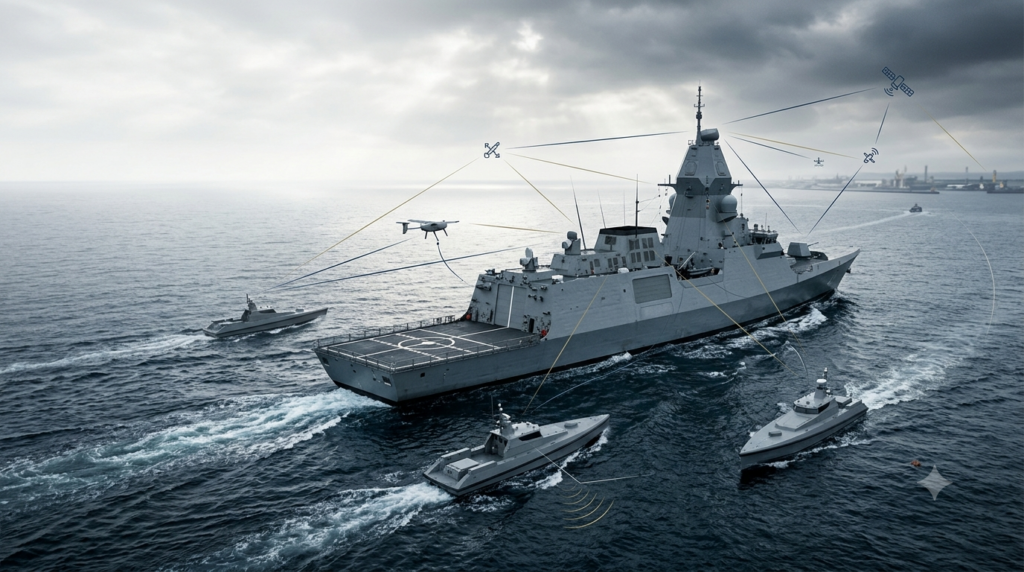
The Navy’s response has been to pursue a “hybrid fleet” integrating manned and unmanned systems under the concept of Distributed Maritime Operations (DMO). The objective is to disperse sensors, shooters, and command nodes across a wider geographic area, complicating adversary targeting while maintaining offensive mass. Unmanned systems are central to this concept because they can be deployed in larger numbers, operate in higher-risk environments, and extend the reach of manned platforms without requiring proportional increases in crew.
This strategic shift is not unique to the United States. China, Russia, Turkey, Iran, and a growing number of middle powers are investing heavily in naval unmanned systems. The result is a global competition not merely for technological superiority but for industrial capacity—the ability to produce, deploy, and sustain unmanned systems at scale.
Detailed Analysis
The Economics of Naval Drone Warfare
The most immediate and visible impact of naval drones is economic. The cost-exchange ratio between offensive drones and defensive interceptors has become a central concern for naval planners.
In the Red Sea, the U.S. Navy fired 120 SM-2, 80 SM-6, and 20 Evolved Sea Sparrow and SM-3 missiles to defeat Houthi attacks.
At unit costs of approximately $2.1 million for the SM-2, $3.9 million for the SM-6, and between $9.6 million and $27.9 million for the SM-3, the material cost of this defensive campaign runs into the hundreds of millions of dollars.
The attacker, meanwhile, employed one-way attack drones such as the Shahed-136 at an estimated unit cost of $20,000 to $52,000, and anti-ship ballistic missiles derived from the Fateh-110 series at a few hundred thousand dollars each.
Even accounting for the full kill-chain cost—command and control, launch infrastructure, and targeting—the economic asymmetry favors the attacker by at least one and often two orders of magnitude.
This asymmetry has strategic consequences beyond immediate expenditure. Every interceptor fired must be replaced through complex supply chains. The Navy planned to procure only 125 Standard Missiles of all types in 2025 and 139 in 2026. At that pace, replenishing the missiles fired in the Red Sea would require approximately two years.
The attacker, by contrast, can produce additional drones using commercial components and relatively simple manufacturing processes on a timeline measured in weeks.
The economic logic extends to sea denial. A handful of naval mines costing a few thousand dollars each can force the suspension of traffic through a chokepoint such as the Strait of Hormuz, which carries roughly 20 percent of global oil supply. Clearing those mines requires extensive naval operations costing millions of dollars per day.
Operational Effectiveness: Three Theaters
The Black Sea. Ukrainian naval drone operations against Russian forces have demonstrated that USVs can achieve strategic effects against a major navy. Using low-profile, semi-submersible, and surface vessels—often modified civilian craft—Ukrainian forces have successfully targeted Russian warships, landing craft, and port infrastructure. These operations have been characterized by innovative tactics, including coordinated aerial and maritime drone strikes, and have compelled the Russian Black Sea Fleet to relocate assets and alter operational patterns.
The Black Sea experience has provided the U.S. Navy and its allies with operational data on USV employment, but analysts caution against direct extrapolation to the Indo-Pacific. The Black Sea is a constrained, littoral environment where drones can be launched from shore and transit relatively short distances. The Indo-Pacific, by contrast, involves vast distances, open ocean, and a peer adversary with sophisticated anti-access/area denial capabilities.
The Red Sea. The Houthi campaign represented the first sustained combat encounter between a U.S. carrier strike group and massed drone and missile attacks. The USS Eisenhower and its escorts achieved a high intercept rate, validating Aegis combat system performance under operational stress. However, the campaign also revealed limitations. The strike group expended ordnance at a rate that strained magazines, required innovative adaptations such as increased Sidewinder carriage on fighters, and demonstrated that even unsuccessful attacks impose significant operational costs through fuel, maintenance, and crew fatigue.
The Indo-Pacific. This theater represents the pacing challenge. The U.S. Navy’s plans for unmanned systems in the Indo-Pacific are the most ambitious. The Replicator initiative, championed by U.S. Indo-Pacific Command, seeks to field thousands of attritable autonomous systems across multiple domains by the late 2020s. The concept—sometimes described as a “hellscape”—envisions swarms of drones denying Chinese forces operational freedom in a Taiwan contingency by saturating sensors, exhausting defenses, and complicating targeting.
Military Dimension
The military implications of naval drones extend across all domains: surface, subsurface, air, and electromagnetic.
Surface Warfare
Unmanned surface vessels are evolving from experimental platforms to operational systems. The U.S. Navy’s Medium Unmanned Surface Vessel (MUSV) and Large Unmanned Surface Vessel (LUSV) programs aim to produce vessels capable of sustained autonomous operations with modular payloads. The MUSV is designed as a sensor-ship; the LUSV as an “adjunct magazine” carrying offensive missiles.
The Sea Hunter and Seahawk prototypes have demonstrated trans-Pacific autonomous transit, and the Overlord program has converted commercial fast supply vessels to test USV autonomy and fleet integration.
In April 2026, the Military Sealift Command conducted the first astern refueling of a MUSV at sea—a critical milestone for sustained deployed operations.
China, meanwhile, has tested autonomous maritime drone swarms designed to complicate U.S. naval operations in the South China Sea and Western Pacific. Rather than matching the U.S. Navy ship-for-ship, Beijing is pursuing asymmetric capabilities that exploit cost and scale advantages.
Undersea Warfare
Unmanned undersea vehicles (UUVs) offer perhaps the most significant long-term transformation. The U.S. Navy’s Extra Large UUV program, exemplified by the Orca, is designed for long-endurance seabed warfare, mine countermeasures, and payload delivery. UUVs can operate in environments too dangerous or too distant for manned submarines, and their stealth characteristics make them difficult to detect and counter.
Aerial Systems
Naval aviation is undergoing a parallel transformation. The MQ-25 Stingray will provide carrier-based aerial refueling, extending the range of manned strike fighters. The MQ-4C Triton provides persistent maritime intelligence, surveillance, and reconnaissance. More significantly, the development of Collaborative Combat Aircraft (CCA)—”loyal wingman” drones designed to operate alongside manned fighters—promises to multiply the combat power of carrier air wings without proportional increases in pilot numbers.
China’s Jiu Tian high-altitude, long-endurance drone mothership, with a 25-meter wingspan and capacity to release 100–150 loitering munitions, represents a different approach: using a single large platform to deploy massed smaller systems deep in contested airspace.
Political Dimension
The proliferation of naval drones is altering the political calculus of maritime conflict. Because unmanned systems reduce the risk of personnel casualties, they lower the threshold for employing force. A state may be more willing to conduct strikes using drones than manned platforms, particularly in gray-zone scenarios below the threshold of armed conflict.
This dynamic complicates deterrence. Traditional deterrence theory relies, in part, on the credible threat of unacceptable costs—including loss of life—to dissuade aggression. When the attacking force is unmanned, the defender may struggle to impose proportionate costs, and the attacker may perceive a reduced risk of escalation.
The Taiwan Strait exemplifies this paradox. As both the United States and Taiwan develop drone swarm capabilities, and as China fields its own unmanned systems, the capability window for decisive action may narrow. Some analysts warn that this compression of timelines could create incentives for preemptive action, mirroring the dynamics of the pre-World War I naval arms race.
Moreover, the delegation of targeting decisions to autonomous systems raises unresolved questions about command authority, legal accountability, and the laws of armed conflict. The Department of the Navy has acknowledged these challenges, identifying “Policy, Law, & Ethics” as a functional area requiring deliberate attention.
Economic Dimension
The naval drone revolution is reshaping defense economics at three levels: procurement, sustainment, and industrial base.
Procurement. Unmanned systems offer a fundamentally different cost curve than manned platforms. A modern guided-missile destroyer costs approximately $2 billion; an LUSV may cost a fraction of that. A carrier-based fighter costs approximately $80 million; a loyal wingman CCA may cost $20–30 million. While unmanned systems cannot fully replace manned platforms, they offer a means to increase fleet capacity without proportional budget increases.
Sustainment. The operating costs of unmanned systems are lower than manned equivalents. They do not require crew quarters, life support, or rotation schedules. However, they do require robust command and control networks, maintenance infrastructure, and software sustainment—capabilities that the U.S. Navy is still developing.
Industrial Base. The critical vulnerability in the drone era is not platform cost but production capacity. Ukraine’s ability to produce millions of drones annually, adapting designs within weeks based on battlefield feedback, contrasts sharply with Western defense acquisition cycles measured in years.
The United States has recognized this gap through the Replicator initiative, which emphasizes rapid, scalable production of attritable systems. Whether the U.S. defense industrial base can adapt to this model remains an open question.
Technological Dimension
The effectiveness of naval drones depends on the maturity of several enabling technologies.
Autonomy and Artificial Intelligence
Current naval drones operate primarily under human supervisory control, with autonomy limited to navigation and collision avoidance. The transition to fully autonomous targeting—particularly in contested electromagnetic environments—requires advances in onboard processing, machine learning, and resilient communications. The Department of the Navy has emphasized “human-machine teaming” rather than full autonomy, reflecting both technical limitations and ethical concerns.
Counter-Drone Technologies
The race between drones and counter-drone systems is intensifying. Current naval countermeasures include:
- Kinetic interceptors: Standard Missiles, Evolved Sea Sparrow, and Close-In Weapon Systems (CIWS). Effective but economically unsustainable against massed attacks.
- Electronic warfare: Jamming, spoofing, and blinding drone navigation and command links. Effective against remotely piloted systems but less so against autonomous or inertially guided platforms.
- Directed energy: High-energy lasers and high-power microwaves. The UK’s DragonFire laser has demonstrated a per-shot cost of approximately $12, offering a potential solution to the cost-asymmetry problem. However, atmospheric conditions, power requirements, and line-of-sight limitations constrain deployment at sea.
- Counter-swarm architectures: China’s proposed multilayered defense integrates satellites, AI-powered sensors, hypersonic missiles, lasers, and microwave beams to defeat saturation attacks by up to thousands of drones.
Network Resilience
Distributed Maritime Operations depends on resilient networks connecting manned and unmanned platforms. Adversaries will target these networks through electronic warfare, cyber attack, and anti-satellite weapons. The Navy’s Project Overmatch and the Joint All-Domain Command and Control (JADC2) initiative aim to build the necessary architecture, but operational resilience at scale remains unproven in high-intensity combat.
Legal / Diplomatic Dimension
The legal framework governing unmanned systems at sea remains underdeveloped. The United Nations Convention on the Law of the Sea (UNCLOS) does not explicitly address autonomous vessels, creating ambiguity regarding rights of innocent passage, flag state responsibility, and the definition of a “ship.”
The delegation of lethal decision-making to autonomous systems raises questions under international humanitarian law, particularly regarding distinction, proportionality, and accountability. The U.S. policy position maintains that autonomous weapons must operate under meaningful human control, but the definition of “meaningful” varies across nations and contexts.
Diplomatically, the proliferation of naval drones complicates maritime confidence-building measures. Verification of drone deployments is difficult, and the dual-use nature of unmanned technology—applicable to both military and civilian purposes—complicates export control regimes.
Scenario Analysis
Scenario A: Gradual Integration (Probability: Moderate)
In this scenario, major navies continue to integrate unmanned systems incrementally. The U.S. Navy fields MUSVs and LUSVs in limited numbers, primarily for maritime domain awareness and mine countermeasures. China deploys drone swarms for area denial but avoids direct confrontation. Naval warfare evolves toward a hybrid model where unmanned systems supplement rather than replace manned platforms. The cost-asymmetry problem is partially addressed through directed-energy weapons and electronic warfare, but kinetic interceptors remain the primary defense. This scenario assumes continued technological maturation without a catalyzing crisis.
Scenario B: Strategic Shock (Probability: Moderate)
A Taiwan contingency or similar crisis accelerates unmanned system employment beyond current planning assumptions. The U.S. “hellscape” concept is activated, deploying thousands of attritable drones to deny Chinese amphibious operations. China responds with massed drone and missile attacks against U.S. and allied naval forces. The cost-exchange ratio rapidly depletes missile magazines on both sides, forcing a shift to lower-cost defenses and potentially unconventional tactics. This scenario tests the industrial base, command and control resilience, and strategic decision-making under compressed timelines. The risk of escalation is elevated due to the reduced human cost of drone warfare and the difficulty of attributing attacks.
Scenario C: Technological Breakthrough (Probability: Low)
A breakthrough in artificial intelligence, directed energy, or quantum sensing renders current drone swarms obsolete. Highly effective, low-cost countermeasures—perhaps AI-directed laser networks or quantum radar—restore the advantage to defensive systems. Naval warfare reverts to a more platform-centric model, with unmanned systems relegated to niche roles. This scenario is considered low probability because the technological trends favoring distributed, low-cost systems appear more durable than any single countermeasure.
Scenario D: Proliferation and Fragmentation (Probability: Moderate to High)
Naval drone technology proliferates to middle powers and non-state actors, fragmenting maritime security. Multiple actors employ USVs and UUVs for sea denial, commerce raiding, and infrastructure attack in regions such as the Persian Gulf, the South China Sea, and the Eastern Mediterranean. The result is a more congested and contested maritime environment where traditional sea control becomes increasingly difficult. International shipping faces higher insurance costs and route disruptions, with significant economic consequences.
Probability Assessment
Table
| Development | Probability | Timeframe | Rationale |
|---|---|---|---|
| U.S. Navy fields 1,000+ USVs in Indo-Pacific | High | 2028–2032 | Program of record; congressional and operational support; pacing threat from China |
| Directed-energy weapons achieve initial operational capability at sea | Moderate | 2028–2035 | Technical progress but atmospheric and power constraints persist |
| Major naval engagement involving massed drone swarms | Moderate | 2027–2032 | Taiwan contingency or similar crisis provides catalyst |
| China deploys operational drone mothership squadrons | Moderate to High | 2026–2028 | Jiu Tian testing; PLA institutional momentum |
| Global naval drone proliferation to non-state actors | High | Ongoing | Commercial technology diffusion; low barriers to entry |
| Cost-exchange asymmetry forces restructuring of missile defense architecture | Very High | 2025–2028 | Red Sea and Ukraine evidence is compelling; budget pressures are acute |
Strategic Outlook
The transformation of naval power in the drone age is neither complete nor irreversible, but the trajectory is clear. Unmanned systems will constitute an increasing share of naval capability, not as replacements for manned platforms but as force multipliers, risk absorbers, and cost imposers. The navies that succeed in this environment will be those that master four competencies:
First, industrial scalability. The ability to produce, adapt, and sustain unmanned systems at scale will be as important as the ability to design exquisite platforms. The Ukrainian model—rapid iteration based on operational feedback—offers lessons that traditional defense acquisition must absorb.
Second, human-machine integration. The effective employment of unmanned systems requires not merely technical connectivity but doctrinal integration. Tactics, techniques, and procedures for manned-unmanned teaming remain underdeveloped across most navies.
Third, layered defense. No single countermeasure will defeat the drone threat. Effective defense will require integrating kinetic interceptors, electronic warfare, directed energy, and passive measures such as dispersion and deception. The economic imperative is to shift the cost-exchange ratio back toward the defender.
Fourth, strategic discipline. The lower threshold for employing unmanned force carries escalation risks. Navies must develop clear rules of engagement, escalation ladders, and communication protocols for crises involving autonomous systems.
The central challenge for the United States and its allies is to adapt faster than adversaries can exploit the vulnerabilities revealed in the Black Sea and the Red Sea. The window for adjustment is narrow. China’s military modernization, combined with its own investments in unmanned systems and countermeasures, suggests that the Indo-Pacific will be the decisive theater in which the future model of naval power is tested.
Conclusion
Naval power is being redefined not by the displacement of capital ships but by the democratization of precision strike at sea. The drone revolution has demonstrated that relatively inexpensive, mass-produced unmanned systems can impose strategic costs on advanced navies, disrupt commerce, and contest sea control in ways that were impractical a decade ago. The economic asymmetry between drones and missile defenses has become a structural feature of maritime warfare, compelling a reconsideration of fleet architecture, industrial policy, and operational doctrine.
The operational record from Ukraine and the Red Sea provides both warning and instruction. Warning, because even the most technologically sophisticated naval forces can be strained by sustained, low-cost attacks. Instruction, because these same forces have demonstrated adaptability, innovation, and the capacity to integrate new capabilities under operational pressure.
The next decade will determine whether the major navies can transition from a platform-centric to a capability-centric model—whether they can field distributed, autonomous, and networked forces at the speed and scale that the strategic environment demands. The alternative is strategic obsolescence in an era when the sea is more contested, more surveilled, and more lethal than at any point since the Second World War.
Sources
- U.S. Naval Institute News. “Navy to Deploy Thousands of Unmanned Surface Vessels to the Indo-Pacific by 2030.” April 21, 2026. https://news.usni.org/2026/04/21/navy-to-deploy-thousands-of-unmanned-surface-vessels-to-the-indo-pacific-by-2030
- U.S. Naval Institute Proceedings. “Industrial Warfare Returns to the Sea.” June 4, 2026. https://www.usni.org/IndustrialWarfareAtSea
- Department of the Navy. “Unmanned Campaign Framework.” 2021. https://www.navy.mil/Portals/1/Strategic/20210315%20Unmanned%20Campaign_Final_LowRes.pdf
- RAND Corporation. “David vs. Goliath: Cost Asymmetry in Warfare.” March 6, 2025. https://www.rand.org/pubs/commentary/2025/03/david-vs-goliath-cost-asymmetry-in-warfare.html
- European Policy Centre. “The New Economics of Warfare.” March 9, 2026. https://www.epc.eu/publication/the-new-economics-of-warfare/
- The Diplomat. “The Drone Swarm Paradox in the Taiwan Strait.” June 23, 2025. https://thediplomat.com/2025/06/the-drone-swarm-paradox-in-the-taiwan-strait/
- South China Morning Post. “China’s Plan for a Naval ‘Great Wall’ to Fend Off Thousand-Drone Swarm Attack.” September 19, 2025. https://www.scmp.com/news/china/science/article/3325299/china-plans-build-naval-great-wall-fend-thousand-drone-swarm-attack
- CNA Corporation. “China Readies Drone Swarms for Future War.” September 24, 2025. https://www.cna.org/our-media/indepth/2025/09/china-readies-drone-swarms-for-future-war
- Naval News. “‘Battle of the BAM’: An Inside Look at Early Red Sea Combat Operations.” March 24, 2025. https://www.navalnews.com/naval-news/2025/03/battle-of-the-bam-an-inside-look-at-early-red-sea-combat-operations/
- Stars and Stripes. “Navy Fired More Than 200 Missiles to Fight Off Red Sea Shipping Attacks, Admiral Says.” January 16, 2025. https://www.stripes.com/branches/navy/2025-01-16/houthis-navy-red-sea-missiles-drones-16500246.html
- U.S. Naval Institute News. “Top Stories 2024: The Battle Between the Houthis and Commercial Shipping.” January 2, 2025. https://news.usni.org/2025/01/02/top-stories-2024-the-battle-between-the-houthis-and-commercial-shipping
- Naval Postgraduate School. “Counter Directed Energy Weapons and the Defense of UAVs.” https://nps.edu/documents/10180/142489929/JDE_7-2_Johnson.pdf
- Defense.info. “The US Navy Prepares the Way for Unmanned Surface Vessels.” https://defense.info/wp-content/uploads/2021/02/Preparing-the-Way.pdf
- The Defense Watch. “China Tests Autonomous Maritime Drone Swarm To Counter Future US Naval Operations.” March 31, 2026. https://thedefensewatch.com/naval-maritime/china-autonomous-maritime-drone-swarm-tested-to-counter-us-navy-operations/