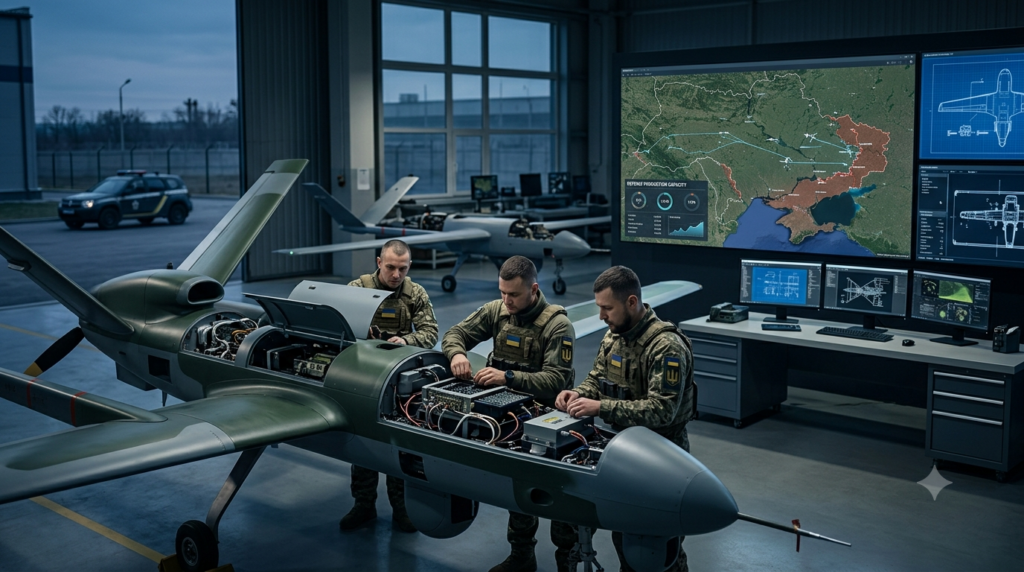
Ukraine’s Defense Production Model During the War with Russia
Ukraine’s wartime defence-industrial model combines decentralised production, rapid battlefield feedback, domestic procurement and foreign-financed capacity.
Ukraine has not simply expanded arms production during the war with Russia. It has built a wartime production model around decentralisation, rapid battlefield feedback, domestic procurement and foreign-financed industrial capacity.
Executive Summary
Ukraine’s defence-industrial model is best understood as a system of rapid adaptation rather than a conventional, centrally planned arms economy. It combines state direction with a broad ecosystem of private manufacturers, soldiers, engineers, volunteer networks and foreign partners.
The model has been particularly effective in drones, electronic warfare-related systems, software-enabled battlefield tools and other equipment that can be redesigned quickly. It is less able to replace foreign support in air defence, long-range munitions, complex engines and certain high-end components.
The strategic lesson is not that Ukraine has become self-sufficient. Rather, it has shown how a country under sustained attack can shorten the path from battlefield problem to industrial response.
Key Judgments
- Ukraine’s comparative advantage lies in fast iteration, not in matching Russia system-for-system in heavy industrial output.
- Domestic producers have become central to Ukrainian procurement, especially in unmanned systems and battlefield equipment.
- A decentralised supplier base improves resilience against strikes and enables faster innovation, but creates quality-control, financing and component-security challenges.
- Foreign funding and joint production are becoming as important as weapons deliveries themselves.
- The model is strongest where products are relatively inexpensive, software-defined and quickly replaceable; it is weakest in capital-intensive strategic capabilities.
From Dependency to Wartime Adaptation
At the start of the full-scale invasion in February 2022, Ukraine depended heavily on inherited Soviet-era industrial capacity, foreign military assistance and emergency volunteer procurement. The urgency of the war forced a different approach: equipment had to be designed, tested, modified and fielded in weeks or months rather than through the multi-year cycles typical of peacetime defence procurement.
This pressure created a production model with four linked elements:
- A state that defines urgent military requirements and finances procurement.
- Private firms and start-ups that compete to provide solutions.
- Direct feedback from soldiers and commanders.
- External partners that supply financing, components, technology and production cooperation.
The result has been especially visible in drones. Ukraine’s Ministry of Defence reported that domestic manufacturers accounted for 82% of the Defence Procurement Agency’s contracted military purchases in 2025, compared with 46% the previous year. Domestic procurement was reported at nearly UAH 430 billion. Ukraine’s Ministry of Defence
The Core of the Model: Rapid Battlefield Iteration
Ukraine’s most important innovation is organisational rather than technological. The country has reduced the distance between the front line and the factory floor.
A drone design that proves vulnerable to Russian electronic warfare can be altered quickly. A unit that needs a different payload, antenna, navigation method or control system can communicate that requirement through military networks, procurement channels and direct relationships with producers. This produces a continuous cycle:
battlefield problem → prototype → field test → modification → procurement → wider deployment
This is fundamentally different from the traditional defence-industrial model, in which a small number of large companies develop systems over many years before military adoption. Ukraine still needs large, complex systems from foreign partners, but it has created an unusually agile ecosystem for expendable and adaptable technologies.
The scale is considerable. Ukraine’s Defence Procurement Agency stated that it had delivered more than one million FPV drones to the armed forces between January and July 2025. Later official reporting said that 2.4 million FPV drones had been delivered during 2025. Ministry of Defence update Year-end procurement update
Decentralisation as Industrial Resilience
Russia’s ability to strike Ukrainian industrial sites makes concentration dangerous. Ukraine’s answer has been to distribute production across many smaller facilities, workshops and supplier networks.
This has several advantages:
- No single factory shutdown can halt an entire category of production.
- Smaller firms can enter the market with lower capital requirements.
- Designs can be changed without waiting for a large industrial bureaucracy.
- Production can be geographically dispersed and, where necessary, moved.
The trade-off is that decentralisation can complicate standardisation, inspection, security and supply-chain management. A large number of small manufacturers may produce equipment with uneven reliability. The state therefore needs clear technical requirements, testing mechanisms and procurement systems that reward performance rather than personal connections.
Ukraine’s model is not simply “small firms replacing major factories.” It is a layered system: small and medium-sized firms are highly important in drones and software-enabled weapons, while state enterprises and foreign industrial partners remain essential for armoured vehicles, ammunition, missiles, repairs and other complex capabilities.
Procurement as a Strategic Instrument
Ukraine has increasingly treated procurement as a tool for building industry, not merely buying equipment. Demand signals from the military give companies a reason to invest in production lines, staff and supply networks.
This is why long-term contracts and predictable financing matter. A manufacturer cannot scale production on the basis of one-off emergency purchases alone. The state’s role is to convert urgent battlefield demand into contracts that allow firms to expand without carrying unsustainable financial risk.
Foreign financing has reinforced this process. Ukraine’s Ministry of Defence stated that it secured more than $6 billion for the domestic defence industry in 2025 through mechanisms including direct procurement by partner governments, the Danish model and proceeds linked to frozen Russian assets. The ministry also reported a domestic production capacity of $35 billion in 2025. Ministry of Defence announcement
The Danish model is strategically important because it funds Ukrainian producers directly rather than only sending finished foreign-made weapons. This can reduce delivery times, support local employment and expand Ukrainian capacity. It also gives European partners access to lessons from a battlefield where weapons are being tested under intense operational pressure.
Drones Are the Most Visible Success — Not the Whole Story
Ukraine’s drone sector is the most mature example of the wartime model. It includes FPV strike drones, reconnaissance systems, maritime drones, interceptors and longer-range strike platforms. Production can be relatively cheap compared with conventional precision weapons, and designs can evolve rapidly in response to enemy adaptation.
Official Ukrainian reporting indicated that domestic capacity for FPV drones exceeded eight million units annually by 2026. Such capacity figures should be treated carefully: capacity is not the same as funded output, and not every platform can be produced at the same quality or delivered to units at the same rate. Still, the figure illustrates the extraordinary scale of Ukraine’s shift toward mass unmanned production. National Security and Defense Council assessment
However, drones do not eliminate the need for artillery shells, air-defence interceptors, armoured vehicles, combat aircraft, satellite services or advanced sensors. Ukraine’s model complements foreign support; it does not replace it.
The Limits of the Model
Ukraine faces four structural constraints.
1. Financing
Domestic industry may have more production capacity than Ukraine can afford to contract. This creates a gap between what firms could build and what the government can buy. External financing is therefore central, not supplementary.
2. Components and Supply Chains
Many systems depend on imported electronics, optics, batteries, machine tools and specialised materials. A domestic final-assembly line can still be vulnerable to foreign supply disruption.
3. Russian Strikes
Distributed production improves resilience but cannot remove the risk from missiles, drones and sabotage. Protection, dispersal, repair capacity and operational security remain permanent requirements.
4. Complex Strategic Systems
Ukraine can innovate rapidly in selected categories, but sophisticated air defence, long-range missiles, jet engines and certain munitions require capital, technology and industrial depth that take years to build.
The broader industrial comparison is sobering. A 2025 RUSI study argues that the war has exposed major weaknesses in European defence-industrial capacity while also showing how Russia, Ukraine and their partners have adapted production to sustained conflict. RUSI report: Winning the Industrial War
Strategic Outlook
Ukraine’s production model is likely to endure beyond the immediate war because it is now embedded in its military, industrial and political systems. The most likely future is a hybrid structure:
- Ukraine produces large volumes of drones, software-enabled systems, electronic-warfare tools and selected munitions.
- European and other partners co-finance production, provide components and participate in joint ventures.
- Foreign suppliers remain essential for the most complex high-end capabilities.
- Battlefield feedback continues to shape Ukrainian and European defence innovation.
The decisive question is whether Ukraine’s partners will treat Ukrainian industry as a temporary wartime supplier or as a permanent part of Europe’s defence-industrial base. If investment, procurement and technology-sharing become durable, Ukraine could emerge from the war with one of Europe’s most adaptive military-industrial ecosystems.
Conclusion
Ukraine’s defence production model is not based on industrial mass alone. It is based on speed, decentralisation, battlefield learning and the ability to turn urgent operational problems into manufactured solutions.
Its greatest strength is that it makes innovation continuous. Its greatest vulnerability is that innovation still depends on funding, imported components and protection from Russian attack.
For other states, the lesson is clear: modern war will not be won only by possessing advanced weapons. It will also be shaped by the ability to redesign, produce and deliver usable systems faster than the enemy can adapt.