Strategic Forecasting, Great Power Competition, Technology & AI
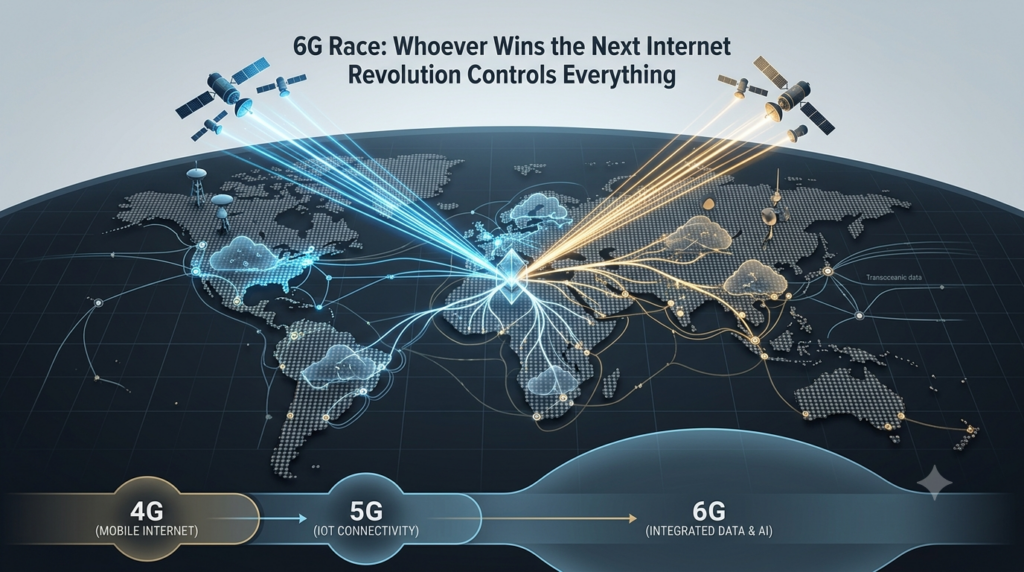
6G Race: Whoever Wins the Next Internet Revolution Controls Everything
A strategic assessment of the global 6G race: standards, spectrum, semiconductors, and military stakes behind who shapes the next era of the internet.
Executive Summary
Sixth-generation wireless technology (6G) has moved from a laboratory curiosity to a declared instrument of state power. The International Telecommunication Union’s IMT-2030 framework, formally adopted in December 2023, set a three-stage path toward commercial 6G networks around 2030. The Third Generation Partnership Project (3GPP) opened its first 6G study phase, Release 20, in mid-2025, with normative specifications due in Release 21 by roughly 2028. In practical terms, this means no country has “won” the 6G race in any deployable sense — the contest today is over standards, spectrum, patents, semiconductors, and open-source software architecture, not operating networks.
Yet the political stakes have escalated sharply. China accounts for roughly 40 percent of global 6G patent filings and has fused 6G development into state industrial policy through its IMT-2030(6G) Promotion Group. The United States, in a December 2025 presidential memorandum titled “Winning the 6G Race,” designated 6G as foundational to national security and economic prosperity, triggering spectrum reallocation, a 20-plus-nation diplomatic coalition, and a Pentagon-backed open-source radio access network initiative (OCUDU) intended to break the Ericsson-Nokia-Huawei oligopoly. The European Union, Japan, South Korea, and India are each pursuing parallel strategies that hedge against dependence on either Washington or Beijing.
This assessment concludes that infrastructure leadership in 6G will confer real, durable advantages in economic productivity, military command-and-control, and technological standard-setting — but the framing that a single actor will “control everything” substantially overstates the likely outcome. Deep supply-chain interdependence, the persistence of Huawei despite sanctions, and the multipolar hedging strategies of middle powers point toward a contested, only partially bifurcated global telecommunications order rather than winner-take-all dominance.
Key Judgments
- 6G remains pre-standardization technology. 3GPP Release 20 studies began in August 2025 and will run 18–21 months; Release 21 will deliver the first formal 6G specifications by approximately 2028, with commercial launch targeted around 2030. Claims of an active “race” refer to influence over rules and architecture, not deployed capability. (High confidence.)
- China holds the most advanced position in raw 6G patent volume and state coordination, but this lead in filings does not yet translate into settled global standards, and patent counts are an imperfect proxy for technological or commercial leadership. (High confidence on the fact; moderate confidence on its strategic significance.)
- Washington has shifted from passive standards participation to direct state intervention, via spectrum reallocation, an allied diplomatic coalition, and a Department of War-backed open-source RAN effort explicitly designed to dislodge both Chinese and Western incumbent vendors. (High confidence.)
- Global radio spectrum allocation, decided through the ITU’s World Radiocommunication Conferences (WRC-23 concluded, WRC-27 pending), is the most concrete and near-term battleground, with material economic consequences independent of how the broader “6G race” narrative resolves. (High confidence.)
- Sanctions and market bans have not eliminated Chinese vendor competitiveness. Huawei remains the leading radio access network (RAN) vendor in three of five global regions despite a six-year-old US-led exclusion campaign, indicating that export controls alone are unlikely to determine 6G market outcomes. (Moderate-to-high confidence.)
- 6G’s technical convergence with artificial intelligence, integrated sensing and communication (ISAC), and low-Earth-orbit satellite connectivity gives it inherent military relevance beyond civilian throughput gains, attracting direct Pentagon and Chinese military-industrial investment. (Moderate confidence on scope and timeline.)
- Semiconductor and compound-material chokepoints — gallium nitride RF components, sub-terahertz chips, advanced packaging — are increasingly instrumentalized as bilateral leverage, extending the US-China chip conflict into 6G-specific hardware. (High confidence on the fact; moderate confidence on future trajectory.)
- A credible minority of industry analysts argue the “6G race” is substantially political rhetoric that recycles 5G-era framing ahead of commercial substance, noting that 5G’s own strategic promises were only partially realized. This is a legitimate competing interpretation, not a fringe position. (Presented as a competing school of thought, not adjudicated as fact.)
- Middle powers — India, Japan, South Korea, and the EU — are pursuing multi-vector hedging rather than binary alignment, signing cooperation agreements across both US- and China-adjacent standards bodies simultaneously, which points toward a multipolar rather than bipolar 6G order. (Moderate confidence.)
Introduction
Every generational shift in mobile communications has been accompanied by claims that it would remake the global balance of power. Most of these claims proved partially true and substantially overstated. 5G was billed as the network that would enable autonomous vehicles, remote surgery, and smart cities at scale; a decade later, its principal achievements have been incremental capacity gains and a geopolitical fight over vendor trust that reshaped telecom procurement but did not reorder the international system.
6G arrives with the same rhetorical ambition, now amplified by the simultaneous rise of artificial intelligence, the militarization of connectivity, and a US-China strategic rivalry that treats nearly all advanced technology as contested terrain. Governments increasingly describe 6G not as a consumer upgrade but as critical infrastructure — comparable to semiconductors, energy grids, and financial payment rails — because it is expected to underpin AI inference at the network edge, autonomous systems, and next-generation military command-and-control.
This assessment examines the actors, capabilities, and intentions shaping the 6G contest as of mid-2026; distinguishes between what is established fact, reasoned analysis, and forecast; and evaluates competing interpretations of what “winning” the 6G race would actually mean — and whether the premise of the question is itself sound.
Historical Background
Mobile telecommunications standards have evolved through five prior generations, each roughly a decade apart, and each shifting the locus of industrial advantage:
- 1G–2G (1980s–1990s): Analog and early digital voice networks, largely regionally fragmented (Nordic NMT, American AMPS, European GSM). GSM’s adoption as a near-universal standard gave European vendors (Nokia, Ericsson, Siemens) a durable manufacturing advantage.
- 3G–4G (2000s–2010s): IP-based mobile broadband enabled the smartphone era. Qualcomm’s CDMA patent portfolio and, later, its dominance in 4G LTE chipsets, established the United States as the commercial leader in mobile silicon even as network equipment leadership remained largely European and, increasingly, Chinese.
- 5G (late 2010s–present): The decisive turning point. Huawei’s cost and technical competitiveness in RAN equipment, combined with intelligence concerns about Chinese state access to telecom infrastructure, triggered the US “Huawei ban” beginning with the May 2019 executive order restricting foreign adversary telecommunications equipment. The ensuing campaign to exclude Huawei from allied 5G networks became the template for treating telecom infrastructure as a national security asset rather than a purely commercial procurement decision.
The 5G episode is the direct precedent for today’s 6G posture, and it offers two lessons that inform this assessment. First, the campaign to build a Western alternative to Huawei through “Open RAN” — disaggregating network hardware and software to broaden the vendor base — struggled commercially; despite roughly $1.5 billion in US subsidies channeled through the O-RAN Alliance and related efforts, Open RAN deployments lagged, and Mavenir, one of the most credible US-aligned RAN challengers, later withdrew from the radio-unit market amid financial restructuring. Second, and consequently, Huawei’s global market position proved more resilient than sanctions architects anticipated: despite being cut off from leading-edge chip foundries, the company retained the largest or near-largest RAN market share in most world regions outside North America and parts of Europe by relying on domestically available chips and an entrenched cost and service advantage in developing markets. Both lessons directly shape expectations for how a 6G contest is likely to unfold.
Strategic Context
The formal architecture of the 6G race operates on two parallel tracks. The International Telecommunication Union (ITU-R) sets the global vision and spectrum framework through its “IMT-2030” process, formalized in Recommendation ITU-R M.2160 (approved November 2023). This recommendation defines fifteen target technical capabilities, four cross-cutting design principles (sustainability, ubiquitous intelligence, security/resilience, and connecting the unconnected), and a three-stage timeline: vision (completed 2023), requirements and evaluation methodology (targeted 2026), and finalized specifications (targeted 2030).
The 3rd Generation Partnership Project (3GPP), the industry body that actually writes deployable technical standards, opened its first 6G-specific study phase under Release 20 in August 2025, running through early 2027, with the first formal 6G specifications expected in Release 21 by roughly 2028 — enabling the commercial rollouts ITU-R anticipates around 2030. As of the March 2026 3GPP plenary, foundational studies — including a use-case and service-requirements report (TR 22.870) and a radio scenarios study (TR 38.914) — were substantially, though not fully, complete.
Around this technical scaffolding, a dense web of national and regional programs has formed:
- China established the IMT-2030(6G) Promotion Group in 2019 under coordinated ministry leadership and published its first 6G vision white paper in 2021. By mid-2025, Chinese entities accounted for approximately 40.3 percent of global 6G patent applications, the largest national share, according to industry tracking cited at the 2025 World Internet Conference. Huawei and ZTE lead Chinese commercial 6G research despite continued US export restrictions.
- The United States relies on a nominally private-sector-led body, the Next G Alliance (under ATIS), for technical roadmapping, but government involvement has intensified sharply. A December 19, 2025 presidential memorandum, “Winning the 6G Race,” directed the relocation of federal spectrum users from the 7.125–7.4 GHz band to free it for commercial 6G use and instructed federal agencies to prioritize US positions at the 2027 World Radiocommunication Conference. NTIA followed in mid-2026 by convening a “Call to Action for 6G Leadership and Security” with more than twenty partner governments, including the UK, Japan, South Korea, and several European and Nordic states.
- The European Union funds its 6G research primarily through the Hexa-X and Hexa-X-II flagship projects under Horizon Europe’s Smart Networks and Services Joint Undertaking, with roughly €250 million allocated across an initial portfolio of 35 projects, explicitly framed around preserving European “strategic autonomy” in next-generation networks.
- Japan channels 6G development through the Beyond 5G Promotion Consortium and NTT’s Innovative Optical and Wireless Network (IOWN) initiative, which pursues an alternative photonics-based architecture promising substantially lower latency and power consumption than conventional electronic switching, and which NTT is now working to standardize internationally through partnerships with European bodies.
- South Korea targets a 6G pilot beginning around 2026 and commercial service between 2028 and 2030, backed by a roughly $169 million government R&D commitment (2021–2026).
- India, through the Bharat 6G Alliance launched under the 2023 Bharat 6G Vision, aims to capture at least 10 percent of global 6G-related intellectual property and has signed bilateral cooperation agreements with the United States, Japan, South Korea, Germany, Finland, Brazil, and the United Kingdom simultaneously — an explicit hedging posture rather than alignment with a single bloc.
Detailed Analysis
Military Dimension
6G’s military relevance stems less from raw speed than from its architectural convergence with artificial intelligence, sensing, and space-based connectivity. The US Department of War’s FutureG Office has shifted its primary research focus from 5G to 6G, citing requirements for tactical-edge connectivity, drone detection, and AI-enabled command-and-control that current networks cannot support. Its flagship effort, OCUDU (Open Centralized Unit/Distributed Unit), launched in 2025 and expanded through a Linux Foundation-hosted “Ecosystem Foundation” in 2026 with participation from Ericsson, NVIDIA, and AMD, aims to replace proprietary RAN software with an open-source stack — explicitly framed by FutureG director Tom Rondeau as necessary to prevent continued dependence on a small number of vendors for both commercial and battlefield connectivity. The office received a reported $500 million through 2025 budget reconciliation legislation to accelerate this work, and in 2026 awarded contracts including a $28 million effort to convert commercial cell infrastructure into drone-detection sensors using integrated sensing and communication (ISAC) techniques.
China’s military-technical establishment has pursued parallel, and in some respects more advanced, demonstrations. Chinese state media reported in 2025 what researchers described as the first field-tested 6G-linked electronic warfare system, capable of simultaneous jamming and communication and reportedly able to generate thousands of false radar targets — illustrating how 6G-adjacent technologies (high-frequency signal processing, integrated sensing) are being militarized ahead of civilian standardization. More broadly, both the US and Chinese militaries assess 6G-era technology as central to network-centric warfare: real-time multi-sensor fusion, AI-assisted decision-making, distributed autonomous systems (drones, unmanned vehicles), and resilient communications across contested electromagnetic environments.
The strategic logic is that whichever military-industrial base first fields reliable AI-native, sensing-integrated wireless networks gains a meaningful edge in situational awareness and autonomous-systems coordination — though this is properly characterized as an assessment rather than an established fact, since neither side has fielded genuinely 6G-standard capability, and current initiatives largely repurpose 5G-Advanced and pre-standard research.
Political Dimension
The political contest over 6G reflects two distinct governing logics operating simultaneously.
The first is techno-nationalist and state-directed, most visible in China’s approach: a ministry-coordinated promotion group, explicit patent-share targets, and integration of 6G into broader industrial policy alongside AI and quantum computing. The United States has moved substantially toward this model since December 2025, with direct presidential direction of spectrum policy, coalition diplomacy explicitly aimed at countering a named strategic competitor, and defense-department subsidization of commercial RAN software — a departure from the traditionally private-sector-led US telecom standards posture embodied by the Next G Alliance.
The second logic is institutionalist and multilateral, embodied by the ITU-R’s consensus-based IMT-2030 process, which continues to function as a genuinely global forum in which China, the United States, the EU, and more than 150 other member states negotiate shared technical frameworks despite bilateral tension. Realist analysts read this coexistence skeptically, viewing multilateral standards bodies as arenas for pursuing state interests by other means rather than as evidence of genuine cooperation. Liberal-institutionalist analysts counter that the practical need for global interoperability — no country wants a 6G network unable to communicate with the rest of the world — imposes real cooperative constraints even amid rivalry, pointing to the fact that WRC-23 produced binding multilateral spectrum agreements covering the large majority of the world’s population despite the concurrent US-China standoff.
A third position, favored by middle powers, treats the binary “US bloc versus China bloc” framing as itself a strategic trap. India’s Bharat 6G Alliance, the EU’s 6G-IA, Japan’s Beyond 5G/XG Mobile Forum, and South Korea’s 6G Forum jointly signed a “Delhi Declaration” in 2025 alongside nine international standards bodies affirming shared principles for open, secure, and interoperable 6G — while each of these same actors also maintains separate bilateral technical cooperation with both Washington and, to varying degrees, Chinese-adjacent research networks. This pattern suggests that most consequential middle powers are optimizing for technological access and market position rather than picking a definitive geopolitical side, a posture consistent with broader trends in technology hedging observed across AI and semiconductor policy.
Economic Dimension
Quantifying the 6G market at this stage requires substantial caution: commercial market-research estimates for the global 6G market in 2026 range from under $1 billion to roughly $15 billion depending on methodology and scope, with projected 2033–2035 values spanning from roughly $60 billion to over $800 billion — a variance wide enough to indicate that no reliable consensus valuation yet exists. What can be stated with confidence is the scale of adjacent investment: the GSMA estimates mobile technologies already generate approximately $1.6 trillion in annual economic value in North America alone, and industry-wide capital expenditure on telecommunications infrastructure is projected to exceed $1 trillion globally in 2026, providing the financial base from which 6G-specific investment will be drawn.
The more economically consequential near-term battleground is semiconductor supply chains, particularly for radio-frequency components. 6G’s reliance on higher frequencies (upper mid-band, centimeter-wave, and eventually sub-terahertz spectrum) requires compound semiconductors — gallium nitride (GaN), gallium arsenide (GaAs), and silicon germanium — manufactured through specialty processes largely independent of the leading-edge silicon logic supply chain dominated by TSMC. This creates a distinct chokepoint structure: Western GaN and RF front-end capacity is comparatively concentrated, while China holds significant leverage over the raw gallium and germanium inputs used in these processes, having already imposed export licensing controls on both materials. In June 2026, Chinese state-linked research institutes announced delivery of five million GaN radio-frequency chips for 6G-adjacent “space-air-ground integrated network” applications, signaling a deliberate push toward supply-chain self-sufficiency in exactly the component category where China’s leverage is greatest and Western dependency is deepest.
Layered atop this is the broader US-China semiconductor export control regime — covering advanced logic chips, fabrication equipment, and increasingly RF and packaging technologies — which has proven only partially effective at constraining Chinese capability while imposing real costs on US chip firms’ China revenue. This dynamic, established in the AI-chip context since 2022, is now extending into 6G-relevant hardware, meaning that 6G economic competition cannot be analyzed in isolation from the broader technology-trade conflict.
Technological Dimension
Three technical shifts distinguish 6G from prior generations and drive its strategic salience:
AI-native networking. Unlike 5G, into which AI/ML functions were retrofitted, 6G is being designed from inception with artificial intelligence embedded in the radio access network itself — for waveform optimization, spectrum sharing, and autonomous network management. This is the explicit premise of initiatives like OCUDU and the NVIDIA/Linux Foundation-backed “AI-RAN” ecosystem, which frame 6G as the physical substrate for distributed AI inference rather than merely a faster data pipe.
Integrated sensing and communication (ISAC). 6G radio signals are being designed to double as environmental sensors — detecting drones, vehicles, and physical obstacles using the same spectrum used for data transmission. This has direct dual-use military application (as China’s demonstrated electronic warfare system illustrates) and civilian applications in autonomous transport and infrastructure monitoring.
Non-terrestrial network (NTN) integration. 6G is designed, from the outset, to unify terrestrial cellular networks with low-Earth-orbit satellite constellations, enabling direct handset-to-satellite connectivity without specialized hardware. This builds on 3GPP’s Release 17 NTN standardization for 5G and is expected to extend coverage to previously unconnected regions while creating new interdependencies between telecom operators and satellite constellation operators — a genuinely novel commercial and regulatory relationship.
Japan’s alternative technical bet — NTT’s IOWN photonics-electronics convergence architecture, promising dramatically lower power consumption and latency than conventional electronic switching — illustrates that “6G” is not a single agreed technical path even at the architecture level; multiple competing approaches to core infrastructure are being pursued simultaneously, with eventual convergence (or fragmentation) to be determined through the 3GPP process rather than by any single national program.
A notable institutional development in 2026 is the direct entry of open-source software governance into what was previously a proprietary hardware and software domain dominated by Ericsson, Nokia, Huawei, and Samsung. Whether OCUDU or comparable open-source initiatives can genuinely displace incumbent vendors — as Linux did for operating systems and Kubernetes did for cloud computing, the analogy its proponents invoke — remains an open empirical question; the preceding decade’s Open RAN campaign pursued similar ambitions with limited commercial success, a precedent this assessment treats as a material reason for caution rather than dismissal.
Legal / Diplomatic Dimension
Global spectrum allocation is governed through the ITU’s quadrennial World Radiocommunication Conferences, which function as binding multilateral treaty negotiations. WRC-23 (Dubai, November–December 2023) identified the upper 6 GHz band (6.425–7.125 GHz) for mobile broadband across most world regions and set the agenda for WRC-27 to evaluate additional bands (4.4–4.8 GHz, 7.125–8.4 GHz, and 14.8–15.35 GHz) explicitly for 6G. These are treaty-level decisions requiring consensus among more than 190 member states, and they illustrate that even amid strategic rivalry, the technical machinery of global telecommunications governance continues to produce binding multilateral outcomes — a point that complicates narratives of clean technological bifurcation.
Standard-essential patents (SEPs) represent a second legal battleground. China’s outsized share of 6G patent filings, if converted into declared standard-essential patents within 3GPP, would grant Chinese firms substantial royalty leverage over any 6G equipment manufactured globally — a dynamic already visible in 5G, where Huawei holds more declared 5G standard-essential patent families than any other single company, according to US regulatory assessments. This creates a structural tension: even countries that exclude Chinese network equipment on security grounds may remain dependent on Chinese-held intellectual property embedded in the global standard itself.
Export control regimes constitute the third and most rapidly evolving legal dimension. US semiconductor export controls, dating to a comprehensive October 2022 rule and repeatedly amended since, restrict Chinese access to advanced computing chips and fabrication equipment; China has responded with its own export licensing controls on gallium, germanium, and related materials critical to RF chip production. Enforcement has proven imperfect — reports indicate continued flows of controlled equipment into China through allied-country channels — and the policy framework has shifted repeatedly, including a 2026 partial reversal and re-tightening of controls on advanced AI accelerators, underscoring that the legal architecture governing 6G-relevant technology transfer remains unsettled rather than fixed.
Scenario Analysis
Scenario A — Managed Bifurcation (“Splinternet 2.0”): Two substantially separate 6G technology ecosystems emerge — one built around Chinese standards, equipment, and patents and adopted primarily across the Global South and China-aligned states; the other built around a US/EU/Japan/Korea coalition using OCUDU-style open architectures alongside incumbent Western vendors. Interoperability persists only through ITU-mandated baseline spectrum and protocol compatibility. This scenario assumes continued escalation of export controls, further Huawei-style exclusion campaigns extended proactively to 6G, and successful Western open-source RAN adoption at scale.
Scenario B — Negotiated Interoperable Pluralism (base case): A single, globally interoperable 3GPP/ITU 6G standard is adopted, as occurred with 5G, but commercial competition remains intense and multipolar: Chinese vendors dominate price-sensitive markets, Western/Japanese vendors retain premium and security-sensitive markets, and open-source alternatives (OCUDU and successors) capture a meaningful but not dominant share. Middle powers (India, EU members, ASEAN states) purchase from multiple vendor ecosystems simultaneously. This scenario assumes supply-chain interdependence and multilateral spectrum governance continue to outweigh bifurcation pressures, consistent with the post-WRC-23 pattern and with Huawei’s demonstrated post-sanctions resilience.
Scenario C — Decisive Single-Pole Dominance: Either (i) China achieves durable standards and market dominance analogous to a “6G equivalent” of its position in solar panels or 5G RAN market share in the developing world, leveraging patent volume, state financing, and vertically integrated GaN/chip production; or (ii) the US-led open-source and allied-coalition strategy succeeds decisively in displacing both Chinese vendors and the legacy Ericsson-Nokia duopoly, achieving something closer to the “Linux/Kubernetes” disruption its architects invoke. Either variant would represent a sharp discontinuity from the pattern observed across 4G and 5G, where no single actor achieved comprehensive dominance.
Probability Assessment
| Scenario | Qualitative Probability | Key Assumption at Risk |
|---|---|---|
| A — Managed Bifurcation | Moderate | Continued escalation of export controls and exclusion policy |
| B — Negotiated Interoperable Pluralism | Moderate-to-High | Persistence of supply-chain interdependence and ITU consensus norms |
| C — Decisive Single-Pole Dominance | Low | Requires a discontinuity from the 4G/5G historical pattern |
Scenario B is assessed as most likely because it is most consistent with the empirical record of the 4G and 5G transitions, the continued functioning of ITU multilateral spectrum governance through WRC-23, and Huawei’s demonstrated resilience despite six years of sustained exclusion efforts — all of which suggest structural limits on how cleanly the global telecommunications market can bifurcate. Scenario A cannot be excluded and would become substantially more likely if the United States and allied governments extend Huawei-style exclusion policy proactively to 6G equipment before commercial deployment, as some elements of the December 2025 presidential memorandum and the NTIA’s 2026 coalition-building suggest may already be underway. Scenario C is assessed as least likely in either direction, given that no prior mobile generation produced comprehensive single-actor dominance and that the structural conditions favoring diffusion — multiple credible national R&D programs, ITU consensus governance, and the failure of prior attempts at either Chinese or Western monopolization — remain largely intact.
Strategic Outlook
Over the next 18–24 months, four developments will be the most reliable indicators of how the broader contest is trending, independent of political rhetoric:
- WRC-27 preparatory outcomes. The extent to which the United States, China, and the EU converge on or diverge over the 4.4–4.8 GHz, 7.125–8.4 GHz, and 14.8–15.35 GHz candidate bands will signal whether spectrum policy — the most concrete near-term lever — is trending toward harmonization or fragmentation.
- 3GPP Release 21 scoping decisions, expected through 2026–2027, which will determine whether 6G’s core architecture accommodates multiple competing technical approaches (as with NTT’s photonics bet) or converges early around a dominant design.
- OCUDU’s commercial traction. Whether the Pentagon-backed open-source RAN stack attracts genuine carrier deployment beyond pilot and defense contexts by 2027 will indicate whether the “Linux/Kubernetes” disruption thesis is credible or whether it repeats Open RAN’s largely unrealized ambitions from the 5G era.
- Trajectory of compound-semiconductor and rare-material export controls, particularly any escalation or relaxation of Chinese gallium/germanium licensing and US restrictions on RF and packaging equipment, which will determine how much of the 6G supply chain becomes genuinely bifurcated versus remaining interdependent.
Policymakers, defense planners, and enterprise technology leaders should treat 6G less as a single race with a finish line and more as a multi-front contest across standards bodies, spectrum negotiations, patent portfolios, and semiconductor supply chains — each of which may resolve differently and on different timelines.
Conclusion
The proposition that “whoever wins the 6G race controls everything” captures something real: control over next-generation communications infrastructure genuinely does confer economic, military, and diplomatic advantages, and every major power now treats it accordingly, as reflected in China’s patent strategy, Washington’s December 2025 presidential memorandum, and the EU’s explicit “strategic autonomy” framing for Hexa-X-II. But the historical record of prior mobile generations, the demonstrated resilience of excluded vendors, the continued functioning of multilateral spectrum governance, and the hedging behavior of consequential middle powers all suggest that a clean, winner-take-all outcome is the less likely scenario. The more probable trajectory is a globally interoperable but commercially and politically contested 6G order — one in which leadership is real, valuable, and worth the intense state mobilization now underway, but partial, contestable, and unlikely to be permanently settled by any single actor before the decade is out.
Frequently Asked Questions
What is 6G and how is it different from 5G? 6G is the sixth generation of mobile wireless technology, expected to launch commercially around 2030. Unlike 5G, into which artificial intelligence was added after the fact, 6G is being designed from the outset as an AI-native network that also integrates sensing capabilities and direct satellite connectivity, alongside higher data rates and lower latency than 5G.
When will 6G actually be available? The ITU’s IMT-2030 framework and 3GPP’s standardization timeline both target the first commercial 6G specifications by roughly 2028, with initial commercial deployments expected around 2030. As of mid-2026, 6G remains in the technical study and pre-standardization phase.
Is the United States or China currently leading the 6G race? The two countries lead on different metrics. China leads in raw 6G patent filings (roughly 40 percent of the global total) and has more centralized state coordination. The United States has more recently mobilized direct government intervention — spectrum policy, allied coalition-building, and Pentagon-backed open-source network software — aimed at offsetting that lead. No single, authoritative measure yet determines overall leadership.
Why does 6G matter for national security? 6G’s integration with artificial intelligence, integrated sensing (which can detect drones and other objects using communication signals), and satellite connectivity gives it direct military applications in situational awareness, autonomous systems coordination, and resilient battlefield communications — which is why both the US Department of War and Chinese military-research institutions are directly funding 6G-adjacent research.
Will 6G make 5G or Wi-Fi obsolete? No. 6G is expected to complement rather than fully replace existing infrastructure, extending coverage through satellite integration and improving capacity in dense urban and industrial environments, while 5G-Advanced networks continue operating in parallel through the 2030s as 6G is gradually deployed.
Sources
- ITU-R Recommendation M.2160, “Framework and overall objectives of the future development of IMT for 2030 and beyond” — International Telecommunication Union (itu.int)
- ITU, “ITU advances the development of IMT-2030 for 6G mobile technologies” (December 2023) — itu.int
- ITU Hub, “IMT-2030: Technical requirements for the 6G future” (March 2026) — itu.int
- 3GPP, “Release 20” specifications and work-plan tracker — 3gpp.org
- Ericsson, “6G standardization: The technology realization step begins” (June 2025) — ericsson.com
- Qualcomm/RCR Wireless, “3GPP Release 20: Completing the 5G Advanced evolution and preparing for global 6G standardization” (June 2025)
- NTIA, “NTIA Launches Global ‘Call to Action for 6G Leadership and Security'” (2026) — ntia.gov
- The Register, “Uncle Sam needs you to fight for 6G leadership and security, lest Beijing get there first” (July 2026)
- Frank Rayal, “The Mirage of a 6G Race” (December 2025) — frankrayal.com
- Xinhua, “China charts 6G tech course to unlock future growth” (November 2025)
- Digitimes, “China leads global 6G patent applications” (November 2025)
- Hexa-X-II Project / European Commission Smart Networks and Services Joint Undertaking — hexa-x-ii.eu; digital-strategy.ec.europa.eu
- GSMA / Telefónica / Qualcomm, WRC-23 spectrum outcome analyses (2023–2024)
- IEEE ComSoc Technology Blog, “Omdia on resurgence of Huawei” (August 2025)
- Congressional Research Service, “U.S. Restrictions on Huawei Technologies” and “U.S. Export Controls and China: Advanced Semiconductors” — congress.gov
- DefenseScoop, “DOD turns its focus to 6G” (March 2025) and “Pentagon to publish open-source software stack for 5G, 6G network innovation” (March 2026)
- Breaking Defense, “Pentagon seeks open-source software for 5G, 6G networks” (2025)
- Light Reading / TechTimes, coverage of the OCUDU initiative (2026)
- Bharat 6G Alliance and RCR Wireless, coverage of India’s 6G Mission and Delhi Declaration (2025–2026)
- NTT, press materials on the IOWN All-Photonics Network (2026)
- Pandaily, “China Delivers 5 Million GaN RF Chips for 6G Networks” (June 2026)
This assessment reflects publicly available information as of August 2026. Given the pre-standardization state of 6G technology, all forward-looking statements should be understood as analytical judgments subject to revision as 3GPP Release 20/21 milestones, WRC-27 negotiations, and export-control policy evolve.