Can Syria Become a Gulf Oil Export Corridor? A Strategic Assessment of the Post-Hormuz “Land Bridge”
Can Syria replace Hormuz as a Gulf oil export route? A strategic assessment of Syria's pipelines, sanctions relief, and Gulf energy diplomacy in 2026.
Executive Summary
The near-total closure of the Strait of Hormuz since the outbreak of the US-Israel war with Iran on February 28, 2026, followed in September by the disabling of Saudi Arabia’s own Red Sea bypass route, has forced Gulf producers, Washington, and international oil majors to take seriously an idea long dismissed as impractical: routing Gulf crude and gas westward across Syria to the Mediterranean. This assessment finds the strategic logic real but the near-term potential modest, since Syria correctly draws attention for its geography but faces harder realities in security and market economics. Syria possesses two historic transit pipelines — the Kirkuk-Baniyas line and the Trans-Arabian Pipeline (Tapline) — both dormant since the 1980s, plus a fragile new government eager to monetize transit fees and reconstruction investment. Gulf states, particularly Saudi Arabia, Qatar, and the UAE, have pledged billions of dollars to Syria’s reconstruction and are exploring pipeline extensions. Iraq’s cabinet has already approved reviving a pipeline through Syrian territory. Yet Syria’s own hydrocarbon reserves are modest, its security environment remains fragile, its governance is highly centralized and undertested, and the commercial logic of routing Gulf energy toward Europe cuts against the reality that Asia — not the West — is where Gulf oil and gas demand growth actually lies. Syria is likely to become a meaningful supplementary node in regional energy logistics over the next several years, not a substitute for the Strait of Hormuz. The Washington Institute
Key Judgments
- (High confidence) The 2026 closure of the Strait of Hormuz and the September 2026 disabling of Saudi Arabia’s East-West Pipeline have created the strongest commercial and strategic incentive in decades for reviving Syrian transit infrastructure, and have already produced concrete government-to-government agreements, tenders, and international oil company MOUs.
- (Moderate confidence) Syria will incrementally expand its role in regional energy logistics — through truck-based “pipeline on wheels” crude transport, the Arab Gas Pipeline, and the Kilis-Aleppo gas link — well before any large new cross-border pipeline becomes operational.
- (Moderate confidence) Full-scale revival of the Kirkuk-Baniyas oil pipeline is achievable on a roughly three-year technical timeline, but is more likely to move at the pace of Syria’s internal stabilization than of Gulf urgency.
- (Low confidence) A genuinely new pipeline connecting Saudi Arabia, Kuwait, or Qatar directly through Syrian territory to the Mediterranean will be operational and carrying meaningful volumes before 2029, given financing, security, and Israeli-Golan complications.
- (High confidence) Syria’s own oil and gas reserves are too limited to make it a major hydrocarbon producer in its own right; its strategic value is overwhelmingly as a transit and reconstruction-investment destination rather than a resource base.
- (Moderate confidence) Persistent sectarian violence, incomplete SDF integration, ISIS remnants in central and eastern Syria, and an unresolved Israeli security posture constitute the single greatest risk to any large-scale pipeline investment.
Introduction
For most of the past half-century, “Syria” and “energy security” have been mentioned together mainly as a cautionary tale — a country whose pipelines were built, then bombed, sabotaged, nationalized, or simply abandoned as war and sanctions closed in. That history has, since December 2024, been reopened. The collapse of Bashar al-Assad’s government, Washington’s rapid rollback of sanctions, and the Gulf states’ aggressive re-engagement with Damascus under President Ahmed al-Sharaa converged with an entirely separate shock: the outbreak of open war between the United States, Israel, and Iran in February 2026, which shut the Strait of Hormuz to normal commercial traffic for most of the year and, by September, had disabled even Saudi Arabia’s principal overland bypass route. Before the war, roughly 69 percent of the crude oil transiting Hormuz moved to China, India, Japan, and South Korea, and Saudi Arabia alone exported some 40 percent of the barrels passing through the strait. The question this assessment addresses — can Syria serve as an export option for Gulf oil — is therefore no longer speculative. Gulf governments, Iraq, Turkey, the United States, and a lengthening list of international oil companies are actively testing the answer in 2026. This assessment separates the observed facts of what has already been rebuilt, agreed, or tendered from the analytical judgments about what is commercially and politically realistic, and from the forecasts of where the trend is likely to lead. politifact
Historical Background
Syria’s role as an energy transit corridor is not a new ambition; it is a resumption of a role Syria held, unevenly, for most of the twentieth century — and one that pipelines have never made politically comfortable for Damascus. The US-backed Trans-Arabian Pipeline, or Tapline, built to carry Saudi crude to the Mediterranean, contributed to Syria’s very first military coup: after independence in 1946, President Shukri al-Quwatli resisted American pressure to let the line cross the Golan Heights as an infringement on sovereignty, and in March 1949 army chief Husni al-Zaim overthrew him and promptly approved the pipeline — only to be overthrown himself months later. The Tapline, opened in 1950 as the world’s longest pipeline at the time, carried roughly 500,000 barrels per day of Saudi crude over a thousand miles through Saudi Arabia, Jordan, and southern Syria to Sidon on Lebanon’s coast.
A second line, the Kirkuk-Baniyas pipeline — sometimes called the Iraq-Syria-Lebanon pipeline — opened in 1952 and carried Iraqi crude from the Kirkuk fields to the Syrian Mediterranean port of Baniyas at a capacity of roughly 700,000 barrels per day. Israeli forces struck its pumping stations during the 1956 Suez Crisis, and in 1982 Hafez al-Assad shut the line entirely after aligning with Iran against Saddam Hussein in the Iran-Iraq War; the route briefly revived under a secret Bashar al-Assad-Saddam arrangement that evaded UN sanctions, before US forces struck its infrastructure during the 2003 invasion of Iraq, ending operations for good. In the early 1980s, Israeli authorities in the occupied Golan Heights also cut and sealed the section of the Tapline running through Israeli-held Syrian territory, a complication that still shadows any attempt to revive that particular route today. The lesson of this history, as one longtime Syria analyst has put it, is that pipelines crossing Syrian territory have rarely been insulated from the country’s political and military crises — more often, they have become casualties of them.
Syria’s civil war, beginning in 2011, compounded this pattern on a much larger scale. Syrian oil and gas output, which had peaked at 677,000 barrels per day in 2002 — comparable to Oman’s production at the time — collapsed to just 30,000-50,000 barrels per day for most of the decade after 2013, as the Islamic State and other armed factions systematically targeted pipelines, pumping stations, and export terminals as military objectives and revenue sources. By the time the Assad regime fell in December 2024, much of Syria’s energy transport network had been damaged, looted, or rendered inoperable.
Strategic Context
The catalyst reshaping this history is the 2026 Iran war. After the United States and Israel began attacking Iran on February 28, 2026, Iran retaliated with drones, ballistic missiles, and small attack boats against vessels attempting to transit the Strait of Hormuz, and the resulting closure of the strait — through which most Gulf oil is exported — was initially driven partly by the practical need to adjust tanker insurance contracts before becoming an outright blockade. Within forty-eight hours of the initial strikes, major shipping lines suspended transits and more than 150 tankers anchored outside the strait rather than risk attack, while Houthi forces in Yemen seized the opportunity to resume attacks on Red Sea shipping. Brent crude surged past $120 a barrel after the strait’s closure on March 4, 2026, and QatarEnergy was forced to declare force majeure on its LNG exports — a disruption the International Energy Agency characterized as the largest in the history of the global oil market. From chokepoint to crisis: The Strait of Hormuz and global oil markets | Brookings +4
A fragile ceasefire and a June 2026 US-Iran memorandum briefly reopened the strait to limited traffic, with the US Treasury issuing General License X on June 21 to authorize Iranian crude exports and associated banking and insurance transactions — the most expansive Iran energy license since sanctions began — before renewed attacks on commercial vessels in early July prompted Washington to revoke it. The crisis then compounded rather than eased. On September 11, 2026, Saudi Arabia shut down its East-West Pipeline — the kingdom’s main Hormuz-bypass route, moving up to five million barrels a day to the Red Sea port of Yanbu — after drone attacks traced to Iraq, where Iran-backed militias operate. The closure came the same week that Houthi forces made rapid advances along Yemen’s Red Sea coast and seized the strategic island of Mayun (Perim) at the mouth of the Bab al-Mandeb strait, meaning, as one Al Jazeera analysis noted, that Saudi Arabia could not simply reroute the same crude toward the Red Sea while both the pipeline and the sea route it feeds were simultaneously imperiled. Brent traded near $105-108 a barrel through mid-September as Gulf states postponed talks with Iran on a temporary shipping arrangement, and the crisis has, in effect, closed both of the Gulf’s main southern escape valves for oil at once. The Strait of Hormuz: Security Developments and Impacts on Oil, Gas, and Other Commodities | Congress.gov | Library of Congress +3
It is this dual chokepoint failure — not simply the original Hormuz closure — that has concentrated Gulf, Iraqi, and American attention on Syria. For a world confronting oil shortages from Iran’s blockage of the strait since March 2026, Syria’s rehabilitated relations with Washington and the Gulf monarchies present a timely, if partial, potential solution, leveraging its geography as a transit country for Mediterranean exports of Iraqi, Saudi, and other Gulf hydrocarbons. But the same body of analysis complicates the enthusiasm: much of the excitement over Syrian transit routes assumes Gulf producers want to redirect exports toward Europe, when in reality the center of gravity of global energy demand lies increasingly in Asia, giving producers a stronger incentive to prioritize routes serving Eastern rather than Western markets.
Detailed Analysis
Economic Dimension
Syria’s own hydrocarbon endowment is modest by regional standards. The country holds estimated proven oil reserves of roughly 2.5 billion barrels — about 0.1 percent of global reserves — meaning Syria’s strategic value lies far more in geography than in resources. Production has nonetheless recovered sharply since Damascus regained control of the northeast. Under a comprehensive 14-point ceasefire agreement reached January 17-18, 2026, government forces regained control of oil resources in Deir Ezzor and Raqqa from the Syrian Democratic Forces, transferring all oil and gas fields and related infrastructure to Damascus for the first time in over a decade. Output subsequently rose to a claimed 130,000 barrels per day by July 2026, though only about 40 percent of Syria’s wells were operational, the rest offline from war damage or natural decline. Syrian officials have set a target of roughly 200,000 barrels per day by the end of 2026, a return to the prewar high of about 400,000 barrels per day by the end of 2027, and — contingent on new exploration success — as much as 800,000 barrels per day by 2030. KaramshaarBaker Institute
Existing and improvised transit options are already operating well ahead of any new pipeline. The Arab Gas Pipeline is again carrying supplies from Jordan into Syria, including gas of Israeli origin swapped for Qatari LNG at Aqaba, while the newly completed Kilis-Aleppo pipeline delivers Azerbaijani gas financed by Qatar through Turkish territory into northern Syria. Most strikingly, an improvised “pipeline on wheels” has emerged between Iraq and Syria’s coast, with tanker trucks reportedly moving between 140,000 and 220,000 barrels per day of crude through Iraqi Kurdistan to the Baniyas refinery and export facilities, already helping bypass the Strait of Hormuz.
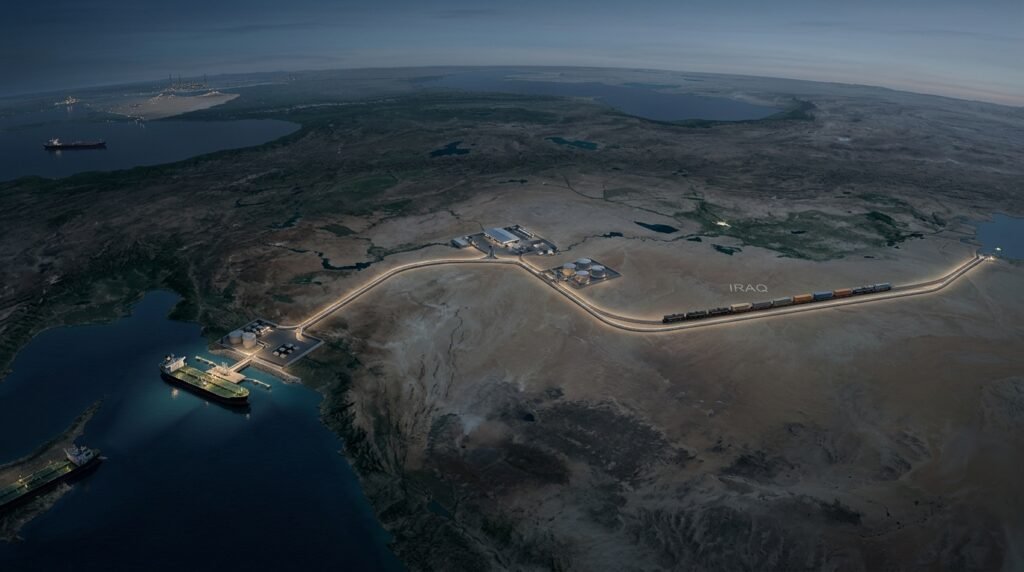
Formal pipeline revival is moving in parallel but more slowly. Iraq and Syria agreed in August 2025 to form a joint committee, with an international consultant, to study reactivating the Baniyas pipeline after two decades of dormancy. By July 2026, Iraq’s cabinet had approved building a new oil pipeline through Syria to the Mediterranean, explicitly to diversify away from Gulf export channels and the politically sensitive Iraq-Turkey pipeline to Ceyhan, alongside a separate MoU with ConocoPhillips, TI Capital, and Novaterra to assess Iraq’s Akkas gas field. In June 2026, Syria’s national oil company issued a tender for a new 400,000-barrel-per-day heavy crude pipeline linking northeastern fields to the Baniyas refinery, while SPC’s CEO estimated that reopening the full Kirkuk-Baniyas link would take about three years, and TotalEnergies’ chief executive said in July 2026 that Syria is positioned as a key transit corridor for Iraqi crude and voiced his company’s readiness to help finance the project, joining the Trump administration’s push for a US-Qatari consortium including Chevron to prioritize the line’s revival. newsonairThe National
Gulf interest extends beyond Iraq’s crude. Syrian officials say they have already fielded calls from Qatari investors about extending the Iraq-Syria pipeline to Qatar, and analysts believe the project could eventually attract Kuwait and Bahrain as well, while Qatar has separately floated building a liquefied natural gas pipeline through Syria to load tankers at Baniyas. Kuwaiti officials have spoken publicly of investing in a Tapline revival as a backup export route, though this would require a 120-mile spur and new pumping infrastructure, with Israeli control over part of the historic route creating pressure either for a partial reroute around the Golan or a diversion through Jordan’s Aqaba port instead. On the refining side, Syria’s larger Baniyas refinery, currently processing about 90,000 barrels a day, is slated for an upgrade to 145,000 barrels a day, while the aging Homs refinery is to be decommissioned and replaced by a new facility with up to 200,000 barrels a day of capacity — though domestic refining still falls well short of Syria’s roughly 140,000 barrels a day of fuel consumption, requiring continued imports. Spokesman-Review
Reconstruction capital is flowing, if unevenly. President al-Sharaa announced Syria attracted $28 billion in investment during 2025, including $14 billion in memoranda of understanding signed at a single August 2026 ceremony, against World Bank estimates that Syria’s total reconstruction needs exceed $216 billion. Saudi Arabia and Qatar pledged investment packages of $11.7 billion and $11 billion respectively following President Trump’s sanctions rollback, though much of this commitment remained notional for months while Syria’s terrorism-sponsor designation was still in place. The UAE has emerged as one of Syria’s largest investors, with DP World signing an initial $800 million agreement to redevelop the port of Tartus, while Qatar’s Power International Holding is developing agriculture, aviation, energy, and tourism projects, including rehabilitation of a Damascus airport terminal, and Saudi Arabia has announced 47 separate agreements across real estate, infrastructure, and telecommunications involving more than 100 Saudi companies. Offshore, Syria has opened five exploration blocks in the Mediterranean’s Levant Basin — the same basin containing Israel’s Leviathan field — with Chevron and Qatar’s UCC Holding signing an MOU on Block 1 in February 2026, and TotalEnergies, ConocoPhillips, and QatarEnergy following with a Block 3 MOU in May 2026. Syria Economy 2026: Post-Sanctions Era & $216 Billion Reconstruction | Al Arabia Law +2
Set against this momentum is a demand-side argument that Gulf pipeline advocates tend to underweight. China, India, Japan, South Korea, and Southeast Asia remain the primary growth markets for Gulf oil and gas, strengthening the appeal of routes that bypass Hormuz without crossing Syria at all — Saudi Arabia already has pipeline capacity to the Red Sea, while the UAE and Oman offer routes to the Gulf of Oman and Arabian Sea that keep exports oriented toward Asia. There are exceptions: landlocked Iraqi Kurdistan has a genuine incentive to use Mediterranean access through Syria, and Qatar may show renewed interest in overland gas routes now that the war has exposed the vulnerability of LNG shipments dependent on uninterrupted Hormuz navigation, particularly given Doha’s additional gas markets in Europe. A further complication is structural rather than geopolitical: the global gas trade is shifting decisively from pipelines to LNG, with more than half of long-distance gas trade expected to move by LNG by 2029 and roughly 300 billion cubic metres of new global LNG capacity coming online by 2030 — a trend that narrows the long-run commercial case for large new fixed pipeline infrastructure of the kind a Qatar-Turkey line would represent. Al Majalla
Political Dimension
Syria’s political transition remains the central variable shaping investor confidence. President al-Sharaa, the former Hayat Tahrir al-Sham commander who broke with al-Qaeda in 2016, has moved quickly to build international legitimacy. Syria’s Constitutional Declaration, signed in March 2025, established a five-year transitional period but concentrated extensive executive, legislative, and judicial authority in the presidency, eliminating the role of prime minister and weakening institutional checks, and foreign direct investment approvals now run through the Higher Council for Economic Development and the Syrian Investment Authority, both under the presidency, giving al-Sharaa primary control over project selection. Recent disputes inside the Syrian Petroleum Company between its chief executive and the energy minister-led board have done little to reassure prospective investors, illustrating a governance risk that the Washington Institute assesses may prove more consequential than the physical pipelines themselves.
Diplomatic normalization with Washington has nonetheless proceeded rapidly and with unusual bipartisan durability. The United States delisted al-Sharaa and Interior Minister Anas Khattab from its terrorism sanctions list on November 7, 2025, alongside similar UK and UN Security Council actions, and al-Sharaa’s November 2025 Oval Office meeting with President Trump marked the first-ever visit by a Syrian head of state to the White House. Sanctions relief has advanced in stages: Trump announced the lift during his May 2025 Riyadh trip, signed an executive order revoking the Syria sanctions program on June 30, 2025, and Congress repealed the Caesar Act in December 2025, before the State Department rescinded Syria’s State Sponsor of Terrorism designation on August 24, 2026 — the single step Washington’s own analysts had identified as most essential to unlocking Gulf investment pledges that banks and companies had, until then, been unable to formally execute. WikipediaTreasury
Military and Security Dimension
Security remains Syria’s most acute vulnerability for any large transit-infrastructure investment. Sectarian violence in coastal Latakia in March 2025 killed roughly 1,500 people, most of them Alawite civilians, and further violence in Suweida province between Druze and Bedouin factions in July 2025 left more than 1,000 dead and displaced over 128,000 civilians, with the UN’s Syria Commission later estimating around 1,700 killed and 200,000 displaced across the broader wave of violence, and finding in 2026 that accountability efforts had made no meaningful progress. The five provinces most affected by this violence account for over 4,600 reported fatalities, some 60 percent of the nationwide total, and the Islamic State has meanwhile returned to familiar patterns as a resilient insurgent force in the northeast and central desert — precisely the sparsely populated terrain that any revived Kirkuk-Baniyas or prospective Qatar-Turkey pipeline would have to cross. Both projects would traverse vast stretches of territory where Islamic State remnants and Iran-backed Shia militias remain active, terrain that has frustrated outside powers from the Ottomans to the British and that neither the Assad regime nor its successor has ever fully secured. April 2025 massacres of Syrian Druze +2
Kurdish integration has progressed further than expected but remains incomplete. Extensive fighting in Kurdish areas continued into January 2026 before the transitional government reached a ceasefire and integration agreement with the Syrian Democratic Forces, which — as noted above — transferred the northeast’s oilfields to Damascus. ISIS attacks fell 17 percent between January and April 2026 and a further 67 percent between April and June, coinciding with the withdrawal of US troops from Syria, though a series of bombings targeting a café, hotel, and bus in Damascus in July and August 2026 illustrated how fragile ground-level security remains. House of Commons Library
Israel’s posture is a further complicating factor. Since Assad’s fall, Israeli forces have conducted thousands of strikes inside Syria, destroyed roughly 85 percent of the Syrian military’s defensive capabilities, and occupied additional territory beyond the Golan Heights. US-mediated talks toward a security arrangement have advanced unevenly: reports in January 2026 suggested discussions of a 25-year Golan lease and a possible Israeli embassy opening by late 2026, but by August 2026 the talks had stalled over an Israeli demand for a “humanitarian corridor” linking the occupied Golan to Sweida province, which Damascus views as a backdoor means of expanding Israeli control beyond the 1974 disengagement line. Meanwhile, Russia’s military footprint — long a source of Iranian-aligned deconfliction risk for any Western-backed pipeline scheme — is effectively winding down: Syria and Russia signed a memorandum on August 9, 2026 transferring the Hmeimim airbase and Tartus naval base’s civilian facilities to Syrian administration and converting the military installations into joint training centers, a change one NATO official described as leaving the historic Tartus base with essentially no operational Russian presence since June 2026. Golan Spat Exposes One Reason Israel-Syria Talks Stalled +3
Legal and Diplomatic Dimension
The clearest legal obstacle to reviving the Tapline route specifically is the unresolved status of the Golan Heights, which Israel occupies but which the United Nations does not recognize as annexed territory — and through which a segment of the original pipeline still runs, sealed since the 1980s. Any Tapline revival therefore hinges on either an unlikely Israeli concession or a reroute that adds cost and complexity via Jordan. More broadly, Syria’s investment framework is still being built from scratch: the Syrian Petroleum Company, created by presidential decree in October 2025, has adopted three contract models — production-sharing agreements for upstream exploration, build-operate-transfer structures for major infrastructure such as the Kirkuk-Baniyas revival, and standard service contracts for smaller rehabilitation work — a reasonably conventional legal architecture, but one that international financiers have yet to test at scale in a jurisdiction with weak judicial enforcement and, per the Washington Institute, unresolved internal disputes over decision-making authority at the state oil company itself.
Technological Dimension
Two technological trends bear directly on Syria’s prospects. First, the global gas market’s structural pivot from long-distance pipelines toward LNG (detailed above) works against grand multi-billion-dollar pipeline schemes like a full Qatar-Turkey line, even as it strengthens the logic of smaller, faster-to-build options such as Qatar’s proposed LNG-loading pipeline to Baniyas. Second, Syria’s own upstream and midstream capacity is technologically hollowed out after more than a decade of war and sanctions; state officials acknowledge the Syrian Petroleum Company lacks the technical expertise, technology, or capital required to develop deepwater Levant Basin resources on its own, driving its active search for international oil company partnerships. Financial-system reintegration — Syria’s return to SWIFT and the opening of a government account at the Federal Reserve Bank of New York — is a necessary, though not sufficient, technological and institutional precondition for any large project financing to proceed.
Scenario Analysis
Scenario 1 — “Land Bridge Realized.” Syria’s internal security stabilizes further, the Israel-Syria security track produces a durable if limited arrangement, and Damascus, Baghdad, Riyadh, and Doha sustain the current momentum. The Kirkuk-Baniyas pipeline reopens on roughly its estimated three-year timeline, the Arab Gas Pipeline extension to Turkey and the Baniyas LNG-loading project are completed, and Syria becomes a genuine, if secondary, Mediterranean outlet for Iraqi crude and some Gulf volumes by 2028-2029.
Scenario 2 — “Incremental Corridor.” The current trajectory continues but at a slower pace than advocates hope. Trucked crude, the Arab Gas Pipeline, and Kilis-Aleppo gas flows expand steadily; feasibility studies and MOUs multiply; but the Kirkuk-Baniyas revival and any Gulf-financed new-build pipeline are repeatedly delayed by financing gaps, contract disputes, and security setbacks. Syria remains a marginal, supplementary route alongside Saudi Arabia’s and the UAE’s own bypass infrastructure rather than a transformative one.
Scenario 3 — “Renewed Fragmentation.” Sectarian violence escalates again, SDF integration unravels, ISIS exploits the security vacuum in the eastern desert, and the Israel-Syria security track collapses entirely. International oil companies suspend or withdraw from Syrian commitments, echoing the pattern of 1949, 1982, and 2003 in which political rupture repeatedly aborted Syrian transit projects just as they gained momentum.
Probability Assessment
| Judgment | Probability |
|---|---|
| Continued incremental growth in existing workarounds (trucked crude, Arab Gas Pipeline, Kilis-Aleppo) over the next 2 years | High |
| Kirkuk-Baniyas pipeline substantially rebuilt and carrying meaningful Iraqi volumes within roughly 3 years | Moderate |
| A new Gulf-financed pipeline (Qatar, Kuwait, or Saudi-linked) reaching final investment decision within 2 years | Moderate |
| That same new Gulf pipeline actually operational and carrying significant volumes before 2029 | Low |
| Qatar-Turkey gas pipeline constructed within 5 years | Low |
| A durable Israel-Syria security arrangement reducing political risk along prospective corridors within 2 years | Moderate |
| Renewed major disruption to Syrian pipeline plans from internal conflict or sectarian violence within 2-3 years | Moderate |
| Syria displacing more than a small fraction of total Gulf oil currently transiting Hormuz within 5 years | Very Low |
Strategic Outlook
Syria’s re-emergence as a discussed alternative to the Strait of Hormuz is a genuine and consequential shift in regional energy geography, but it is best understood as additive rather than substitutive. The dual chokepoint crisis of 2026 — Hormuz’s closure compounded by the disabling of Saudi Arabia’s own East-West Pipeline and mounting Houthi control over Bab al-Mandeb — has given Gulf producers, Iraq, and Washington a strategic and commercial rationale for Syrian transit infrastructure that simply did not exist in earlier decades of intermittent interest. Concrete steps have followed: Iraqi cabinet approval of a new pipeline, a Syrian tender for northeastern crude transport, IOC exploration MOUs, and public statements of interest from Kuwaiti, Qatari, and Bahraini officials. None of this, however, changes the underlying arithmetic that Syria’s own reserves are small, that the bulk of Gulf hydrocarbon demand growth runs eastward to Asia rather than westward to Europe, and that Syria’s internal security and governance remain works in progress rather than settled facts. The most likely trajectory over the next three to five years is a gradual thickening of Syria’s role as one of several partial bypass options — alongside Saudi Arabia’s own Red Sea infrastructure and the UAE’s and Oman’s Arabian Sea routes — rather than Syria emerging as a primary or dominant channel for Gulf oil exports. That trajectory could accelerate meaningfully if the Hormuz-Bab al-Mandeb crisis proves durable rather than transient, since a prolonged, multi-year closure would materially strengthen the economic case for diversification investments that currently still carry a substantial risk premium.
Conclusion
Syria can be, and to a modest degree already is, part of the answer to the Gulf’s 2026 export crisis — but it is not, and is unlikely to become in the near term, a wholesale export option capable of substituting for the Strait of Hormuz. The country’s revived pipelines, tendered projects, and Gulf investment pledges represent a meaningful reweaving of Syria back into regional energy logistics after more than a decade of war and isolation, driven as much by Washington’s strategic interest in reducing Iranian leverage as by Gulf producers’ own commercial calculations. Whether this reweaving deepens into a genuine land bridge or stalls as previous Syrian pipeline ventures have stalled will depend less on engineering than on politics: the durability of Syria’s internal stabilization, the fate of Israeli-Syrian security negotiations, and the pace at which Damascus can build institutions capable of reassuring the international capital this vision requires.
Frequently Asked Questions
Can Syria realistically replace the Strait of Hormuz for Gulf oil exports?
No. Syria’s transit capacity, even under optimistic pipeline-revival scenarios, would carry a small fraction of the roughly 20 percent of global oil trade that historically moved through Hormuz. Syria is best understood as a supplementary, partial bypass option rather than a substitute.
What is the Kirkuk-Baniyas pipeline, and can it be revived?
It is a dormant 1952-era pipeline that once carried up to 700,000 barrels per day of Iraqi crude from Kirkuk to the Syrian Mediterranean port of Baniyas, closed since the 2003 Iraq war. Syrian and Iraqi officials, along with US and European oil majors, are actively studying its revival, with estimates suggesting roughly three years to full restoration.
Why are Gulf states investing in Syria’s energy sector now?
The combination of US sanctions relief, Ahmed al-Sharaa’s diplomatic outreach, and the 2026 Hormuz and Bab al-Mandeb disruptions has created both a reconstruction opportunity and a strategic incentive to diversify Gulf export routes away from vulnerable maritime chokepoints.
What are the biggest risks to Syria’s pipeline ambitions?
Persistent sectarian violence, incomplete Kurdish (SDF) integration, active Islamic State remnants in the sparsely populated corridors any pipeline must cross, an unresolved Israeli security posture including disputes over the Golan Heights, and Syria’s still-untested governance and investment institutions.
Is the long-discussed Qatar-Turkey gas pipeline through Syria actually going to be built?
Not imminently. The project remains commercially and politically complex, and the global gas market’s broader shift toward LNG reduces the long-term case for large fixed pipeline infrastructure, even as it strengthens interest in smaller, faster options like a Qatari LNG-loading pipeline to Baniyas.
Sources
- Rice University Baker Institute for Public Policy, Leveraging Oil, Gas, and Geography for Syria’s Postwar Recovery, Sept. 3, 2026
- The Washington Institute for Near East Policy, Syria’s Pipeline Dream Meets Hard Realities, June 10, 2026
- Karam Shaar Advisory, Iraq-Syria Oil Pipeline: Kirkuk-Baniyas Revival Costs, June 2026
- The National, Iraq and Syria Revive Oil Pipeline Plan to Mediterranean in Export Push, July 26, 2026
- Al Majalla, The US Plan to Turn Syria into an Oil Transit Hub
- U.S. Department of the Treasury (OFAC), Sanctions and Export Controls Relief for Syria, updated August 2026
- Foundation for Defense of Democracies, Sharaa’s Gulf Tour Is All About the Economy, April 2026, and Saudi Arabia Closes Its East-West Pipeline After Attacks From Iraq, September 2026
- Brookings Institution, From Chokepoint to Crisis: The Strait of Hormuz and Global Oil Markets, June 2026
- Congressional Research Service, The Strait of Hormuz: Security Developments and Impacts on Oil, Gas, and Other Commodities, August 2026
- House of Commons Library, Syria in 2026: Minority Religious and Ethnic Groups After Assad and Interim Government and Kurdish Integration
- ACLED, Sectarian Violence Threatens Syria’s Chance at Stability, December 2025
- Human Rights Watch, World Report 2026: Syria
- Council on Foreign Relations, Global Conflict Tracker: Instability in Syria
- Al Jazeera, France 24, Reuters/NBC/CNN/CNBC news reporting on the East-West Pipeline shutdown and Bab al-Mandeb developments, September 2026
- World Bank Group, press release on Syria’s post-conflict reconstruction cost estimate, October 2025
This runs long for chat, matching the institutional template — happy to turn it into a formatted Word or HTML document if that’s more useful for StratReview.