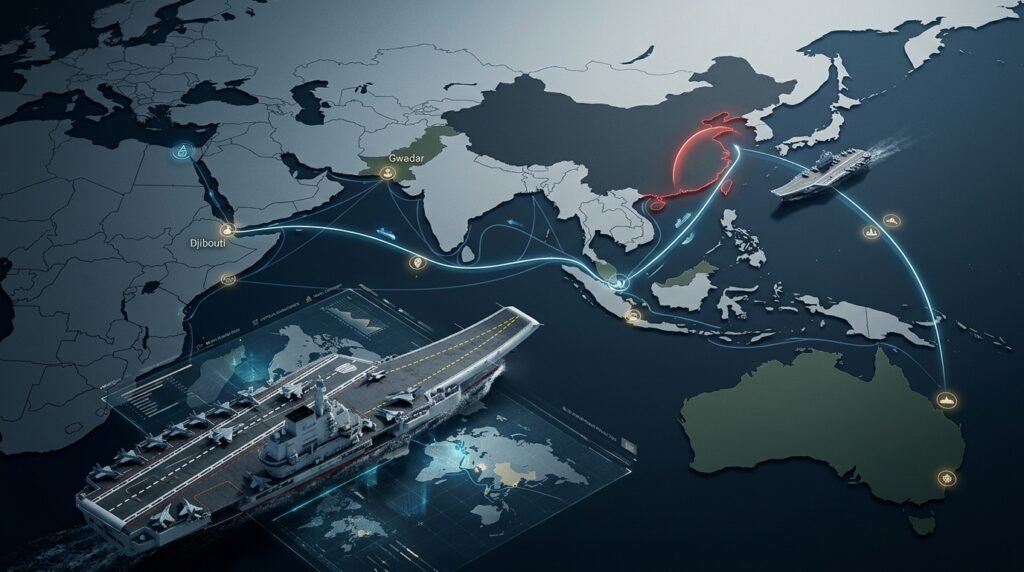
China’s Maritime Strategy: From Coastal Defense to Indo-Pacific Power
China's Maritime Strategy: Coastal Defense to Sea Power Meta Description: A strategic intelligence assessment of China's transformation from a coastal-defense force into an Indo-Pacific maritime power, and what it means for regional stability.
Executive Summary
Over four decades, the People’s Republic of China has converted a coastal-defense navy into the world’s largest maritime force by hull count and a central instrument of national strategy. The transformation, formalized under Admiral Liu Huaqing in the 1980s and accelerated under Xi Jinping since 2012, has moved the People’s Liberation Army Navy (PLAN) outward in three conceptual stages: control within the First Island Chain, operational reach to the Second Island Chain, and, by mid-century, a globally deployable fleet. This assessment examines the drivers, capabilities, and constraints behind that trajectory and evaluates its implications for the South China Sea, the Taiwan Strait, the East China Sea, and the wider Indo-Pacific security order.
China’s maritime buildup is not solely a military phenomenon. It is inseparable from an economic vulnerability — the so-called Malacca Dilemma — that ties Chinese energy security and export competitiveness to sea lanes it does not control; from a political system that has consolidated maritime law-enforcement, militia, and naval assets under unified Communist Party direction; from a technological modernization drive that has produced electromagnetic catapults, hypersonic anti-ship weapons, and increasingly autonomous surveillance platforms; and from a legal-diplomatic contest over the 2016 South China Sea arbitral ruling that Beijing continues to reject. Each dimension reinforces the others, producing a maritime strategy that is simultaneously defensive in its origins and expansionary in its present-day effects.
The assessment finds that outright conventional war remains a lower-probability outcome than continued “gray zone” coercion — the incremental use of coast guard vessels, maritime militia, and legal pressure to alter the status quo below the threshold that would trigger a US or allied military response. However, the risk of miscalculation is rising as the frequency and intensity of confrontations increase across the South China Sea, the Taiwan Strait, and the East China Sea simultaneously. Regional and extra-regional actors — the United States, Japan, Australia, India, the Philippines, and Vietnam among them — are responding with expanded alliance architecture, but the durability of that response depends on sustained political will and defense investment that is not guaranteed.
Key Judgments
- High confidence. China has fielded the world’s largest navy by number of hulls and is pursuing a nine-carrier force by 2035, though the PLAN’s blue-water sustainment, joint-force integration, and combat experience still lag behind those of the US Navy.
- High confidence. Beijing’s use of its coast guard and maritime militia as instruments of coercion — rather than the PLAN navy directly — is a deliberate strategy to expand control while remaining below the threshold of armed conflict.
- Moderate-to-high confidence. China’s economic dependence on maritime chokepoints, particularly the Strait of Malacca and the Taiwan Strait, remains a genuine strategic vulnerability that continues to shape naval investment, pipeline diplomacy, and strategic reserve policy, even as Beijing has only partially mitigated it.
- Moderate confidence. The likelihood of a full-scale Chinese amphibious invasion of Taiwan in the near term (through 2028) is low; the likelihood of continued or intensified gray-zone pressure, including blockade-rehearsal exercises, is high.
- Moderate confidence. Alliance responses — AUKUS, the Quad, and bilateral US treaty commitments to Japan and the Philippines — are deepening but remain contingent on burden-sharing decisions in Canberra, Tokyo, Manila, and Washington that could shift with domestic politics.
- Low-to-moderate confidence. A negotiated ASEAN-China Code of Conduct that meaningfully constrains Chinese behavior in the South China Sea is unlikely to be concluded on terms acceptable to all claimant states within the current negotiating cycle.
Introduction
For most of the twentieth century, Chinese naval power was an afterthought to continental security concerns — border defense, internal stability, and land-based deterrence against the Soviet Union and, earlier, Japan. That posture has been inverted. China today operates the numerically largest navy in the world, fields the region’s most extensive anti-ship missile architecture, and has translated its Belt and Road Initiative into a network of port access points stretching from the South China Sea to the Horn of Africa and the Mediterranean. This assessment traces how that shift occurred, what capabilities and doctrines underpin it, and what scenarios plausibly lie ahead for the Indo-Pacific maritime order.
The analysis draws on open-source assessments from institutions including the RAND Corporation, the Center for Strategic and International Studies (CSIS), the Council on Foreign Relations (CFR), the International Institute for Strategic Studies tradition of naval analysis, the US Department of Defense’s annual reports on Chinese military power, the Armed Conflict Location & Event Data Project (ACLED), and national defense ministries in the region. Where sources disagree — as they frequently do on exact fleet counts, financial figures, and intentions — this assessment notes the range of estimates rather than presenting a single number as definitive.
Historical Background
China’s maritime strategy has passed through four broad phases since 1949.
Coastal defense (1949–1982). Following the founding of the People’s Republic, the fledgling navy existed primarily to defend the coastline and support the ground forces, reflecting Mao-era emphasis on continental security and limited industrial capacity for blue-water shipbuilding.
Offshore active defense (1982–c. 2000). Admiral Liu Huaqing, often described as the father of the modern Chinese navy, used his position atop the PLAN in the 1980s — with the backing of Deng Xiaoping — to articulate a phased modernization plan. Liu’s strategy envisioned Chinese naval forces achieving effective control within the First Island Chain (running from the Kuril Islands through Japan, the Ryukyus, Taiwan, the Philippines, and into the Indonesian archipelago) by roughly 2000, extending reach to the Second Island Chain (through the Bonins, the Mariana Islands, and Guam) by approximately 2020, and evolving into a globally capable navy by the PRC’s centennial in 2049. Analysts have compared Liu’s institutional role to that of Soviet Admiral Sergei Gorshkov, and his strategic thinking drew on both Alfred Thayer Mahan’s sea-power theory and Julian Corbett’s more limited, land-oriented conception of naval strategy — an eclectic synthesis characteristic of Chinese strategic culture’s blending of foreign and indigenous thought.
Near seas to far seas (2000s–2015). Under Jiang Zemin and Hu Jintao, the PLAN’s mandate broadened gradually from coastal and offshore operations toward what Chinese doctrine termed “far seas” missions — counter-piracy deployments to the Gulf of Aden beginning in 2008 being an early example — even as the core doctrinal emphasis remained on the near seas.
Open seas protection (2015–present). China’s 2015 defense white paper formally added “open seas protection” alongside “offshore waters defense” as a stated naval mission, signaling official acknowledgment that the PLAN’s responsibilities now extended to defending Chinese interests in distant waters, not merely the waters near its coast. This period has coincided with the commissioning of China’s first indigenous aircraft carriers, the establishment of an overseas military base in Djibouti, and the integration of coast guard and maritime militia forces into a unified maritime coercion strategy.
This historical arc matters because it shapes how China’s current posture should be interpreted. Realist scholars point out that much of the buildup originated as a defensive response to a perceived vulnerability — the Malacca Dilemma and the historical memory of Western and Japanese naval intervention along China’s coast during the “Century of Humiliation.” Other analysts, drawing on offensive realist logic associated with scholars such as John Mearsheimer, argue that a rising power’s accumulation of maritime capability, once regional primacy becomes attainable, tends to translate defensive origins into revisionist behavior. Both readings find support in the empirical record, and this tension between defensive rationale and expansionary effect runs through the remainder of this assessment.
Strategic Context
China’s geography is central to understanding its maritime strategy. The country’s coastline is bounded by a chain of islands and archipelagos — Japan, the Ryukyus, Taiwan, the Philippines — that are not under Chinese sovereignty and that historically hosted US and allied military access. This “First Island Chain” constrains Chinese naval movement in any contingency and provides the geographic foundation for the anti-access/area-denial (A2/AD) literature that has shaped Western naval planning for two decades.
Economically, China’s growth model depends on seaborne trade and energy imports that transit a small number of narrow chokepoints, most critically the Strait of Malacca. First articulated by then-President Hu Jintao in 2003, the Malacca Dilemma reflects Beijing’s assessment that a hostile power could, in a crisis, restrict Chinese access to Middle Eastern and African energy supplies and disrupt the seaborne trade that underpins Chinese manufacturing exports. According to CSIS trade-flow analysis, roughly $963 billion of Chinese trade transited the Strait of Malacca in 2024, accounting for approximately 21 percent of Chinese imports and 14 percent of exports — figures that, while large, are actually smaller than the volume of Chinese trade transiting the Taiwan Strait, estimated at approximately $1.3 trillion, including 33 percent of total Chinese imports and 58 percent of maritime imports. Other estimates, using broader definitions of seaborne dependency, put the share of Chinese trade moved by sea at around 90 percent and the share of oil imports transiting Malacca at approximately 80 percent. China has partially hedged this exposure through a strategic petroleum reserve estimated at roughly 900 million barrels — providing on the order of 80 days of import coverage — and through overland pipeline capacity from Russia and Central Asia that, while strategically significant, remains modest relative to total import volumes.
Politically, Xi Jinping has centralized maritime policy to a degree unmatched by his predecessors, integrating the PLAN, the China Coast Guard (reorganized under the People’s Armed Police in 2018), and the People’s Armed Forces Maritime Militia (PAFMM) into a layered instrument of state power. This “three sea forces” model allows Beijing to calibrate the intensity of maritime coercion — from militia “swarming” of contested reefs to coast guard water-cannon confrontations to, at the most escalatory end, PLAN combat operations — while maintaining plausible ambiguity about state responsibility.
Strategically, all of this occurs against the backdrop of a broader US-China competition in which the Indo-Pacific has become the primary theater. Washington’s 2026 National Defense Strategy places heavy emphasis on allied burden-sharing in the region, implicitly relying on frameworks such as the Quadrilateral Security Dialogue (Quad) and AUKUS without naming them explicitly, while regional states — most visibly Australia, Japan, and the Philippines — are increasing defense spending and deepening security cooperation with Washington and with one another.
Detailed Analysis
Military Dimension
Fleet structure and capital ships. Open-source fleet trackers place total PLAN hull count at over 1,000 vessels when patrol craft, mine warfare ships, and auxiliaries are included, spanning 62 submarines, three aircraft carriers, roughly 60 destroyers, around 59 frigates, and approximately 50 corvettes, with additional stealth corvettes operated by the coast guard. US Department of Defense assessments have historically used a narrower “battle force ship” count that yields lower totals but still identifies the PLAN as the world’s largest navy by number of major combatants — a distinction analysts attribute in part to counting methodology rather than a fundamental disagreement about China’s shipbuilding lead.
China’s carrier program illustrates the pace of change. The Liaoning, a rebuilt Soviet-era hull commissioned in 2012, served primarily as a training and trials platform. The Shandong, commissioned in 2019 as China’s first domestically built carrier, represented an incremental improvement using the same ski-jump, short-takeoff design. The Fujian, commissioned in November 2025, marks a genuine technological leap: at roughly 80,000–85,000 tons full load, it is the first PLAN carrier equipped with an electromagnetic catapult-assisted takeoff, arrested-recovery (CATOBAR) system, comparable in concept — though smaller in scale — to the system used on the US Navy’s Gerald R. Ford-class carriers. Chinese state media reporting in 2026 indicated the Fujian was expected to approach full operational capability during the year, though independent analysts caution that integrating fifth-generation J-35 fighters and KJ-600 airborne early warning aircraft into a mature carrier air wing, and building the escort, logistics, and sustainment architecture around it, will take considerably longer than commissioning the hull itself. A fourth carrier, the Type 004, reportedly under construction at Dalian and widely assessed to be nuclear-powered, is expected to approach 120,000 tons — in the same class as the Ford. The Pentagon’s 2025 annual report to Congress assessed that the PLAN intends to field nine total carriers by 2035, a figure that would nearly triple the current force.
Undersea and strike capabilities. China’s submarine fleet — assessed by the US Office of Naval Intelligence to grow from roughly 66 boats to 76 by 2030 — includes an expanding ballistic-missile submarine (SSBN) component. Six Type 094 (Jin-class) SSBNs, based at Longpo Naval Base on Hainan Island, provide what the Pentagon has characterized as China’s first credible sea-based nuclear deterrent, armed with JL-2 and increasingly JL-3 submarine-launched ballistic missiles. A next-generation Type 096 (Tang-class) SSBN, reportedly displacing 15,000–20,000 tons submerged and potentially carrying up to 24 JL-3 missiles with an estimated range approaching 10,000 kilometers, is under development at the Bohai shipyard, with Pentagon projections suggesting China could operate up to eight SSBNs by 2030. Analysts assess the JL-3’s range as sufficient to threaten the continental United States from protected waters near the Chinese coast, reducing the boats’ exposure to US and allied anti-submarine forces.
Above the surface, China’s anti-access/area-denial complex centers on a layered family of anti-ship ballistic and hypersonic missiles. The DF-21D, often termed a “carrier killer,” is assessed to have a range on the order of 1,500–2,150 kilometers, sufficient to threaten naval forces operating within the First Island Chain. The DF-26, sometimes called the “Guam killer” for its reach toward the Second Island Chain, is estimated to have a range approaching 4,000 kilometers, with the US intelligence community estimating on the order of 250 launchers and up to 500 missiles in the inventory. The YJ-21 hypersonic anti-ship missile, launched from Type 055 destroyers, and a developmental anti-ship variant of the DF-17 hypersonic glide vehicle extend this threat envelope further and complicate missile-defense planning by combining speed with maneuverability. Military analysts caution that the operational effectiveness of this “carrier-killer” architecture depends less on the missiles’ technical specifications than on China’s ability to maintain a persistent, accurate, and jam-resistant targeting and surveillance network capable of locating and tracking a moving carrier strike group under contested conditions — a system-of-systems requirement that has not been demonstrated in combat.
Gray-zone forces. Alongside the PLAN, China operates the world’s largest coast guard and an extensive maritime militia — fishing vessels crewed and equipped for military-adjacent purposes, dubbed “little blue men” by US Naval War College analyst Andrew Erickson. RAND Corporation research characterizes China’s gray-zone approach as operating in the ambiguous space between peace and war, blending civilian and military assets to achieve incremental territorial control while remaining below the threshold that would trigger a conventional US or allied military response. Documented tactics include militia “rafting” — lashing vessels together to occupy contested features, as observed with more than 130 ships at Whitsun Reef in 2021 — coast guard ramming and water-cannon use against Philippine vessels, and, more recently, Chinese coast guard proposals to convert disputed South China Sea features into unmanned, AI-enabled surveillance outposts.
Regional flashpoints. In the South China Sea, China has continued construction of military facilities in the Paracel Islands and maintains militarized artificial islands in the Spratlys equipped with airstrips, radar, and missile systems, notwithstanding a 2015 assurance by Xi Jinping to the Obama administration that China would not militarize the features. Confrontations with the Philippines intensified through mid-2026, with reported clashes at Scarborough Shoal and Second Thomas Shoal occurring three times within a single week in July 2026, prompting joint US-Philippines-Japan maritime exercises. In the Taiwan Strait, PLA aircraft sorties around Taiwan have become a near-daily occurrence — averaging 7.5 sorties per day in the first half of 2026 according to Taiwanese defense ministry data compiled by regional trackers — punctuated by large-scale exercises such as the 2024 Joint Sword and 2025 Strait Thunder drills, which CSIS and other analysts assess have increasingly incorporated blockade-related elements: control of maritime and air approaches, inspection procedures, and simulated interdiction of shipping. Taiwan’s own exercises, including the 2025 Han Kuang 41 drills involving more than 22,000 reservists, reflect growing acknowledgment in Taipei that a blockade, rather than an immediate amphibious assault, may be the more probable opening phase of any future crisis. In the East China Sea, Chinese coast guard vessels entered Japanese territorial waters around the Senkaku Islands 27 times in 2025 and sailed within Japan’s contiguous zone a record 357 times, with tensions escalating further after Japanese Prime Minister Sanae Takaichi’s November 2025 remarks characterizing a Chinese use of force against Taiwan as a potential threat to Japan’s survival — a framing that would activate Japan’s collective self-defense provisions.
Political Dimension
China’s maritime assertiveness is underpinned by a domestic political architecture that has increasingly subordinated maritime law enforcement to national strategic objectives. The 2021 Coast Guard Law authorized Chinese coast guard vessels to use force, including against foreign ships, in waters China claims — a move regional states and international legal scholars viewed as an attempt to legitimize coercive gray-zone activity under domestic statute rather than international law. Xi Jinping’s consolidation of authority over the Central Military Commission and the integration of coast guard command structures under People’s Armed Police (and ultimately Party) control has reduced the bureaucratic friction that might otherwise constrain escalatory maritime operations.
Regionally, ASEAN states remain divided in their response. The Philippines under President Ferdinand Marcos Jr. has pursued the most confrontational posture among claimant states, publicizing Chinese coast guard and militia activity and deepening security cooperation with the United States, Japan, and Australia, while periodically signaling openness to joint resource exploration with Beijing. Vietnam has pursued a hedging strategy, strengthening its own Spratly infrastructure while avoiding open alignment with Washington. Negotiations toward an ASEAN-China Code of Conduct for the South China Sea have continued intermittently, with Philippine and Malaysian officials expressing hope for conclusion within 2026, but independent analysts assess that a text simultaneously satisfying Chinese preferences and providing adequate assurances to smaller claimant states is unlikely to emerge on that timeline.
In Northeast Asia, the China-Japan relationship entered what regional observers describe as its most confrontational phase since diplomatic normalization in 1972, driven by the Takaichi government’s more explicit linkage of Taiwan contingencies to Japanese security and by Tokyo’s decision to accelerate defense spending toward 2 percent of GDP ahead of its original fiscal year 2027 target.
Economic Dimension
China’s maritime economic exposure operates in two directions: as a vulnerability driving strategic behavior, and as a tool of influence projected outward through the Belt and Road Initiative’s maritime component, the 21st Century Maritime Silk Road, announced by Xi Jinping in 2013.
On the vulnerability side, the Malacca Dilemma remains a central driver of Chinese strategic thought, even as its precise magnitude is debated among analysts using different trade and energy datasets. China has pursued several partial mitigations: a strategic petroleum reserve providing roughly 80 days of import cover; overland energy links with Russia and Central Asia, including pipeline infrastructure that, while strategically insulated from naval interdiction, carries only a fraction of the volume moved by sea; and interest in Arctic shipping routes — the Polar Silk Road — that would bypass the Strait of Malacca and the South China Sea entirely, though these routes remain seasonally limited and commercially marginal at present. A long-discussed Kra Canal across the Thai isthmus, which proponents estimate could shorten shipping routes by roughly 1,200 kilometers at an estimated cost of $25–30 billion, remains a recurring topic of discussion rather than a funded project, facing Singapore’s opposition and unresolved financing and environmental questions.
On the influence side, the Maritime Silk Road has funded port development across the Indian Ocean and beyond, including Pakistan’s Gwadar port — anchor of the $62 billion China-Pakistan Economic Corridor — Sri Lanka’s Hambantota port, Djibouti’s port and logistics facilities, and Greece’s Piraeus, among others. Cumulative BRI investment estimates vary widely by methodology and time period, with figures commonly cited in the range of $1 trillion or more since the initiative’s 2013 launch. These investments have generated a persistent “debt-trap diplomacy” critique, most often illustrated by Sri Lanka’s 2017 transfer of Hambantota port to Chinese state-linked operators on a 99-year lease following debt-servicing difficulties, though scholars are divided on whether individual cases like Hambantota reflect deliberate Chinese strategic design or the more mundane consequences of poorly structured commercial lending compounded by recipient-country fiscal mismanagement. Regardless of intent, the strategic effect — a network of dual-use commercial ports along China’s key sea lanes, several capable in principle of supporting PLAN logistics and, eventually, basing — has been sufficient to prompt India, in particular, to characterize the pattern as a “String of Pearls” encircling its maritime periphery, and to accelerate its own naval outreach to Indian Ocean states including Seychelles.
Technological Dimension
China’s naval modernization has been paralleled by a technological modernization that increasingly narrows — though does not eliminate — the gap with the US Navy in specific capability areas. The Fujian’s electromagnetic catapult system represents the clearest example: only the United States and China currently operate carriers with this technology, which enables higher sortie generation rates and the launch of a broader range of aircraft types than the ski-jump systems used on China’s earlier carriers and on most other navies’ carriers worldwide. The integration of the J-35 stealth fighter and KJ-600 airborne early warning aircraft into PLAN carrier air wings extends this technological convergence into naval aviation.
In missile technology, the hypersonic YJ-21 and the developmental anti-ship variant of the DF-17 reflect a broader Chinese emphasis on hypersonic glide vehicles designed to defeat existing missile-defense architectures through combined speed and maneuverability — an area where multiple US defense assessments have acknowledged Chinese technical progress. In undersea technology, reported acoustic quieting improvements in the Type 096 SSBN, if realized, would narrow a historical Chinese disadvantage relative to Western submarine stealth.
Perhaps most significant for gray-zone operations is the emerging integration of artificial intelligence and unmanned systems into China’s maritime coercion toolkit. Chinese coast guard proposals to convert disputed South China Sea features into unmanned, AI-powered surveillance and monitoring outposts — described in regional reporting as “robot fortresses” — would, if realized, allow Beijing to sustain a persistent presence at contested features with reduced personnel exposure and plausible deniability, representing a qualitatively new phase in the gray-zone playbook rather than merely an incremental capability upgrade.
Legal and Diplomatic Dimension
The foundational legal dispute underlying China’s maritime strategy remains the 2016 ruling by an arbitral tribunal constituted under the UN Convention on the Law of the Sea (UNCLOS), which found in favor of the Philippines and rejected the legal basis for China’s expansive “nine-dash line” claims to the South China Sea. China has consistently refused to recognize the ruling, and its subsequent island-building, militarization, and gray-zone coercion have proceeded largely as if the tribunal decision did not exist — a posture that has eroded confidence among regional states in the enforceability of international maritime law absent great-power backing.
Diplomatically, the region has developed a multilayered response architecture. The Quad — the United States, Japan, Australia, and India — has broadened its agenda beyond traditional security cooperation to include critical mineral supply chains, energy security, and maritime domain awareness, reflecting a judgment among member states that economic and technological competition with China cannot be separated from maritime security. AUKUS, the trilateral security partnership among Australia, the United Kingdom, and the United States established in 2021, advanced in 2026 with expanded arrangements for the deployment of US Virginia-class attack submarines to Western Australia and streamlined pathways for Australia’s planned acquisition of three Virginia-class boats, alongside cooperation on autonomous underwater systems, artificial intelligence, and electronic warfare. Bilateral treaty commitments — the US-Philippines Mutual Defense Treaty dating to 1951 and the US-Japan Treaty of Mutual Cooperation and Security, whose Article 5 the United States has reaffirmed applies to the Japanese-administered Senkaku Islands — continue to anchor the alliance structure, even as questions persist in allied capitals about the durability and consistency of US commitment across changes in administration.
Scenario Analysis
Scenario 1: Continued gray-zone incrementalism (status quo trajectory). China continues to expand de facto control through coast guard and militia coercion, artificial island militarization, and persistent military pressure around Taiwan, without crossing a threshold that triggers direct conventional conflict with the United States or its allies. Regional states continue a mix of resistance and accommodation. This scenario is consistent with the trajectory observed through 2025–2026 and does not require any actor to make a dramatic strategic choice — it simply requires continuation of current trends.
Scenario 2: Blockade or quarantine of Taiwan short of invasion. China imposes a partial or full blockade, quarantine, or customs-inspection regime around Taiwan — potentially framed domestically as law enforcement rather than an act of war — using PLAN, coast guard, and militia assets to disrupt Taiwanese shipping and air traffic without an amphibious landing. Analysts increasingly regard this as a more militarily plausible near-term coercive option than a full invasion, given demonstrated exercise patterns.
Scenario 3: Localized miscalculation or limited clash. A collision, ramming incident, or exchange of fire — at Second Thomas Shoal, near the Senkakus, or in the Taiwan Strait — escalates beyond the intentions of either side, drawing in treaty allies and producing a limited but consequential military engagement that stops short of general war. The increasing frequency and intensity of confrontations across multiple simultaneous flashpoints raises the statistical likelihood of this scenario even absent any deliberate decision for war by either government.
Scenario 4: Full-scale invasion of Taiwan. China launches a large-scale amphibious and airborne assault intended to achieve unification by force, accepting the risk of direct conflict with the United States and potentially Japan. This scenario would require extensive, difficult-to-conceal preparation and carries the highest costs and risks for Beijing, including to the survival of the Chinese Communist Party’s political legitimacy in the event of failure.
Scenario 5: Negotiated de-escalation. A binding or near-binding ASEAN-China Code of Conduct is concluded, alongside informal understandings that reduce Taiwan Strait tensions and East China Sea friction, driven either by mutual exhaustion with escalation risk or by a broader US-China strategic accommodation. This scenario would represent a genuine departure from trends observed through 2026.
Probability Assessment
| Scenario | Time Horizon | Qualitative Probability | Primary Drivers |
|---|---|---|---|
| Continued gray-zone incrementalism | Through 2028 | Very High | Demonstrated multi-year trend; low cost to Beijing; avoids triggering allied military response |
| Taiwan blockade/quarantine short of invasion | Through 2030 | Moderate | Consistent with documented exercise patterns (Joint Sword, Strait Thunder); lower risk than invasion; still carries significant escalation risk |
| Localized miscalculation or limited clash | Through 2028 | Moderate | Rising frequency of close-quarters confrontations across multiple flashpoints simultaneously |
| Full-scale invasion of Taiwan | Through 2030 | Low | High cost, high risk of US/allied intervention and PLA’s unproven joint-operations experience; no confirmed evidence of imminent preparation |
| Negotiated Code of Conduct / broad de-escalation | Through 2028 | Low | Fundamental gap between Chinese and claimant-state positions; incentives currently favor continued Chinese pressure over compromise |
These probabilities should be read as directional assessments based on currently observable trends, capabilities, and stated intentions rather than as precise forecasts. Assessments of this kind carry substantial uncertainty, particularly regarding scenarios 2 and 4, where the decisive variable is a political judgment inside the Chinese leadership that is not directly observable from open sources.
Strategic Outlook
Absent a significant shift in either Chinese strategic calculation or the cohesion of the US-led alliance architecture, the Indo-Pacific maritime environment is likely to remain characterized by persistent, multi-front gray-zone competition punctuated by periodic acute crises rather than a single decisive military confrontation. For policymakers, this suggests that investment in gray-zone response capacity — coast guard modernization, maritime domain awareness, legal and diplomatic tools, and economic resilience against coercion — may deliver more near-term value than conventional force posture alone, even as the latter remains essential to deterring the higher-end scenarios.
For military planners, China’s carrier and submarine expansion, combined with its layered anti-ship missile architecture, argues for continued diversification of allied force posture away from concentration on a small number of high-value, potentially vulnerable platforms and toward distributed, resilient capabilities, a shift already underway in US and allied planning documents.
For diplomats, the credibility gap between the 2016 arbitral ruling and its practical enforcement underscores the limits of international law absent great-power willingness to back it with consistent diplomatic and, where necessary, military signaling — a dynamic smaller claimant states are likely to continue navigating through hedging rather than firm alignment.
For business and economic policymakers, the dual nature of Chinese maritime strategy — vulnerability-driven at its economic core, expansionary in its military and diplomatic effects — means that firms and governments engaging with Belt and Road maritime infrastructure should weigh not only commercial and debt-sustainability risk but also the strategic externalities of dual-use port development along contested sea lanes.
Conclusion
China’s maritime strategy represents one of the most consequential transformations in the international system since the end of the Cold War: the emergence, within a single generation, of a second major naval power in a region long dominated by US sea control. That transformation is neither purely defensive nor purely revisionist — it is both, shaped by a genuine economic vulnerability to chokepoint disruption and by an increasingly evident ambition to establish regional primacy commensurate with China’s economic weight. The interaction of these motives, playing out simultaneously across the South China Sea, the Taiwan Strait, and the East China Sea, will likely define the central axis of Indo-Pacific security competition for the remainder of this decade. How effectively the United States and its allies calibrate their response — neither escalating unnecessarily nor ceding contested space by default — will shape whether that competition remains managed short of open conflict.
Frequently Asked Questions
Is China’s navy now larger than the US Navy? By total number of hulls, open-source trackers place the PLAN fleet above 1,000 vessels, exceeding the US Navy’s approximately 290–300 ships; however, the US Navy retains significant advantages in individual ship tonnage, carrier air wing experience, and blue-water sustainment capability, so raw hull counts alone do not capture overall combat power.
What is the Malacca Dilemma? It is the term, coined by then-President Hu Jintao in 2003, describing China’s strategic vulnerability arising from its dependence on the narrow Strait of Malacca for a large share of its seaborne energy imports and trade, and the risk that a hostile power could restrict that access during a crisis.
Has China militarized the South China Sea despite its 2015 pledge not to? Independent tracking by CFR, CSIS, and other institutions documents continued construction of military facilities, including airstrips, radar installations, and missile systems, on artificial islands in the Spratlys and on natural features in the Paracels, which most analysts assess is inconsistent with Xi Jinping’s 2015 assurance to the Obama administration.
Is a Chinese invasion of Taiwan imminent? Current open-source assessments do not identify evidence of imminent invasion preparation; analysts instead assess a blockade or quarantine scenario, employing coast guard, militia, and naval assets to pressure Taiwan short of full-scale invasion, as a more immediately plausible coercive option based on demonstrated exercise patterns.
What is AUKUS and how does it relate to China’s naval buildup? AUKUS is a 2021 trilateral security partnership among Australia, the United Kingdom, and the United States, centered on providing Australia with nuclear-powered (though conventionally armed) attack submarines and on broader cooperation on advanced military technologies; it is widely understood, including by US officials, as a direct response to China’s expanding naval capabilities in the Indo-Pacific.
Sources
- US Naval Institute, Proceedings, “China’s First Supercarrier,” March 2026 — usni.org
- USNI News, “PLAN Carrier Fujian Expected to Achieve Full Readiness This Year,” April 2026 — news.usni.org
- The War Zone, “China’s Next Aircraft Carrier Is Taking Shape,” 2026 — twz.com
- Geopolitical Monitor, “China’s PLA Navy: A Peer Competitor Emerges,” February 2026 — geopoliticalmonitor.com
- Institute for Maritime and Ocean Affairs, “Tensions and Developments Escalate in the South China Sea,” 2026 — imoa.ph
- ACLED, “Q&A: As South China Sea Confrontations Ramp Up, What’s the Risk of Open Conflict?” June 2026 — acleddata.com
- Council on Foreign Relations, “Territorial Disputes in the South China Sea,” Global Conflict Tracker, updated August 2026 — cfr.org
- East Asia Forum, “Drifting Through Dispute in the South China Sea,” February 2026 — eastasiaforum.org
- RAND Corporation, “The Era of Coast Guards: Combating Gray Zone Tactics,” February 2024 — rand.org
- RAND Corporation, “Understanding and Countering China’s Maritime Gray Zone Operations,” November 2024 — rand.org
- Center for International Maritime Security, “China Coast Guard: On a Trajectory for Peace or Conflict?” — cimsec.org
- CSIS, “Signals in the Swarm: The Data Behind China’s Maritime Gray Zone Campaign Near Taiwan,” May 2026 — csis.org
- CSIS, “Troubled Straits: Analyzing Trade Chokepoints in the South China Sea,” July 2026 — csis.org
- The Diplomat, “China and Maritime Chokepoints: Hormuz, Malacca, and Indo-Pacific Vulnerability,” May 2026 — thediplomat.com
- The Diplomat, “China Moves to Lock in a New Edge on Taiwan Before the Next Trump-Xi Summit,” July 2026 — thediplomat.com
- Foreign Policy, “China’s Malacca Dilemma, After the Hormuz Blockade,” May 2026 — foreignpolicy.com
- Wikipedia / open-source compilation, “Malacca Dilemma” — en.wikipedia.org
- South China Morning Post, “How Taiwan Is Preparing for a PLA Sea Blockade in Its Biggest War Games,” 2026 — scmp.com
- Defense News, “Chinese Drill Near Taiwan Seen as Test Run for Blockade, Message to US,” January 2026 — defensenews.com
- ASPI, “State of the Strait Weekly Digest,” 2025–2026 — stateofthestrait.substack.com
- Congress.gov / Congressional Research Service, “AUKUS and Indo-Pacific Security,” IF12113 — congress.gov
- The Diplomat, “What Does Australia’s National Defense Strategy Mean for the Quad?” April 2026 — thediplomat.com
- Army Recognition, “US UK Australia Fast-Track AUKUS Submarines,” June 2026 — armyrecognition.com
- Nuclear Threat Initiative, “China Submarine Capabilities,” November 2025 — nti.org
- Bulletin of the Atomic Scientists, “Chinese Nuclear Weapons, 2026” — tandfonline.com
- Newsweek, “China’s Senkaku Incursions Are Flying Under US Radar” and related reporting, 2025–2026 — newsweek.com
- Japan Times, “Coast Guard Ships from Japan and China Face Off Near Senkaku Islands,” July 2026 — japantimes.co.jp
- Japan Ministry of Foreign Affairs, Senkaku Islands documentation — mofa.go.jp
- Council on Foreign Relations, “China’s Massive Belt and Road Initiative” — cfr.org
- ResearchGate, “The Evolution of China’s Naval Strategy and Capabilities: From ‘Near Coast’ and ‘Near Seas’ to ‘Far Seas'” — researchgate.net
- Asia Maritime Transparency Initiative / CSIS, “Facing China’s Sea Power: Strategic Culture and Maritime Strategy” — amti.csis.org
- Council on Geostrategy, “The Chinese Navy: From Minnow to Shark,” December 2022 — geostrategy.org.uk
- US Naval Institute, Proceedings, “China’s Mahan,” March 1996, and “Island Chains and Naval Classics,” November 2014 — usni.org
Note: This assessment synthesizes and paraphrases publicly available reporting and analysis current as of late August 2026. Fleet figures, financial estimates, and capability assessments vary across sources and should be treated as ranges rather than precise counts. This is analysis, not investment, legal, or policy advice.