Geopolitics, Strategic Forecasting
Does India Need to Worry About the Mecca Agreement?
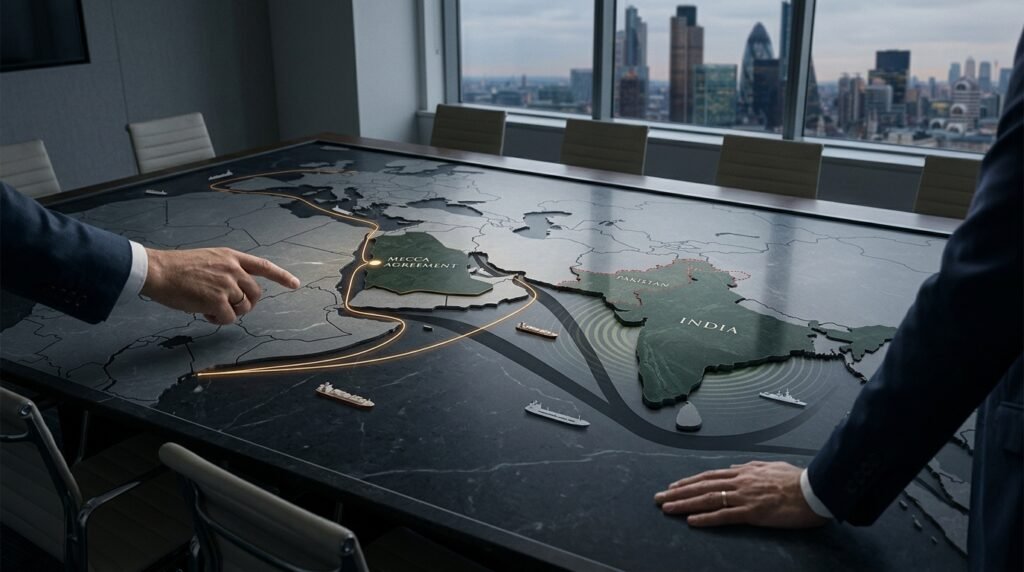
Saudi Arabia, Pakistan and Turkey's Mecca Joint Defence Agreement is reshaping West Asian security. This assessment examines what it means for India's strategic calculus.
Executive Summary
On 7 August 2026, Saudi Arabia, Pakistan and Türkiye signed the Mecca Joint Defence Agreement (also called the Mecca Pact) at Al-Safa Palace in Mecca, formalising a NATO Article 5-style collective-defence arrangement among three of the Muslim world’s most militarily significant states. The pact expands the bilateral Strategic Mutual Defense Agreement (SMDA) that Pakistan and Saudi Arabia signed in September 2025, folding in Türkiye’s NATO-integrated armed forces and expansive drone-manufacturing base. It arrives amid the widening 2026 Iran war, at a moment when Gulf states have grown visibly uneasy about the durability of the American security guarantee.
For India, the agreement is consequential but not, on present evidence, an acute military threat. Its significance lies less in any explicit anti-India clause — the text, still unpublished in full, contains none — than in three second-order effects: it enlarges the diplomatic and material cover available to Pakistan in any future crisis with India; it introduces genuine, if contested, ambiguity around the extension of Pakistan’s nuclear deterrent to a third state; and it signals an accelerating multipolar reordering of West Asia in which India’s own web of relationships — with Saudi Arabia, Israel, the Gulf states and, more distantly, Iran — will require more careful management. New Delhi’s public posture, delivered through the Ministry of External Affairs, has been deliberately measured: acknowledging the pact, promising vigilance, and avoiding characterisation of it as directed against India. This assessment argues that posture is broadly appropriate, while identifying the indicators New Delhi should watch to judge whether the Mecca Agreement evolves from a political declaration into an institutionalised alliance with tangible South Asian consequences.
Key Judgments
- India faces an indirect, diplomatic-political risk rather than an imminent military one. (High confidence) The pact’s language invokes Article 51 of the UN Charter and does not name India as a target; its immediate strategic logic is oriented toward Iran and Israel, not South Asia.
- The pact materially strengthens Pakistan’s regional standing and potential wartime diplomatic cover, without creating a binding obligation on Saudi Arabia or Türkiye to intervene militarily on Pakistan’s behalf against India. (Moderate-to-high confidence) Historical precedent — Pakistan’s non-response to the 2019 Abqaiq attack on Saudi Arabia, and its calibrated, post-ceasefire troop deployment during the 2026 Iran war — suggests all three signatories will interpret “collective defence” narrowly and self-interestedly when a crisis does not touch their core threat perceptions.
- The question of whether Pakistan’s nuclear deterrent now implicitly covers Saudi Arabia remains genuinely unresolved. (Low-to-moderate confidence in any single interpretation) Pakistani officials have given contradictory public statements, and independent analysts are divided on whether this represents extended deterrence, calculated ambiguity, or domestic political theatre.
- Türkiye’s role is the most operationally significant addition for India to monitor, given Ankara’s documented supply of drones and, per Indian government and media claims, technical support to Pakistan during Operation Sindoor in May 2025 — a bilateral relationship that predates and will likely outlast the formal pact. (High confidence on the historical record; moderate confidence on future trajectory)
- Deep and growing India-Saudi economic interdependence — in energy, trade, remittances and diaspora welfare — creates a structural disincentive for Riyadh to allow the pact to be instrumentalised against India. (Moderate-to-high confidence)
- The pact’s ultimate strategic weight will be determined by institutionalisation, not rhetoric — specifically, whether it acquires a permanent headquarters, integrated command arrangements, joint exercises and binding logistics agreements, as opposed to remaining a loose political compact. (High confidence as an analytical framework; the outcome itself remains uncertain)
- India retains multiple levers to hedge against the pact’s risks, including its IORA chairmanship, an expanding India-Israel strategic partnership, bilateral defence and economic diplomacy with Riyadh and Ankara independent of the trilateral structure, and continued efforts to stabilise the China relationship to avoid simultaneous multi-front pressure. (High confidence on the existence of these levers; moderate confidence on their sufficiency)
Introduction
The signing of the Mecca Joint Defence Agreement on 7 August 2026 was, by most accounts, sudden in its timing but not in its logic. It was the culmination of a trajectory that began with the Pakistan-Saudi Strategic Mutual Defense Agreement of September 2025 and accelerated sharply once the 2026 Iran war widened to threaten Gulf oil infrastructure, shipping through the Red Sea and the Bab al-Mandeb Strait, and the broader sense among Gulf and Levantine states that Washington’s security umbrella could no longer be assumed. Saudi Arabia had been struck by Iranian drones after the war’s opening, threatening its oil exports and internal stability, while Türkiye and Pakistan, though less directly exposed to the fighting, were reportedly troubled by the growing regional instability.
Pakistani Prime Minister Shehbaz Sharif travelled to Jeddah on 6 August, performed Umrah in Mecca the following day, and joined Turkish President Recep Tayyip Erdoğan and Saudi Crown Prince Mohammed bin Salman in concluding the agreement. Analysts have noted that Pakistan’s nuclear posture remains oriented toward the perceived threat from India even as it joins this broader Muslim-world security framework, with Turkey and Pakistan contributing established defence industries and Saudi Arabia offering financial and technological capacity.
For India, a country whose western neighbour is now formally bound in mutual-defence arrangements with two other significant military powers, the natural question — and the one this assessment addresses — is whether the Mecca Agreement changes the structural balance of India’s most consequential bilateral rivalry, and if so, how.
Historical Background
India’s concern about a Pakistan-Gulf security nexus is not new. Pakistan and Saudi Arabia have cooperated militarily since the 1960s, formalised through the 1982 Joint Defense Protocol that created the Saudi-Pakistani Armed Forces Organization and saw over 20,000 Pakistani troops stationed in the Kingdom at various points. Former Pakistan Army Chief General Raheel Sharif has commanded the Saudi-led Islamic Military Alliance to Fight Terrorism since 2017. When Saudi oil facilities at Abqaiq and Khurais were struck by drones and missiles in September 2019 — an attack widely attributed to Iran or Iran-aligned forces — Pakistan did not mount a direct military response despite its deep security relationship with Riyadh, a data point analysts continue to treat as instructive.
The September 2025 SMDA between Pakistan and Saudi Arabia marked a qualitative shift: for the first time, the two states committed in writing that an attack on either would be treated as an attack on both, and Pakistani Defence Minister Khawaja Asif suggested — in statements he subsequently contradicted — that Pakistan’s nuclear capability would be made available to Saudi Arabia under the agreement. This ambiguity, deliberate or not, has persisted into the Mecca Agreement.
The more immediately relevant precedent for India, however, is Operation Sindoor. Following the 22 April 2025 terrorist attack in Pahalgam that killed 26 people, India conducted precision strikes on 7 May 2025 against nine sites in Pakistan and Pakistan-occupied Jammu and Kashmir. During the four-day exchange that followed, Pakistan’s military reportedly used 300–400 drones on the nights of 7–8 May to target Indian military infrastructure along the northern and western borders, according to Indian Army officials. Indian government sources and media outlets subsequently reported that Türkiye had supplied more than 350 drones and provided operational coordination to Pakistan during the conflict, with two Turkish operatives reportedly killed during India’s campaign. Whatever the precise scale of that assistance, the episode established — well before the Mecca Agreement’s existence — that Ankara is prepared to provide material support to Islamabad in a crisis with India. This is the essential historical backdrop against which the trilateral pact must be read: for Turkey and Pakistan, an operational defence relationship already existed; the Mecca Agreement formalises and potentially deepens it, while adding Saudi Arabia’s financial weight to the equation.
Strategic Context
The Mecca Agreement did not emerge in a vacuum. It is a direct product of the 2026 Iran war, which began with Israeli strikes on Iranian military and nuclear sites and expanded to draw in Gulf states whose territory, airspace and shipping lanes came under threat. The pact represented the first major defense decision by a Gulf Arab country following an Israeli strike on Qatar, and the U.S. State Department notably declined to respond to press questions about it — an absence widely read across the region as evidence of Washington’s diminished willingness or capacity to guarantee Gulf security unilaterally.
Structurally, the agreement is more developed than a symbolic declaration but considerably less developed than NATO. Its ultimate character will depend on implementation: a permanent headquarters, contingency planning, joint exercises, logistics agreements and integrated surveillance would indicate an emerging genuine alliance, whereas occasional meetings and arms deals would suggest a looser political compact. Turkish Foreign Minister Hakan Fidan has stated that the pact will function similarly to NATO, with a ministerial committee, political and military committees, and a permanent secretariat overseeing implementation — though as of this writing, none of these institutions has been fully stood up, and the full treaty text has not been publicly released.
The pact is also, notably, not static. Bangladesh’s Foreign Affairs Adviser indicated in August 2026 that Dhaka maintains a positive approach toward joining a potential economic or defence framework involving Saudi Arabia, Pakistan and Turkey, while Syria’s foreign minister said Damascus was considering whether to join or cooperate with the agreement during a visit to Pakistan later that month. Should the bloc expand to include additional states along an axis stretching from the eastern Mediterranean to South Asia, its cumulative weight — and the diplomatic complexity it poses for India — would grow correspondingly.
For New Delhi, this strategic context matters as much as the pact’s text. India is simultaneously managing an intensifying strategic partnership with Israel, a deepening but still fragile stabilisation process with China along the Line of Actual Control, and a historically productive but newly complicated relationship with Saudi Arabia and the wider Gulf. The Mecca Agreement inserts itself into all three relationships at once, which is precisely why Indian officials have chosen to respond with calculated ambiguity rather than alarm.
Detailed Analysis
Military Dimension
Militarily, the Mecca Agreement combines three distinct sets of capabilities: Pakistan’s nuclear-armed, India-focused conventional military; Türkiye’s NATO-standard planning experience and large-scale drone and defence-industrial base; and Saudi Arabia’s financial resources and growing appetite for defence-technology investment. The combination is more institutionalised than a symbolic declaration but represents a partnership between states with capable militaries rather than a fully integrated command structure.
The central military question for India is whether this partnership meaningfully increases the material or diplomatic cost of any future India-Pakistan confrontation. On the material side, the honest answer is: not dramatically, at least not yet. Turkish drone and technical support to Pakistan is already a known, demonstrated quantity from Operation Sindoor — the Mecca Agreement formalises rather than creates that channel. Saudi Arabia has historically been a financier rather than a combatant in Pakistan’s conflicts with India, and nothing in the public record suggests Riyadh intends to change that pattern. Indeed, Pakistan’s own conduct during the 2026 Iran war is instructive: despite the SMDA’s mutual-defence language, Pakistan deployed roughly 8,000 troops, a squadron of mostly JF-17 fighter jets, and an HQ-19 air defense system to Saudi Arabia only after a ceasefire had already been reached, having spent much of the crisis attempting to preserve its role as a mediator between Tehran and Washington rather than committing forces during active hostilities.
On the diplomatic-military side, the risk is more real. In any future India-Pakistan crisis, Islamabad will almost certainly attempt to invoke the Mecca framework — rhetorically, at a minimum — to internationalise the dispute, seek diplomatic cover from Riyadh and Ankara, and complicate India’s efforts to keep the conflict bilateral. Regional analysts anticipate that Pakistan will try to project and use the pact as a buffer in future tensions with India, particularly given the lessons Islamabad drew from Operation Sindoor. Whether Saudi Arabia and Türkiye would translate that rhetorical support into material assistance — arms transfers, financing, drone supplies beyond what Turkey already provides bilaterally — is the more consequential and more uncertain question.
Political Dimension
Politically, the Mecca Agreement has generated a wider spread of reactions internationally than India’s own has suggested. The agreement has raised concerns not only in India but also in Israel and Greece, and its viability as a close, functioning military alliance is questioned by regional analysts given the signatories’ divergent threat perceptions, their competition for leadership within the Sunni Muslim world, and the complicated relationships both Turkey and Pakistan separately maintain with Iran.
India’s official response has been notably restrained. Ministry of External Affairs spokesperson Randhir Jaiswal described the government’s posture as one of examining the pact’s implications from the standpoint of national security and regional peace and stability, while committing that India would take all necessary measures to safeguard its national interests — a formulation that, in diplomatic terms, gives little away. Saudi Arabia, for its part, issued a separate statement asserting that the arrangement does not amount to a military axis or a religious bloc, is not linked to nuclear activity or an arms race, and is aimed at building sustainable, self-reliant capabilities without disturbing the Kingdom’s existing strategic relationships at the Gulf, Arab and international levels. That disclaimer is significant: Riyadh has strong incentives, discussed further below, to prevent the pact from being read in New Delhi as a hostile bloc.
A parallel and revealing episode occurred when Turkish and Pakistani media outlets circulated reports that India had urgently approached Israel for a reciprocal bilateral defence pact in response to the Mecca Agreement. India’s Ministry of External Affairs Fact Check unit moved quickly to dismiss these reports as fabricated, even as the spokesperson confirmed that New Delhi was closely following the trilateral deal’s development. This episode illustrates both the information-environment risk India faces — where the pact becomes a vehicle for exaggerated claims about Indian counter-moves — and the underlying reality that India-Israel strategic cooperation continues to deepen on its own trajectory, reinforced rather than caused by the Mecca Agreement.
Within India’s own strategic community, reactions have run considerably hotter than the government’s official line, with commentators increasingly using the “Islamic NATO” framing to describe the pact. That gap between public alarm and official caution is itself analytically significant: it suggests the government’s assessment, at least as of this writing, is that the pact does not yet warrant a more forceful diplomatic response, while leaving room to escalate that response if the pact institutionalises further.
Economic Dimension
The economic relationship between India and Saudi Arabia is the strongest structural check on the Mecca Agreement being turned against Indian interests, and it deserves close attention. Saudi Arabia remains one of India’s largest crude oil suppliers, with bilateral trade reaching roughly USD 41.88 billion in fiscal year 2024-25 — Indian exports of about USD 11.76 billion against imports of USD 30.12 billion — making India Saudi Arabia’s second-largest trading partner and Saudi Arabia India’s fifth-largest. India imported 33.35 million metric tonnes of crude oil from Saudi Arabia in FY 2023-24, accounting for 14.3 percent of India’s total crude oil imports, while Saudi Arabia was India’s third-largest LPG sourcing destination, supplying 18.2 percent of India’s LPG imports.
The relationship extends well beyond hydrocarbons. India-GCC bilateral trade reached USD 178.56 billion in FY 2024-25, accounting for over 15 percent of India’s global trade, and the two sides formally launched negotiations toward a free trade agreement after finalising terms of reference in February 2026. Close to ten million Indians reside in GCC countries, and remittances from Indians in the GCC accounted for nearly 38 percent of India’s total inward remittances of USD 52.44 billion in FY 2024-25. Roughly 2.5 million Indian migrant workers reside in Saudi Arabia alone as of 2024, forming one of the Kingdom’s largest expatriate communities and a significant component of its non-oil private-sector labour force.
Institutionally, this relationship has been actively deepening even as the Mecca Agreement was being negotiated and signed. Bilateral defence cooperation includes the Al Mohed Al Hindi naval exercise and SADA TANSEEQ army exercise; a new Ministerial Committee on Defence Cooperation was announced in April 2025; India and Saudi Arabia signed a mutual visa exemption pact for diplomatic and official passport holders in December 2025; and both governments reaffirmed their commitment to an early bilateral investment treaty in November 2025. This is not the profile of a relationship Riyadh has any evident interest in subordinating to Pakistan’s rivalry with India. Realist logic — the same framework Saudi Arabia itself invoked in disclaiming any anti-India intent — suggests Riyadh’s economic and strategic interests in India are simply too substantial to sacrifice for Islamabad’s benefit in a crisis that does not directly implicate Saudi security.
Technological Dimension
The most consequential technological vector in the Mecca Agreement, from an Indian standpoint, is Turkish unmanned systems technology. Türkiye has built one of the world’s more prolific drone-export industries, and its transfer of platforms and expertise to Pakistan is already documented from Operation Sindoor, when Pakistan reportedly deployed Turkish-made Songar armed drones and other systems against Indian military and civilian targets, all of which Indian air defences intercepted and neutralised. India’s own response has already begun: Chief of Defence Staff General Anil Chauhan has stated that Operation Sindoor underscored the critical importance of indigenous counter-unmanned aerial systems, arguing that dependence on foreign technology weakens preparedness and that India must invest in building its own capabilities.
Under the Mecca framework, the technological risk is one of scale and sophistication rather than novelty: Saudi financing could accelerate joint Pakistani-Turkish drone and missile development, and closer institutional ties could smooth technology transfer that might otherwise move more slowly through purely bilateral channels. This is a trend to monitor rather than a discrete new threat, since the underlying technological relationship predates the trilateral pact.
Legal / Diplomatic Dimension
Legally, the Mecca Agreement is framed, according to Pakistani officials, as an exercise of the inherent right of self-defence under Article 51 of the UN Charter, explicitly open to accession by other states committed to regional peace and stability, and not directed against any specific country. The absence of a published treaty text complicates independent legal assessment; much of what is publicly known — including the NATO Article 5 comparison — derives from official statements rather than the agreement’s actual language.
Diplomatically, India has multiple channels through which to manage the fallout. As current chair of the Indian Ocean Rim Association (IORA), India retains a platform for promoting inclusive, non-bloc-based regional security cooperation as an implicit alternative to the Mecca framework’s more exclusive logic. India has simultaneously continued dialogue with China through mechanisms such as the Working Mechanism for Consultation and Coordination on India-China border affairs, whose 36th meeting in New Delhi on 6 August 2026 — the day before the Mecca Agreement was signed — reviewed the border situation and reaffirmed commitments to peace and tranquillity along the Line of Actual Control. This parallel diplomacy matters: India’s core strategic interest is avoiding a scenario in which pressure from Pakistan’s western partnerships coincides with unresolved tension on its northern border.
Scenario Analysis
Scenario One: Declaratory Compact. The Mecca Agreement remains largely symbolic — periodic ministerial meetings, arms deals, and diplomatic solidarity statements, but no permanent headquarters, integrated command, or binding operational commitments. Pakistan gains diplomatic cover and modest prestige; India’s practical security environment changes little.
Scenario Two: Institutionalisation Focused on West Asia. The pact develops genuine institutional depth — a functioning secretariat, joint exercises, integrated air and missile defence planning — but its operational focus remains anchored in deterring Iran and Israel-related threats to Gulf and Turkish territory. Pakistan benefits from technology transfer and financial support that indirectly strengthens its position vis-à-vis India, but the pact’s activation mechanisms are not triggered by South Asian contingencies.
Scenario Three: Crisis Invocation Without Material Intervention. In a future India-Pakistan crisis, Islamabad formally or informally invokes the Mecca framework to seek diplomatic solidarity, financial support and possibly expedited arms transfers from Riyadh and Ankara, but Saudi Arabia and Türkiye — consistent with their historical pattern of narrow, self-interested threat assessment — decline direct military involvement, offering rhetorical and diplomatic backing rather than combat support.
Scenario Four: Extended Deterrence Consolidation. The ambiguity around Pakistan’s nuclear umbrella hardens into an explicit or widely assumed extension of deterrence to Saudi Arabia, formalising what several analysts have already flagged as a live possibility. This would represent the most consequential outcome for the broader regional nuclear order, prompting responses from Israel and complicating India’s own nuclear signalling calculus, even though Pakistan’s declared doctrine continues to treat India as the primary target of its arsenal.
Probability Assessment
| Scenario | Qualitative Probability (12–24 month horizon) |
|---|---|
| Declaratory Compact | Moderate |
| Institutionalisation Focused on West Asia | Moderate to High |
| Crisis Invocation Without Material Intervention (conditional on an India-Pakistan crisis occurring) | High |
| Extended Deterrence Consolidation | Low |
These assessments carry meaningful uncertainty. The absence of a published treaty text, the contradictory statements already issued by Pakistani officials on the nuclear question, and the fluid state of the broader 2026 Iran war all mean that the pact’s trajectory could shift more quickly than this assessment anticipates. The probability estimates should be revisited as institutional indicators — a permanent secretariat, joint exercises, accession by additional states such as Bangladesh or Syria — become clearer.
Strategic Outlook
India’s optimal posture combines vigilance with restraint. Escalatory rhetoric from New Delhi would do little to alter the pact’s trajectory and risks validating an oversimplified “Islamic NATO versus India” framing that some regional media have already adopted. The more productive strategic outlook rests on several parallel tracks:
First, India should continue deepening bilateral defence and economic ties with Saudi Arabia specifically, reinforcing the structural interdependence that gives Riyadh a strong incentive to keep the Mecca framework from being read as anti-India. The ongoing FTA negotiations, the prospective bilateral investment treaty, and expanded defence exercises all serve this purpose.
Second, India should continue to invest in indigenous counter-drone and integrated air defence capabilities, given the demonstrated role of Turkish-supplied systems in Pakistan’s arsenal during Operation Sindoor — a vulnerability likely to persist and potentially deepen regardless of the Mecca Agreement’s own evolution.
Third, India’s expanding strategic partnership with Israel should proceed on its own merits and timeline, without being cast — inaccurately, per India’s own official denials — as a reactive counter-pact. Overt bloc-formation in response to the Mecca Agreement would risk the same institutionalised polarisation that a more patient, multi-vector approach can avoid.
Fourth, continued stabilisation of the China relationship along the LAC remains a strategic precondition for managing any western-front complications, since India’s least favourable scenario is simultaneous pressure on two fronts.
Finally, India should monitor the specific institutional indicators identified in the scenario analysis above — permanent headquarters, joint exercises, binding logistics agreements, and further accessions — as the clearest signals of whether the Mecca Agreement is evolving toward Scenario Two or Scenario Four, both of which would warrant a more assertive Indian diplomatic and military response than is presently indicated.
Conclusion
The Mecca Agreement is a genuine and consequential development in West Asian and, by extension, South Asian security architecture. It does not, on the evidence available as of August 2026, constitute an imminent military threat to India: its text invokes self-defence rather than aggression, its principal strategic logic responds to the Iran war rather than to India-Pakistan tensions, and its signatories have historically shown themselves reluctant to translate mutual-defence rhetoric into material intervention in disputes that do not touch their own core interests. Where the pact does matter for India is in the diplomatic and psychological terrain of any future crisis with Pakistan, in the unresolved ambiguity surrounding nuclear extended deterrence, and in the broader signal it sends about an accelerating, more multipolar regional order in which India’s own carefully balanced relationships — with Saudi Arabia, Israel, Türkiye and China alike — will require sustained and skilful management. India’s calibrated official response reflects an accurate reading of these stakes. The task ahead is not alarm, but disciplined, indicator-based vigilance.
Frequently Asked Questions
What is the Mecca Agreement, and who signed it? The Mecca Joint Defence Agreement is a collective-defence pact signed on 7 August 2026 by Saudi Arabia, Pakistan and Türkiye, committing each signatory to treat an armed attack on any one of them as an attack on all three, in language modelled on NATO’s Article 5.
Does the Mecca Agreement extend Pakistan’s nuclear umbrella to Saudi Arabia? This remains unresolved and contested. Pakistani officials have made contradictory statements, at times suggesting Pakistan’s nuclear capability would be made available to Saudi Arabia and at other times denying nuclear weapons are part of the arrangement. Independent analysts remain divided on the question.
How has India officially responded to the Mecca Agreement? India’s Ministry of External Affairs has described the government as examining the pact’s implications from a national-security and regional-stability perspective, while stating it will take all necessary measures to safeguard its interests — a deliberately measured, non-alarmist response.
Could Pakistan invoke the Mecca Agreement in a future conflict with India? Pakistan would very likely attempt to invoke the pact diplomatically to seek international cover in a future crisis with India, but historical precedent suggests Saudi Arabia and Türkiye are unlikely to translate that solidarity into direct military intervention unless their own core interests are threatened.
How does the Mecca Agreement affect India-Saudi Arabia relations? Saudi Arabia has explicitly stated the pact is not a military axis or bloc directed at any country, and the deep economic interdependence between India and Saudi Arabia — spanning energy, trade, remittances and a multi-million-strong diaspora — gives Riyadh a strong structural incentive to preserve its relationship with New Delhi independent of the trilateral framework.
Suggested Internal Links
- Pakistan-Saudi Strategic Mutual Defense Agreement: A Precursor Analysis (September 2025)
- Operation Sindoor and the Turkish Drone Question: Reassessing Pakistan’s Unmanned Systems Capability
- The 2026 Iran War and the Fragmentation of the US-Led Gulf Security Order
- India-Israel Strategic Partnership in a Multipolar Middle East
- Nuclear Ambiguity and Extended Deterrence in South Asia and the Gulf
Sources
- Lowy Institute, “The Mecca Pact redraws the Indo-Pacific’s western edge” — lowyinstitute.org
- Wikipedia, “Mecca Joint Defence Agreement” — en.wikipedia.org
- Institute for National Security Studies (INSS), “The Mecca Agreement: Real Substance or Mere Intent?” — inss.org.il
- Council on Foreign Relations, “The U.S.-Led Middle East Order Is Over. The Mecca Agreement Proves It.” — cfr.org
- The Jerusalem Post, “Defense pact between Saudi Arabia, Turkey, Pakistan will boost India-Israel ties” — jpost.com
- The Diplomat, “Mecca Joint Deterrence Agreement: Implications for India” and “What Are the Implications of the Mecca Pact for India?” — thediplomat.com
- Atlantic Council, “Why Saudi Arabia, Pakistan, and Turkey just signed a defense pact” — atlanticcouncil.org
- Foreign Policy, “What Does the Mecca Pact Deliver Pakistan?” — foreignpolicy.com
- University of Michigan News, “Beyond India-Pakistan: What the Mecca defense pact reveals about a changing security order” — news.umich.edu
- Outlook India, “India Examines Mecca Defence Pact’s Impact On National Security, Regional Stability” — outlookindia.com
- CSIS Nuclear Network, “All Military Means? Pakistan, Saudi Arabia, and the Risks of Nuclear Ambiguity” — nuclearnetwork.csis.org
- NBC News, “Saudi Arabia signs mutual defense pact with nuclear-armed Pakistan” — nbcnews.com
- India Brand Equity Foundation (IBEF), “Exploring India Saudi Arabia Trade and Economic Relations” — ibef.org
- Embassy of India, Riyadh, “India-GCC relations” — eoiriyadh.gov.in
- Consulate General of India, Jeddah, “India-Saudi Arabia Bilateral Relations” — cgijeddah.gov.in
- Business Today, “Turkey helped plan drone strikes on India, sent military operatives to Pakistan: Sources” — businesstoday.in
- Deccan Herald, “The role Turkey played in India-Pakistan tensions: from backing Islamabad to supplying drones” — deccanherald.com