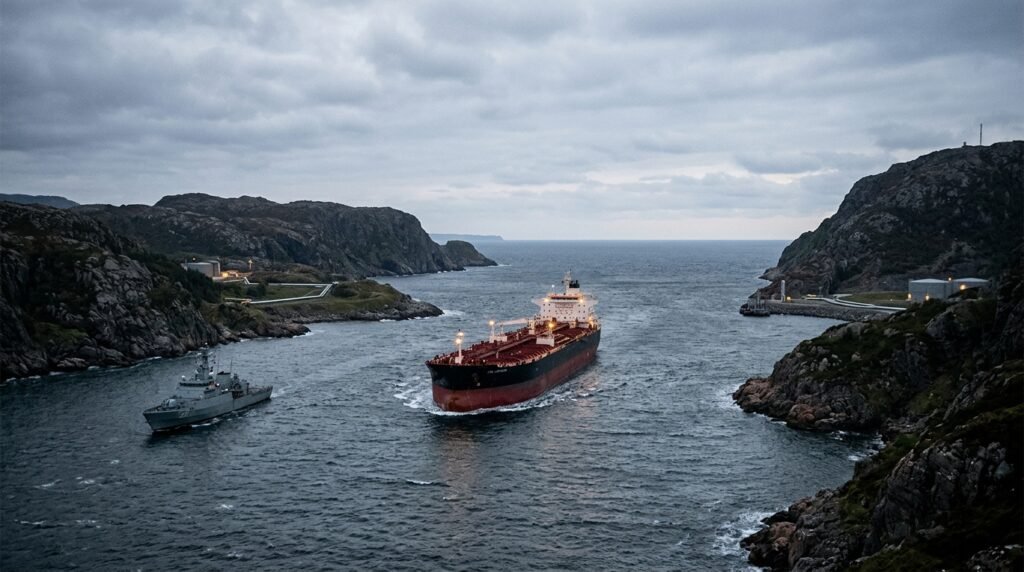
Strangled at the Chokepoints: Saudi Oil Exports and the Wartime Advance of the Petro-Yuan
Iran's Hormuz blockade and a Houthi siege of the Red Sea route are squeezing Saudi oil exports, accelerating China's petro-yuan push. A strategic assessment.
Executive Summary
Since 28 February 2026, the war between the United States, Israel, and Iran has subjected Saudi Arabia’s oil export system to a stress test with no recent precedent: a near-simultaneous squeeze on both of the kingdom’s viable maritime outlets. Iranian mining, tanker seizures, and missile attacks have reduced transit through the Strait of Hormuz to a fraction of its pre-war volume, while a Houthi maritime embargo declared in July 2026 has placed the East-West Pipeline’s Red Sea terminus at Yanbu — Riyadh’s principal relief valve — under direct threat. The result is not a clean binary of “exports strangled” or “exports normal,” but a partial, fluctuating constriction that has cut Saudi crude output by roughly 2 to 3 million barrels a day at its worst points while global prices have risen sharply enough to soften, though not eliminate, the fiscal damage.
This disruption has become the accelerant, not the origin, of a longer-running contest over how oil is priced and paid for. Iran, unable to clear dollar transactions under sanctions, has for years relied on yuan-denominated and intermediated settlement with China; during 2026 it went further, conditioning limited tanker passage through Hormuz on payment in Chinese yuan or stablecoins — turning a physical chokepoint into a currency-enforcement mechanism. China’s cross-border yuan payment infrastructure, particularly the Cross-Border Interbank Payment System (CIPS) and the multi-central-bank digital currency platform mBridge, in which Saudi Arabia’s own central bank participates, has grown rapidly through the crisis. Yet the aggregate data are more sobering for proponents of a “petro-yuan revolution”: the renminbi’s share of global official reserves remains near 2 percent, and the dollar continues to dominate oil invoicing and global currency turnover. This assessment examines the military, political, economic, technological, and legal-diplomatic dimensions of the crisis, and concludes that the war has meaningfully advanced yuan-based settlement at the margins of the Gulf-Asia oil trade without yet producing a structural break from dollar primacy.
Key Judgments
- KJ-1: The 2026 Iran war has produced a genuine two-front constriction of Saudi oil exports — Iranian action against Hormuz and Houthi threats against the Red Sea corridor — that has measurably reduced Saudi export volumes despite substantial pipeline redundancy. (High confidence)
- KJ-2: Elevated global oil prices have partially, but incompletely, offset Saudi Arabia’s revenue losses, producing a fiscal “windfall paradox” in which Riyadh’s budget outcome depends heavily on a war it does not control. (High confidence)
- KJ-3: Iran and China have moved from indirect sanctions-evasion settlement toward explicit currency coercion at a physical chokepoint, conditioning tanker transit on yuan or stablecoin payment. This is a qualitative escalation in the financial dimension of the conflict. (Moderate-to-high confidence)
- KJ-4: Saudi Arabia’s own movement toward yuan-denominated settlement remains gradual, voluntary, and hedging-oriented; no formal bilateral “petrodollar agreement” with the United States ever existed to lapse, and Riyadh has not renounced dollar pricing as its default convention. (High confidence)
- KJ-5: Notwithstanding rapid percentage growth in yuan settlement infrastructure (CIPS transaction records, mBridge expansion), the renminbi’s share of global reserves and oil-trade invoicing remains marginal in absolute terms, indicating a corridor-specific rather than systemic shift. (High confidence)
- KJ-6: China’s strategic petroleum reserves, continued discounted Iranian imports, and administrative restraint on refined-product exports have cushioned it from the worst of the price shock, reducing Beijing’s urgency to force a rapid currency transition. (Moderate confidence)
- KJ-7: A scenario in which both Hormuz and Bab el-Mandeb are closed simultaneously for a sustained period would impose materially different — and larger — costs on Saudi Arabia than the current intermittent disruption, and would likely accelerate, without completing, the shift toward alternative settlement currencies. (Moderate confidence)
- KJ-8: Saudi Arabia’s dual position as a US-aligned belligerent and a strategic hedger toward Beijing constrains how far currency diversification can proceed without jeopardizing its core security relationship with Washington. (Moderate confidence)
Introduction
“Petrodollar” and “petro-yuan” are shorthand for a deeper structural question: which state’s currency underwrites the largest physically traded commodity market in the world, and what follows from that underwriting. The 1974 arrangement between Washington and Riyadh — dollar-denominated oil sales in exchange for security guarantees and reinvested surpluses — was never codified in a single public treaty, but it became the load-bearing convention of the postwar international monetary order, reinforcing dollar demand long after the gold-exchange standard collapsed. China’s attempt to construct a parallel system, dated symbolically to the 2018 launch of yuan-denominated crude futures on the Shanghai International Energy Exchange, has proceeded in fits and starts for nearly a decade.
The 2026 Iran war has compressed years of gradual de-dollarization pressure into a single, acute case study. It has done so specifically through Saudi Arabia, whose export infrastructure sits at the center of both stories: the kingdom is simultaneously the country with the most to lose from a closed Strait of Hormuz and the Gulf state China has most assiduously courted as a partner in yuan settlement. This assessment asks three linked questions. First, how severely, and through what mechanisms, have Saudi oil exports actually been constrained. Second, how has that constraint interacted with the parallel financial contest between the dollar and the yuan. Third, what does the evidence to date imply about the trajectory of both — separating verified fact, reasoned analysis, and forward-looking forecast throughout.
Historical Background
The dollar’s role in oil markets predates any single agreement. Sterling-dominated oil trade gave way to dollar pricing as American oil majors and the Bretton Woods system shaped global commodity markets after 1945. The critical reinforcement came after the 1971 collapse of dollar-gold convertibility, when Washington and Riyadh converged — through a series of understandings rather than one binding pact — on Saudi Arabia’s continued willingness to sell oil in dollars and recycle its surpluses into American assets, in exchange for defense cooperation. No single 50-year contract expiring in 2024 has ever been publicly produced; fact-checking organizations have consistently found no evidence of such a document, and the “expired petrodollar deal” narrative that circulated on social media in 2024 was substantially a myth built on a real, but informal and multidimensional, strategic relationship.
China’s counter-architecture developed more deliberately. The 2018 launch of yuan-denominated crude oil futures on the Shanghai exchange was explicitly framed as a long-term internationalization strategy. Beijing’s diplomatic push accelerated after Russia’s 2022 invasion of Ukraine and subsequent exclusion from dollar clearing, which pushed Moscow toward yuan settlement for its energy exports to China and demonstrated to other producers that a non-dollar channel was operationally viable. Xi Jinping’s December 2022 visit to Riyadh, which included the first China-Arab States Summit and China-GCC Summit, produced a public commitment to fuller use of the Shanghai Petroleum and Natural Gas Exchange for renminbi-denominated settlement, alongside a reported $7 billion currency swap agreement between the two countries’ central banks. Saudi Arabia’s central bank subsequently became one of five participating institutions — alongside the People’s Bank of China, the Hong Kong Monetary Authority, the Bank of Thailand, and the Central Bank of the UAE — in Project mBridge, the multi-central-bank digital currency platform that has since become the principal wholesale infrastructure for cross-border yuan settlement in the Gulf.
Iran’s relationship to non-dollar settlement is structurally different and considerably older. Sanctions imposed after the 2018 US withdrawal from the Joint Comprehensive Plan of Action cut Iran off from dollar-clearing correspondent banking, forcing its oil exports — overwhelmingly to China — into a shadow architecture of intermediated, discounted, non-dollar transactions. The 2021 Iran-China 25-year cooperation agreement formalized this arrangement, reportedly securing several hundred billion dollars of below-market crude sales in exchange for Chinese investment and security cooperation. By the time the 2026 war began, Iran had little dollar exposure left to lose in its oil trade and every incentive to weaponize whatever leverage remained — chief among it, physical control of the Strait of Hormuz.
Strategic Context
The war began on 28 February 2026 with US and Israeli strikes on Iranian nuclear, missile, and leadership targets, an operation Washington termed Operation Epic Fury. Iran’s retaliation centered on the one asset it could not lose through airstrikes alone: control of the sea. The Islamic Revolutionary Guard Corps Navy laid mines, boarded and attacked commercial vessels, and asserted Iranian sovereignty over the Strait of Hormuz, through which roughly a quarter to a third of the world’s seaborne oil trade and a fifth of its liquefied natural gas had transited before the war. Shipping through the strait fell to a near-standstill for extended periods over the following months, punctuated by short-lived ceasefires — an initial truce on 7-8 April, a US naval blockade of Iran from 13 April after the Islamabad Talks failed to produce a settlement, and the Islamabad Memorandum of 14-17 June, which briefly lifted both blockades before Iran reasserted closure on 20 June, citing continued Israeli strikes in Lebanon. The memorandum collapsed definitively on 8 July after Iranian forces attacked three commercial vessels that had used a pre-approved bypass route.
Saudi Arabia’s structural advantage — and the reason the kingdom did not face the same near-total export halt as Iran, Iraq, Kuwait, and Qatar — is the Abqaiq-Yanbu system, commonly called the East-West Pipeline or Petroline, which carries crude from the Eastern Province across the peninsula to the Red Sea port of Yanbu, entirely bypassing Hormuz. Aramco’s chief executive stated in March 2026 that the company was ramping the pipeline toward its upgraded capacity of roughly 7 million barrels a day, of which approximately 5 million barrels a day could be dedicated to export once regional refinery needs were met — enough, in principle, to sustain around 70 percent of the kingdom’s pre-war export volume. That redundancy is precisely why Saudi Arabia, unlike Iran, retained meaningful optionality throughout the crisis, and precisely why its Red Sea outlet became the next target.
That second front opened in July 2026. Israeli strikes on Iran’s power grid on 17 July reportedly triggered instructions to Iran’s Houthi allies in Yemen to close the Red Sea corridor; on 20 July, the Houthis declared a maritime embargo against Saudi Arabia, banning vessels from loading or discharging cargo at Saudi ports and threatening tankers carrying Saudi crude anywhere within their operational reach. Ship-tracking data showed an immediate decline in Bab el-Mandeb transits, with several tankers carrying Saudi cargo turning back rather than risk the strait. By late July, Saudi Arabia was routing an estimated 70 percent of its oil exports through the Red Sea route — precisely the volume the Houthi embargo now threatened — prompting Riyadh to convene a more than 40-country naval coalition on 30 July aimed at securing both the Strait of Hormuz and Bab el-Mandeb. As of mid-September 2026 — day 199 of the war by open-source tracking — fighting continues in both theaters: Brent crude traded near $107 a barrel, Hormuz transit volumes were described as being in the single digits as a share of pre-war norms, and a tanker was struck near Hengam Island, underscoring that neither chokepoint has been durably secured.
Detailed Analysis
Military Dimension
The military logic of the crisis rests on asymmetry. Iran cannot match US and Israeli airpower, but it can impose costs disproportionate to its conventional strength by threatening a chokepoint that carries a fifth of the world’s oil and gas. Its tools have been low-cost and difficult to fully neutralize: naval mines, fast-attack boats, anti-ship missiles, and selective boarding operations that impose a “toll” for safe passage. The United States responded with an aerial campaign beginning 19 March 2026 aimed at destroying Iranian naval assets and drone-launch capability, later escalating to strikes on Larak Island — used by Iran to monitor strait traffic — and, from late August, a systematic mine-clearing operation that reportedly cleared international shipping lanes of Iranian mines by the end of the month. Washington also adopted an explicit reciprocity doctrine by early September: for every Iranian attack on a tanker in the strait, US forces would target an Iranian tanker in response, a policy intended to raise the cost of continued harassment without escalating to a full blockade-for-blockade exchange.
The opening of the Houthi front in July added a second, geographically distinct military problem. Unlike Hormuz, where Iran’s own navy directly controls the chokepoint, Bab el-Mandeb is contested by a non-state actor with a demonstrated, multi-year track record (since the Gaza-linked Red Sea attacks that began in 2023) of sustaining low-intensity but commercially disruptive maritime interdiction. Iran’s ability to activate this front on a matter of days — reportedly in direct response to Israeli strikes on Iranian infrastructure — illustrates how thoroughly Tehran’s regional proxy network functions as an extension of its own deterrence posture, allowing it to answer strikes on the Iranian mainland with pressure on Saudi and allied shipping without any additional exposure of Iranian territory. The Saudi-led 40-country naval coalition announced on 30 July represents an attempt to internationalize the burden of chokepoint security, echoing (though at larger scale) the International Maritime Security Construct and European naval missions assembled during the 2023-2025 Red Sea crisis; its practical effectiveness against mine warfare and swarm-drone tactics remains, as of this writing, unproven.
Political Dimension
Saudi Arabia enters this conflict not as a neutral bystander but as a co-belligerent aligned with the United States, Israel, the UAE, Kuwait, and Bahrain against Iran and its Axis of Resistance network. This alignment is politically consequential for the currency question examined later in this assessment: a state actively relying on US and allied military cooperation for its own security is structurally constrained in how far it can pursue financial diversification that Washington might read as strategic defection. At the same time, the war has reopened old wounds with the Houthis, ending roughly four years of relative calm that had held since the 2022 UN-brokered truce in the Yemeni civil war, and has strained Saudi Arabia’s relations even with erstwhile mediators — Riyadh’s objection to proposed amendments to the Iran-Oman transit-corridor arrangement caused the postponement, without a rescheduled date, of a planned September ministerial meeting between the six Gulf Cooperation Council states and Iran in Salalah.
A further political complication concerns command and control on the Iranian side. Reporting attributes the July attacks that collapsed the Islamabad Memorandum to hardline elements acting without authorization from President Masoud Pezeshkian, the IRGC’s own command structure, or the Supreme National Security Council, with Iranian internal investigations reportedly tracing responsibility to a specific senior cleric. If accurate, this suggests that Iran’s negotiating leadership does not have full operational control over the forces capable of reopening or closing the strait — a factionalized command structure that makes any negotiated de-escalation inherently fragile, since a settlement acceptable to Pezeshkian’s government may not bind hardline factions with independent access to mines and missile boats. Pakistan’s mediating role, including the earlier Islamabad Talks and its joint peace initiative with China in March 2026, reflects a broader pattern — also visible in the August 2026 Mecca Joint Defence Agreement between Saudi Arabia, Pakistan, and Turkey — of Islamabad positioning itself as a diplomatic and security intermediary across Gulf-Iran tensions.
Economic Dimension
The economic story is one of partial, asymmetric compensation rather than clean catastrophe or clean windfall. Saudi crude production, which had been running near 10 million barrels a day under the OPEC+ framework before the war, fell to approximately 6.9 million barrels a day by April 2026 as pipeline capacity constraints — and, in some cases, deliberate voluntary cuts by Saudi Arabia, the UAE, Kuwait, and Iraq to avoid overfilling onshore storage once port loading slowed — bit into output. Simultaneously, Brent crude prices, which had averaged only $61-66 a barrel in 2025, spiked above $100 in March, touched an intraday peak near $128 in early April, and have oscillated in a $90-$128 range through September, most recently near $107. The interaction of these two forces produced a distinctive fiscal pattern: Saudi Arabia recorded its largest-ever quarterly budget deficit in the first quarter of 2026 — roughly $33.5 billion, consuming an estimated three-quarters of its entire annual deficit projection in just three months — because the volume collapse initially outpaced the price gain, even as military spending rose by roughly a quarter and consumer subsidies nearly tripled year-on-year. By the second quarter, as Red Sea rerouting matured and oil revenue rose by an estimated 22 percent year-on-year, the deficit narrowed by close to three-quarters even as real GDP contracted, since GDP measures physical oil output rather than the price at which it sells. The IMF’s own June 2026 Article IV assessment concluded that higher prices are likely to offset volume losses over the year as a whole, generating a net fiscal windfall relative to the original 2026 budget assumptions — but one arriving alongside sharply elevated wartime expenditure, and one entirely contingent on a conflict Riyadh does not control and would prefer to end.
Independent estimates place Saudi Arabia’s fiscal breakeven oil price — the level at which the budget balances — somewhere between $80 and $96 a barrel on a narrow basis, and as high as $113 once full domestic investment spending under Vision 2030 is included; hydrocarbon revenue still accounts for roughly 60 percent of government income and about 40 percent of GDP despite years of diversification effort. This means the current $100-plus price environment is fiscally favorable in isolation, but the underlying volume disruption, elevated wartime spending, and uncertainty over how long the windfall will last complicate any simple reading of Saudi Arabia as a net beneficiary of the war. Aramco’s own leadership has been explicit that continued disruption threatens what it has called potentially catastrophic consequences for global energy markets should the conflict extend further, even as the company’s reported profits have benefited from the combination of higher prices and continued Red Sea-routed exports. On the demand side, China — the marginal buyer whose behavior shapes the global balance — has drawn down commercial oil inventories at a moderate pace (averaging roughly 700,000 barrels a day through the summer, well below the headline size of its estimated 1.3-1.4 billion barrel strategic and commercial reserve), restricted exports of refined products to preserve domestic supply, and allowed refinery throughput to fall from more than 15 million barrels a day to roughly 12.5 million, a contraction analysts have identified as the largest single driver of a broader Chinese industrial slowdown in the second quarter. A coordinated 400-million-barrel release by the 32-member International Energy Agency — the largest in the organization’s history, exceeding the 182-million-barrel release following Russia’s 2022 invasion of Ukraine — helped prevent prices from reaching the $150-200 range that some analysts feared at the war’s outset, though sell-side forecasters (Goldman Sachs and JPMorgan among them) still expect prices to settle well below current levels by the fourth quarter of 2026 should the conflict de-escalate.
Technological Dimension
The most genuinely novel element of this crisis is the fusion of physical chokepoint control with digital currency infrastructure. Where earlier Gulf crises produced sanctions-evasion workarounds after the fact, 2026 has seen Iran impose currency conditions directly at the point of passage: reporting indicates the IRGC has allowed a limited number of tankers from “friendly” flag states to transit Hormuz in exchange for transit fees — reportedly up to $2 million per vessel — payable in Chinese yuan or stablecoins, with a Chinese maritime services intermediary handling at least some of these settlements. Whatever the precise volume involved, analysts broadly agree the arrangement is significant less for its scale than for its precedent: a physical maritime chokepoint has become an instrument for enforcing currency choice, rather than merely for restricting or permitting traffic.
This sits atop a broader and more measurable expansion of yuan-settlement infrastructure through 2026. China’s Cross-Border Interbank Payment System recorded a single-day record of roughly 1.22 trillion yuan (approximately $178.5 billion) in transaction value in April 2026, with average daily volumes in March up 20 percent year-on-year and transaction counts up 9 percent — a surge multiple analysts have directly linked to Middle East-driven demand for yuan in oil-related trade, even as volumes partially normalized by May. Project mBridge, the multi-central-bank digital currency platform whose participants include the central banks of China, Hong Kong, Thailand, the UAE, and Saudi Arabia, had by early 2026 processed more than $55 billion across over 4,000 transactions — a roughly 2,500-fold increase in value since its 2022 pilot phase — with China’s digital yuan accounting for approximately 95 percent of settlement volume, and continued expansion through 2026 into new corridors, including Macau, and rising corporate adoption. The Bank for International Settlements formally exited direct governance of mBridge in October 2024 while explicitly rejecting characterizations of the platform as a sanctions-evasion tool, even as Western institutions have separately accelerated a rival wholesale settlement architecture, Project Agorá, anchored by the Federal Reserve Bank of New York alongside European, Japanese, South Korean, and Mexican central banks.
Legal / Diplomatic Dimension
Iran’s claims of “sovereignty” over the Strait of Hormuz sit uneasily with the international law of the sea. Under the UN Convention on the Law of the Sea, vessels retain a right of transit passage through straits used for international navigation regardless of the coastal state’s territorial claims, even though Iran itself is not a party to the convention and has historically asserted a more restrictive interpretation. Mining international shipping lanes and attacking third-country flagged vessels — the majority of tankers struck have carried no Israeli, Iranian, or American flag — sit well outside any plausible legal justification, a point reflected in near-universal international condemnation even from states, such as China, that have otherwise sought to avoid taking sides in the wider war.
The sanctions and diplomatic architecture around the conflict has shifted repeatedly. The US Treasury briefly authorized limited Iranian crude sales in a General License issued around 21 June 2026, coinciding with the short-lived Islamabad Memorandum, only to revoke that authorization in early September as the ceasefire’s collapse hardened Washington’s posture. The Islamabad Memorandum itself, like the earlier IMO/Oman-brokered evacuation arrangement of 17 June, functioned as an informal memorandum of understanding rather than a binding treaty — a deliberate diplomatic choice that made rapid implementation easier but also made both arrangements unusually easy for any single faction on either side to unilaterally abrogate, as occurred within weeks in both cases. On the financial-legal side, Chinese and Hong Kong-registered intermediaries facilitating yuan or stablecoin payments tied to Iranian oil sit in a legal gray zone under US secondary sanctions authority; Washington has signaled it regards mBridge-style infrastructure, when used to route sanctioned trade, as a target for future enforcement action, even though the platform’s mainstream commercial use (UAE and Saudi transactions, for instance) is not itself sanctionable. Finally, and most structurally, the renminbi’s international ambitions remain bounded by China’s own capital account controls and the absence of full currency convertibility — a legal and regulatory ceiling on yuan internationalization that no amount of wartime settlement volume can, by itself, remove.
Scenario Analysis
Scenario 1 — Negotiated De-escalation. A revived Islamabad-style framework holds this time, both chokepoints reopen to something approaching pre-war throughput within two to three months, and Saudi export volumes normalize toward the 9-10 million barrel range. Yuan settlement infrastructure continues its gradual, multi-year expansion but loses the acute urgency the war has provided. Assessment: plausible if US and Iranian negotiating leadership can constrain hardline factions on both sides; the July collapse of an ostensibly similar arrangement is a material reason for caution.
Scenario 2 — Protracted Intermittent Conflict (Base Case). The pattern of the past six months continues: periodic, partial reopenings of one or both chokepoints, interspersed with renewed attacks, sustaining Brent in a broad $85-$115 band and Saudi export volumes fluctuating between roughly 60 and 85 percent of pre-war levels depending on which route is more disrupted at a given moment. Petro-yuan infrastructure keeps growing at its recent accelerated pace without a single decisive breakthrough. Assessment: this scenario best fits the trajectory observed from March through mid-September 2026 and does not require any new escalatory decision by either side to continue.
Scenario 3 — Simultaneous Dual-Chokepoint Closure. Iran and the Houthis coordinate, deliberately or through parallel escalation, to close both Hormuz and Bab el-Mandeb at the same time for a sustained period (weeks rather than days). Saudi Arabia would be left dependent on onshore storage and whatever residual capacity exists beyond the East-West Pipeline, likely forcing further voluntary production cuts, a much larger price spike, and emergency multilateral reserve releases beyond those already deployed. Under this scenario, yuan or stablecoin settlement could plausibly become the only viable channel for any oil that does move through Iranian-controlled or Iranian-tolerated passage, sharply accelerating (though still not completing) petro-yuan adoption in that specific corridor. Assessment: this is the highest-consequence scenario examined here but requires a level of coordination and risk tolerance neither Iran nor the Houthis has yet sustained for more than brief periods.
Scenario 4 — Horizontal Escalation. Renewed fighting on the Israel-Lebanon or Israel-Iraq fronts draws Saudi Arabia into a more active combat role, or provokes a direct Iranian strike on Saudi territory or infrastructure (echoing the pattern of earlier Iranian-linked attacks on Saudi facilities). This would place Riyadh’s currency diplomacy in a fundamentally different — and less autonomous — position, since a state under direct attack has less latitude to hedge against its principal security guarantor. Assessment: currently a tail scenario, but one whose probability rises materially if the Lebanon front reactivates at scale or if Houthi attacks directly strike Saudi population centers rather than shipping.
Probability Assessment
| Outcome (12-month horizon from September 2026) | Qualitative Probability | Basis |
|---|---|---|
| Strait of Hormuz returns to at least 80% of pre-war transit volume | Moderate | Contingent on a durable, faction-proof ceasefire; prior attempts (April, June) each collapsed within weeks |
| Bab el-Mandeb closure becomes indefinite (beyond 2026) | Low-to-Moderate | Houthi capability to sustain the threat is proven, but full closure has not yet been achieved and carries costs to Yemen’s own trade-dependent economy |
| Saudi Arabia formally announces large-scale yuan-denominated oil contracts with China | Low | Riyadh has consistently favored gradual, multi-currency hedging over a formal, announced pivot away from dollar pricing |
| Renminbi share of global official FX reserves exceeds 3% by end-2026 | Very Low | Share has hovered near 2% for several years; capital account constraints are structural, not cyclical |
| CIPS and mBridge cumulative transaction volumes continue double-digit growth through 2026 | High | Consistent with the trend already observed through the crisis and China’s stated internationalization strategy |
| Direct Saudi-Iranian state-on-state military confrontation (beyond proxy and chokepoint actions) | Low | Both sides have strong incentives to avoid direct escalation despite the belligerent framing of the wider war |
Strategic Outlook
Two competing analytical frames illuminate this crisis, and neither is fully sufficient alone. A structural-realist reading emphasizes that Saudi Arabia’s behavior is best explained by relative power and security dependence: Riyadh hedges toward Beijing economically precisely because it can, secure in the knowledge that its core security relationship with Washington is not genuinely at risk, and it will not push that hedging far enough to jeopardize the security guarantee itself. A complex-interdependence or geoeconomic reading, by contrast, emphasizes that the war has demonstrated how thoroughly financial infrastructure — CIPS, mBridge, sanctions authorities — has become a domain of strategic competition in its own right, one where China is deliberately building parallel settlement “rails” not to displace the dollar outright but to reduce dependence on it across specific corridors, sectors, and use cases, in the framing several financial analysts have used to describe mBridge’s design philosophy.
Both frames converge on a similar bottom line. The 2026 war has functioned as a genuine accelerant for yuan-based oil settlement, but almost entirely within the Iran-China corridor, where sanctions had already eliminated dollar clearing as an option, and within Gulf digital-payments infrastructure that predates the war by several years. It has not converted Saudi Arabia — the country whose participation would be decisive for any systemic petro-yuan transition — from a hedging dollar-pricing state into a yuan-pricing one. The structural indicators that would need to move for a genuine “petro-yuan era” to emerge — renminbi’s reserve currency share, its role in oil invoicing, full capital account convertibility — have not moved appreciably despite a year of acute regional crisis, suggesting that dollar centrality in oil markets, while subject to real erosion over the long run, is being worn down incrementally rather than broken by any single shock, however severe. The more durable legacy of 2026 may prove to be less a currency transition than a demonstrated proof of concept: that chokepoint leverage and payment-rail infrastructure can now be combined into a single coercive instrument, a capability regional and great powers alike will likely study closely regardless of how this particular war concludes.
Conclusion
Saudi Arabia’s oil export system has been genuinely, if not completely, strangled during 2026 — squeezed from the east by Iranian action against the Strait of Hormuz and from the west by a Houthi embargo targeting the kingdom’s principal alternative route. The resulting price spike has cushioned, without eliminating, the fiscal cost to Riyadh, producing a volatile and war-contingent budget picture rather than a clean windfall or a clean crisis. In parallel, the conflict has accelerated the practical infrastructure of yuan-based oil settlement — most dramatically in Iran’s explicit conditioning of Hormuz transit on non-dollar payment — while leaving the deeper structural balance of global reserve currency composition largely unmoved. Policymakers, energy market participants, and financial institutions should treat the petro-yuan’s 2026 advance as real but bounded: a meaningful expansion of optionality and infrastructure that raises the long-run cost of dollar centrality without yet displacing it, occurring alongside — and constrained by — a war whose military and diplomatic trajectory remains genuinely uncertain.
Sources
- International Energy Agency, “Strait of Hormuz,” IEA Oil Security and Emergency Response resources, 2026
- International Energy Agency, “The Middle East and Global Energy Markets,” IEA Topics, August 2026
- Brookings Institution, “From Chokepoint to Crisis: The Strait of Hormuz and Global Oil Markets,” June 2026
- U.S. Congressional Research Service, “The Strait of Hormuz: Security Developments and Impacts on Oil, Gas, and Other Commodities,” Congress.gov, R45281, August 2026
- Carnegie Endowment for International Peace, “The Hormuz Conflict and the Limits of Renminbi Internationalization,” June 2026
- Bruegel, “What the War in Iran Means for China,” Analysis 06/2026
- GIS Reports Online, “Hormuz Crisis Accelerates Petrodollar Decline,” June 2026
- Wikipedia contributors, “2026 Iran War,” “2026 Strait of Hormuz Crisis,” “2026 Iran War Ceasefire,” “Houthi Blockade of Saudi Arabia,” “Red Sea Crisis” (open-source compilations cross-referenced against primary reporting)
- Al Jazeera, reporting on the US-Iran tanker war and the Houthi maritime embargo of Saudi Arabia, 2026
- CNBC, reporting on the Saudi-led naval coalition proposal and the Houthi blockade, July 2026
- Arab Gulf States Institute in Washington (AGSI/AGBI), Saudi fiscal and budget reporting, 2026
- Bloomberg, “Saudi Budget Deficit Narrows Three-Quarters on Wartime Oil Spike,” July 2026
- International Monetary Fund, “2026 Article IV Mission to Saudi Arabia” and Currency Composition of Official Foreign Exchange Reserves (COFER) dataset
- Atlantic Council GeoEconomics Center, reporting and data on Project mBridge and the Dollar Dominance Monitor
- fxcintel, “CIPS Volumes Rise as China Expands Payments Infrastructure,” June 2026
- U.S. Energy Information Administration, strategic and commercial oil inventory estimates, 2026
- OPEC Secretariat, press release on the seven-country voluntary production adjustments, 6 September 2026
Frequently Asked Questions - What is the “petro-yuan,” and how does it differ from the petrodollar? The petrodollar refers to the decades-old convention of pricing and settling most internationally traded oil in US dollars, reinforced by Saudi Arabia’s practice of dollar-denominated sales since the 1970s. The petro-yuan describes China’s effort, underway since at least 2018, to build an alternative settlement system — using yuan-denominated futures, bilateral currency swaps, and digital payment platforms such as mBridge — that allows oil trade, particularly with sanctioned or sanctions-adjacent sellers like Iran and Russia, to bypass dollar clearing.
- Has Saudi Arabia actually abandoned pricing its oil in US dollars? No. Saudi Arabia continues to price and sell the substantial majority of its crude in dollars. It has taken gradual, hedging steps — a currency swap line with China, central bank participation in mBridge, and openness in principle to yuan payment for some transactions — but has not made a formal, wholesale switch, and no such switch is confirmed to have occurred as of this writing.
- Why does the Strait of Hormuz matter so much to global oil markets? Roughly a quarter to a third of the world’s seaborne oil trade, and a large share of global liquefied natural gas trade, transits this narrow passage between Iran and Oman, with very limited options to reroute that volume by other means. Saudi Arabia, historically the single largest exporter through the strait, is also the country best positioned to partially bypass it via pipeline, which is why its export system has proven more resilient than Iran’s, Iraq’s, or Qatar’s during the 2026 crisis.
- Can Saudi Arabia’s Red Sea pipeline fully replace Hormuz as an export route? Only partially. The East-West Pipeline’s upgraded capacity of roughly 7 million barrels a day can cover a substantial share, but not all, of Saudi Arabia’s pre-war export volume, and that Red Sea route itself became a target once the Houthi movement declared a maritime embargo against Saudi Arabia in July 2026, illustrating that pipeline redundancy reduces but does not eliminate chokepoint vulnerability.
- Is the US dollar’s dominance in oil trade at serious risk? The available structural evidence — a renminbi reserve-currency share still near 2 percent, continued dollar dominance in global export invoicing and foreign exchange turnover, and no confirmed large-scale Saudi shift to yuan pricing — suggests the dollar’s aggregate dominance has not been seriously dislodged by the 2026 crisis. The more accurate characterization is incremental erosion at the margins, concentrated in corridors such as Iran-China trade where dollar access was already closed, rather than a systemic transition.