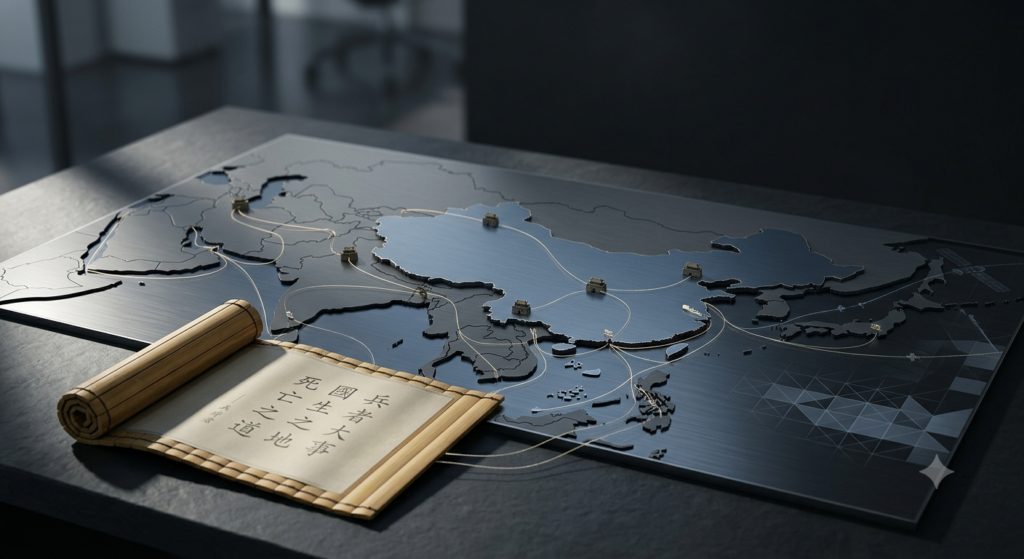
Sun Tzu and the Making of Chinese Strategy: From the Warring States to the Gray Zone
How Sun Tzu's 2,500-year-old Art of War still shapes PLA doctrine, gray-zone coercion, Three Warfares, and China's AI-era rivalry with the US. Suggested URL Slug: /sun-tzu-impact-chinese-strategy
Executive Summary
Sun Tzu’s Art of War, a text of disputed authorship compiled sometime between the late Spring and Autumn period and the Warring States era, remains the single most frequently invoked intellectual reference point in Chinese strategic discourse. Its influence is not static folklore; it is actively reproduced through China’s military education system, doctrinal writing, and applied statecraft. This assessment traces that influence across three registers: the historical transmission of the text itself, its absorption into Maoist revolutionary theory, and its explicit citation in contemporary People’s Liberation Army (PLA) concepts — including “Unrestricted Warfare,” the “Three Warfares,” and gray-zone coercion against Taiwan and in the South China Sea. It also presents the principal scholarly challenge to a simplistic reading of Sun Tzu as a “peaceful” strategist, and situates Sun Tzu’s continuing relevance within debates over artificial intelligence, cyber operations, and economic statecraft. The analysis concludes that Sun Tzu functions less as a deterministic cultural code and more as a legitimating vocabulary — a shared strategic grammar that Chinese planners draw on selectively to frame policies whose underlying drivers are often better explained by material power, regime security, and contemporary technology.
Key Judgments
- Sun Tzu’s Art of War is not merely commemorated in China; it is institutionally embedded, serving as required curriculum at the PLA National Defense University and other command academies.
- Mao Zedong’s synthesis of Sun Tzu with Marxist-Leninist revolutionary theory, not the classical text alone, is the primary conduit through which Sunzian concepts entered modern Chinese military practice.
- Contemporary PLA doctrinal writing explicitly and repeatedly cites Sun Tzu; the “Three Warfares” reference document alone cites him roughly thirty times, according to open-source analysis of PLA publications.
- The popular image of Sun Tzu as advocate of a fundamentally nonviolent, defensive Chinese strategic tradition is contested by serious scholarship; Alastair Iain Johnston’s influential “Cultural Realism” thesis argues the deeper current in classical Chinese military texts is a hard-edged realist (“parabellum”) paradigm that treats force as an unremarkable instrument of statecraft.
- “Winning without fighting” is best read as a coercion strategy — the deliberate raising of costs and foreclosure of options for an adversary — rather than as a pacifist doctrine; China’s South China Sea and Taiwan gray-zone campaigns are the clearest contemporary illustrations.
- Sun Tzu’s logic of deception, information advantage, and calculated economy of force is now explicitly extended by Chinese strategists into cyber operations, disinformation, and artificial intelligence, though empirical evidence (notably from the Russia-Ukraine war) suggests cognitive and cyber tools alone have not proven strategically decisive.
- Analysts should exercise caution against over-reading a 2,500-year-old text as a monocausal explanation for twenty-first-century Chinese policy; nationalism, bureaucratic interest, and material capability constraints increasingly complicate the clean application of Sunzian principles.
Introduction
Few texts in the history of strategic thought have enjoyed a run as long, or as geographically wide, as Sun Tzu’s Art of War. Composed in a China fractured by inter-state war more than two millennia ago, the text has since been absorbed into Chinese imperial military education, Maoist revolutionary doctrine, PLA professional training, and — more recently — the vocabulary Western analysts use to describe Chinese behavior in the South China Sea, the Taiwan Strait, and cyberspace. This durability raises a genuine analytical question, distinct from popular commentary: to what extent does an ancient military treatise meaningfully explain the strategic choices of a twenty-first-century nuclear power with a $18-trillion economy, a rapidly modernizing navy, and a growing arsenal of cyber and artificial intelligence capabilities? This assessment addresses that question directly, moving from the historical origins of the text through its Maoist reinterpretation to its explicit citation in contemporary PLA doctrine, before turning to scenario-based forecasting of how Sunzian logic is likely to shape Chinese behavior toward Taiwan and the wider Indo-Pacific through the remainder of this decade.
Historical Background
The Art of War‘s origins are themselves contested, which matters for how seriously later invocations of “Sun Tzu” should be taken. The Han dynasty historian Sima Qian and other traditional Chinese historians identified the author as a minister to King Helü of the state of Wu, dating his life to roughly 544–496 BC. Modern scholars who accept his historicity generally place the extant text later, in the Warring States period of 475 to 221 BC, based on its style and its descriptions of warfare. The uncertainty runs deeper still: the definitive contemporary account of the relevant Wu-Chu war comes from the Zuo Zhuan, a major history of the Spring and Autumn period, and some scholars conclude the text as it survives is likely a composite work attributed retrospectively to a single “Master Sun.” A parallel confusion, only resolved in the modern era, involved Sun Wu’s purported descendant Sun Bin, who wrote a separate military treatise also attributed to “Sun Tzu”; the two were historically conflated until Sun Bin’s own text was rediscovered in 1972. britannica
That 1972 discovery is itself significant: the earliest extant manuscript of the Art of War is a Han dynasty bamboo-slip text unearthed from the Yinqueshan Han tomb in Shandong, first properly sorted and published in 1975. Before that find, the text’s transmission ran primarily through commentary. Before the bamboo-slip discovery, the most cited version of the Art of War was the annotation produced by Cao Cao, the third-century warlord and founder of the Cao Wei kingdom, who explicitly stated that earlier annotations had failed to grasp the text’s essential ideas. Cao Cao is known to have consulted the text directly in his own campaigns, and his commentary — later carried through the Three Kingdoms period — helped establish the work’s canonical status for subsequent generations of Chinese commanders. By the Song dynasty, the Art of War, together with Cao Cao’s annotations, was formally incorporated into the “Seven Military Classics” (Wujing Qishu), the standard curriculum for imperial military examinations. New World Encyclopedia + 3
Western absorption of the text came far later and through a narrower channel. It was Samuel Griffith’s 1963 English-language translation that drew sustained Western attention to the Art of War as a source of non-Western strategic theory, and Sunzi studies subsequently became a fixture of US military strategic-studies curricula. That translation history matters for the present assessment: much of the contemporary Western discourse linking Sun Tzu to Chinese strategy is itself a product of a mid-twentieth-century rediscovery, filtered through Cold War-era strategic studies, rather than a continuous, unbroken line of interpretation. Strategiesforinfluence
Strategic Context
The concept analysts use to link an ancient text to modern state behavior — “strategic culture” — is itself a relatively recent theoretical import. The term was introduced with reference to Soviet nuclear strategy by Jack Snyder in a 1977 RAND report, which defined strategic culture as the sum of ideas, conditioned emotional responses, and habitual patterns of behavior shared by a national strategic community. Applying this framework to China surfaces two competing schools of interpretation that any serious assessment must hold in tension. Jmss
The first, older reading treats the Art of War‘s central maxim — that “supreme excellence consists in breaking the enemy’s resistance without fighting” — as evidence of a distinctively restrained, defensively-minded Chinese strategic tradition, often paired with Confucian-Mencian abhorrence of violence. This is the popular image most frequently invoked in both Chinese and Western commentary. U.S. Naval Institute
The second, more rigorously tested reading directly challenges this. Alastair Iain Johnston’s landmark study argues that both Chinese and foreign scholars have traditionally and mistakenly concluded that Chinese strategic culture rates the utility of force unusually low and prizes deception and psychological means above all else. Through systematic analysis of the Seven Military Classics, Johnston instead identifies a more realist “parabellum” paradigm underlying classical Chinese strategic thought — one built on a zero-sum conception of conflict that treats violence as a highly effective, unremarkable instrument. Subsequent research examining PLA professional journals from 1992 through the mid-2010s finds that elements of this harder, more realist ancient military thought are readily apparent in contemporary Chinese doctrine and operations, particularly within the PLA itself. Analytically, this matters because it reframes “winning without fighting” not as pacifism but as an economical theory of coercion — achieving political objectives at the lowest acceptable cost, with force held in reserve rather than renounced. Project MUSE + 2
The bridge between the classical text and the modern PLA runs primarily through Mao Zedong. Mao was a self-proclaimed student of Sun Tzu, and his military theorizing — refined over twenty-two years of leading a Communist guerrilla army — paraphrases much of the Art of War, particularly its emphasis on deception, surprise, and targeting an enemy’s will to resist. Mao’s own guerrilla formula — advance when the enemy retreats, harass when it camps, attack when it tires, pursue when it retreats — is Sun Tzu adapted explicitly for revolutionary war, and Mao’s emphasis on protracted conflict designed to exhaust a stronger adversary reflects the same underlying logic. Mao’s synthesis was not, however, purely indigenous. Mao’s exposure to Marxism came substantially through a Stalinist reception of classical thought that also introduced him to Carl von Clausewitz’s philosophy of war, meaning European strategic thought significantly shaped Mao’s thinking even as he continued to invoke Sun Tzu. This hybrid — Sunzian stratagem fused with Clausewitzian mass mobilization and Leninist party organization — is the actual intellectual ancestor of much of what is loosely called “Chinese Sun Tzu strategy” today. MIT OpenCourseWare + 2
Detailed Analysis
Military Dimension
Sun Tzu’s institutional footprint inside the PLA is concrete rather than symbolic. The PLA’s highest educational institution, the PLA National Defense University, has used the Art of War as a foundational text for enlisted servicemen since 2006, the PLA Army Command Academy in Nanjing quotes Sun Tzu on its walls, and even the PLA Navy Submarine Academy applies Sunzian precepts on the nature of warfare. This institutionalization gives the text more than rhetorical weight; it shapes the vocabulary in which several generations of PLA officers have been trained to think about operational problems. MIT OpenCourseWare
The clearest modern extension of Sunzian logic into non-kinetic domains is the 1999 book Unrestricted Warfare. Written by PLA Air Force colonels Qiao Liang and Wang Xiangsui, the book argued for the emergence of new means of waging war and recommended their unrestricted use to achieve victory — the actual object of war. Analyzing US strategy in the first Gulf War, the authors concluded that the era of using military force alone to compel an adversary’s submission had ended, and that contemporary conflict would instead blend political, economic, cultural, diplomatic, and military instruments alongside armed and unconventional forces — a formulation closely resembling the Western concept of hybrid warfare. The book’s central concern is how a state such as China can defeat a technologically superior opponent through means other than direct military confrontation, including political warfare. Crucially, the authors themselves framed this as continuous with, not a departure from, classical thought: commentators have noted that some of the principles governing contemporary hybrid threats were described by Sun Tzu more than two thousand years earlier. DTIC + 3
Assessment: The military dimension shows genuine intellectual continuity rather than mere rhetorical borrowing — but the continuity runs through Mao’s People’s War theory and Unrestricted Warfare‘s explicit adaptation of Sunzian economy-of-force logic to non-kinetic domains, not through a static, unchanged classical doctrine.
Political Dimension
The most explicit contemporary institutionalization of Sunzian principles is China’s “Three Warfares” (san zhong zhanfa) doctrine. The doctrine — comprising public opinion warfare, psychological warfare, and legal warfare — was approved by the Chinese Communist Party’s Central Committee and the Central Military Commission in December 2003 to guide PLA political and information operations, and has since been integrated into PLA teaching programs. Its lineage to Sun Tzu is not inferred by outside analysts but explicit in PLA source material: a hundred-example reference document on the Three Warfares issued by the PLA cites Sun Tzu thirty times. The doctrine’s most fundamental tenet conforms to Sun Tzu’s proclamation that the skillful leader subdues an enemy’s troops without fighting, and to his broader dictum that all warfare is based on deception. The Strategy Bridge + 2
A balanced assessment requires noting the doctrine’s limits. RAND analysis finds that public-opinion warfare plays a load-bearing role in the broader Three Warfares strategy, generating legitimacy for other operations by shaping international opinion, but that rising grassroots Chinese nationalism is increasingly undermining the intended return on Beijing’s substantial investment in these influence operations. This is a meaningful caveat: a doctrine explicitly designed around Sunzian indirection can be partially self-defeating when domestic political dynamics diverge from centrally planned messaging. Taylor & Francis Online
Economic Dimension
Economic instruments occupy an ambiguous but increasingly explicit place in Sunzian-inflected Chinese strategy. The Belt and Road Initiative is characterized by some analysts as a key element of the Three Warfares approach, using infrastructure investment to draw client states into economic and political dependency. This is a contested characterization rather than settled fact — Chinese officials frame the BRI as developmental cooperation, and independent assessments of “debt trap” claims vary considerably by country and project. What is less contested is the deliberate blurring of commercial and state-security functions: China’s 2017 National Intelligence Law requires Chinese companies to cooperate with national intelligence work wherever they operate, meaning private firms operating overseas are legally compelled, if asked, to share data — a structural feature that extends state reach through nominally commercial channels. The Strategy BridgeWikipedia
A more cautious reading of China’s coercive economic and military behavior comes from the Stimson Center’s survey of Beijing’s use of armed coercion, which finds that China’s past use of coercion and force has been closely tied to the defense of specific, long-standing sovereignty claims rather than a simplistic pursuit of unconditional military domination, and argues the appropriate policy response is helping vulnerable states build the capacity to detect and resist Chinese coercion. This nuance matters for the economic dimension specifically: Sunzian “winning without fighting” logic is most persuasive as an explanation for economic statecraft when tied to bounded, historically rooted objectives — not as evidence of unlimited expansionist intent. Indopacificsecurity
Technological Dimension
Chinese and Western analysts increasingly frame artificial intelligence and cyber operations as the newest theater for applying Sunzian principles of deception and information advantage. Analysts argue that cyber warfare, AI-driven disinformation, and social media manipulation now deploy Sun Tzu’s maxims at unprecedented scale and precision, with deepfakes functioning as a technological evolution of the false flags and feints the text originally described. The US-China leadership competition over artificial intelligence is explicitly framed by some commentators as a contemporary “art of war” competition, in which AI, semiconductors, and cyber-governance standards occupy the strategic position that territorial expansion once held. DAUWordPress
This framing, however, should not be overstated. Hudson Institute analysis drawing on the Russia-Ukraine war concludes that cognitive and cyber warfare — conducted through digital means in non-physical domains — do not alone provide decisive strategic advantages, and that neither Sun Tzu’s ideal of subduing an enemy without fighting nor Liddell Hart’s indirect-approach strategy offers concrete guidance on how to achieve this in practice; historically, physical battles have been what actually subdues an enemy’s will. This is an important corrective: the popular claim that AI and cyber tools represent a straightforward, near-complete fulfillment of Sun Tzu’s vision outruns the empirical evidence from the most information-saturated conflict of the current decade. War on the Rocks
Legal / Diplomatic Dimension
Legal warfare (lawfare) constitutes the third pillar of the Three Warfares doctrine and represents perhaps the most literal contemporary application of Sunzian indirection. Chinese lawfare efforts involve exploiting domestic and international legal systems to claim the legal high ground, assert legitimacy, and constrain the operational freedom of adversaries — most visibly in South China Sea territorial disputes. This extends beyond maritime disputes into transnational reach: China has employed Interpol Red Notices, which request the provisional arrest of individuals pending extradition, to target dissidents abroad, most commonly using financial-crime allegations as a pretext. The diplomatic corollary is a deliberate ambiguity strategy in disputed maritime zones, where legal, administrative, and paramilitary presence substitute for outright military occupation — precisely the kind of low-cost, high-persistence pressure Sunzian logic would predict. RANDModern Diplomacy
Scenario Analysis
Scenario 1 — Continued Incremental Gray-Zone Coercion (Status Quo Trajectory). China sustains and gradually intensifies non-kinetic pressure on Taiwan and in the South China Sea without crossing into overt armed conflict. This pattern was already evident by early 2026, with China escalating gray-zone coercion across the Indo-Pacific through military intimidation, economic pressure, cyber and information operations, and calibrated shows of force extending from the Senkaku Islands to the Tasman Sea. Analysts have described the resulting structure as a layered, coordinated multi-agency maritime pressure system, with the PLA Navy providing an outer deterrent layer and the China Coast Guard occupying a middle layer conducting law-enforcement and gray-zone missions that create jurisdictional facts below the threshold of war. This scenario is the most direct contemporary expression of “winning without fighting.” ORF Onlinebrookings
Scenario 2 — Limited Coercive Escalation via a Peripheral Test Case. Rather than a direct move against Taiwan itself, China escalates pressure on an outlying, more defensible target to establish precedent and probe allied resolve. Taiwan’s Pratas Islands have already functioned this way, with Chinese vessels carrying out thirty-nine incursions involving twelve different vessels between February 2025 and May 2026, positioning Pratas as a test case for Beijing’s evolving coercive strategy rather than a peripheral outpost. A limited quarantine, customs-inspection regime, or selective blockade of an outlying feature would be consistent with Sunzian preference for objectives attainable without full-scale war. Canadian Global Affairs Institute
Scenario 3 — Miscalculation-Driven Escalation to Direct Confrontation. Persistent, high-tempo gray-zone operations carry inherent friction risk. The shift from episodic exercises to persistent, round-the-clock presence around Taiwan increases the probability of an accidental collision, an unintended engagement, or a crisis that escalates beyond either side’s original intent, even absent any Chinese decision to seek direct conflict. This scenario would represent a Sunzian failure mode — the text explicitly warns against prolonged, costly conflict — rather than an application of its logic, and would most likely result from operational accident or an allied response Beijing misjudged, rather than deliberate strategic choice. brookings
Probability Assessment
- Scenario 1 (continued gray-zone coercion): High. This is the observed baseline trend through 2025–2026 and requires no change in Chinese risk tolerance, cost structure, or strategic doctrine to continue.
- Scenario 2 (limited escalation via peripheral test case): Moderate. Consistent with demonstrated Pratas-focused behavior and low relative cost, but constrained by the risk of triggering the very allied coordination Beijing seeks to avoid. US analysts have already proposed asymmetric counter-coercion strategies specifically designed to raise the cost of this approach, which could alter Beijing’s calculus. Springer
- Scenario 3 (miscalculation-driven escalation): Low to Moderate. Rising operational tempo increases the base rate of accidents even though neither side currently seeks direct conflict; probability rises over time if presence density continues to increase without corresponding deconfliction mechanisms.
These are qualitative judgments based on open-source trend analysis through mid-2026, not quantitative forecasts, and should be revised as new operational data emerges.
Strategic Outlook
Over the next twenty-four to thirty-six months, the most probable trajectory is continued normalization of gray-zone pressure — reinforced by the Three Warfares framework, sustained by economic and legal instruments, and increasingly extended into cyber and AI-enabled information operations. Analysts already note that Beijing can accumulate operational facts — from ADIZ normalization to submarine-cable incidents to new legal instruments targeting Taiwanese identity abroad — faster than Taipei’s partners can convert diplomatic statements into functioning deterrence. The principal Western policy debate is not whether this pattern will continue but how to respond to it: US planners have historically viewed gray-zone response as a distraction from the more urgent task of pursuing denial-based deterrence against a full invasion scenario, while regional allies have generally urged a more cautious approach to avoid retaliation. Model DiplomatModel Diplomat
Analytically, the central caution for policymakers is methodological. Sun Tzu remains a genuinely useful heuristic for understanding the style of Chinese coercive behavior — indirect, cost-conscious, patient, and oriented toward psychological and legal effect rather than kinetic destruction. It is a poor tool for predicting timing and thresholds, which are shaped by material capability, domestic political cycles, and contingent events far more than by a fixed ancient text. Treating “Sun Tzu” as a complete explanatory key for Chinese strategy risks both overconfidence in forecasting and underestimation of how much contemporary Chinese behavior is driven by ordinary great-power interests — resource access, regime security, technological competition — that would exist with or without a 2,500-year-old treatise to reference.
Conclusion
Sun Tzu’s Art of War is neither a museum piece nor a master key to Chinese behavior; it is a living reference vocabulary that Chinese military and political institutions actively reproduce, cite, and adapt. Its clearest legacy runs through Mao’s revolutionary synthesis into contemporary doctrines — Unrestricted Warfare, the Three Warfares, and gray-zone coercion — that explicitly invoke Sunzian principles of deception, indirection, and cost-economy. At the same time, serious scholarship complicates the popular, softer reading of the text, and empirical evidence from recent conflicts suggests the technological extensions of Sunzian logic into cyber and AI domains remain less decisive in practice than in theory. The most defensible analytical posture treats Sun Tzu as one durable thread within a broader, more materially grounded Chinese strategic tradition — illuminating, but not substituting for, hard analysis of capabilities, interests, and constraints.
Sources
- Classics of Strategy and Diplomacy, Sun Tzu, The Art of War (c. 500–300 B.C.) — classicsofstrategy.com
- Association for Asian Studies, New Perspectives on the Sunzi from Contemporary Chinese Military Writings — asianstudies.org
- The Collector, Sun Tzu: The Man Who Defined Chinese Warfare — thecollector.com
- Wikipedia, Unrestricted Warfare — en.wikipedia.org
- RAND Corporation, Rampant Nationalism Is Undermining China’s “Three Warfares” (2024) — rand.org
- Wikipedia, Three Warfares — en.wikipedia.org
- The Strategy Bridge, Chinese Political Warfare: A Strategic Tautology? (2023) — thestrategybridge.org
- Georgetown Security Studies Review, China’s “Three Warfares” in Theory and Practice in the South China Sea — georgetownsecuritystudiesreview.org
- Wikipedia, Transnational Lawfare by China — en.wikipedia.org
- East Asia Forum, China Remains Undeterred in the Grey Zone (2026) — eastasiaforum.org
- Observer Research Foundation, China’s Grey-Zone Coercion at Taiwan’s Pratas Islands (2026) — orfonline.org
- Brookings Institution, David Sacks, Paint It Black: An Asymmetric Approach to China’s Gray Zone Coercion of Taiwan (2026) — brookings.edu
- Stimson Center, China’s Use of Armed Coercion: To Win Without Fighting (2023) — stimson.org
- CIDOB, Winning Without Fighting: China’s Grey Zone Strategies in East Asia — cidob.org
- War on the Rocks / Hudson Institute, The Future of China’s Cognitive Warfare: Lessons from the War in Ukraine — warontherocks.com
- Princeton University Press, Alastair Iain Johnston, Cultural Realism: Strategic Culture and Grand Strategy in Chinese History (1995) — press.princeton.edu
- Cambridge University Press, Revising China’s Strategic Culture: Contemporary Cherry-Picking of Ancient Strategic Thought, The China Quarterly — cambridge.org
- New World Encyclopedia, Sun Zi — newworldencyclopedia.org
- Encyclopaedia Britannica, Sun Tzu — britannica.com
- U.S. Naval Institute Proceedings, Stop China from Winning Without Fighting (2022) — usni.org
Frequently Asked Questions
Did Sun Tzu really write The Art of War?
This is genuinely disputed. Traditional accounts date him to roughly 544–496 BC as a general serving the state of Wu, but most modern scholars who accept his historicity place the text’s composition later, in the Warring States period, and some argue it is a composite work compiled under his name rather than authored by a single historical figure.
How does the PLA actually use Sun Tzu today?
Beyond symbolic reverence, the Art of War has been formal curriculum at the PLA National Defense University since 2006, and its concepts are cited explicitly and repeatedly in doctrinal reference documents underpinning the Three Warfares strategy.
Is “winning without fighting” an accurate description of overall Chinese strategy?
It describes a real and observable pattern in gray-zone coercion, but scholarship led by Alastair Iain Johnston argues the deeper classical Chinese tradition is more realist and force-tolerant than this phrase implies, meaning it functions as a coercion strategy rather than a pacifist doctrine.
What is the connection between Sun Tzu and China’s Three Warfares doctrine?
The Three Warfares — psychological, public opinion, and legal warfare — was formally approved by the CCP Central Committee and Central Military Commission in December 2003, and PLA reference material explicitly cites Sun Tzu dozens of times as its intellectual foundation.
Does Sun Tzu explain China’s approach to artificial intelligence and cyber operations?
Partially. Analysts frame AI-enabled disinformation and cyber operations as technological extensions of Sunzian deception, but evidence from the Russia-Ukraine war suggests cognitive and cyber tools alone have not proven decisive, cautioning against overstating the fit.