The Heartland Theory and Its Impact on Contemporary Geopolitics
Halford Mackinder’s Heartland Theory remains a useful lens for understanding Eurasia, Eastern Europe, strategic connectivity and the limits of geographical power in modern geopolitics.
Executive Summary
Halford Mackinder’s Heartland Theory remains one of the most influential ideas in classical geopolitics. It argues that control of the central Eurasian landmass can confer major strategic advantages because of its scale, resources and interior lines of communication.
The theory does not explain modern geopolitics by itself. Airpower, nuclear deterrence, global trade, cyber capabilities, space systems and maritime power have all limited the idea that territorial control alone determines global power.
Nevertheless, the theory remains useful as a framework for understanding why Eastern Europe, Ukraine, Central Asia, the Arctic and trans-Eurasian transport corridors retain major strategic importance.
Key Judgments
- The Heartland Theory is best used as an analytical lens, not as a deterministic law of history.
- Russia’s war against Ukraine has renewed attention on Eastern Europe as a strategic gateway between Russia and the wider European security order.
- China’s connectivity projects reflect the continuing importance of land routes, infrastructure and influence across Eurasia.
- Maritime power remains essential; modern competition is shaped by the interaction of land power, sea power, technology and economic networks.
- No state can dominate Eurasia through geography alone without economic capacity, political legitimacy, technological strength and reliable alliances.
What Is the Heartland Theory?
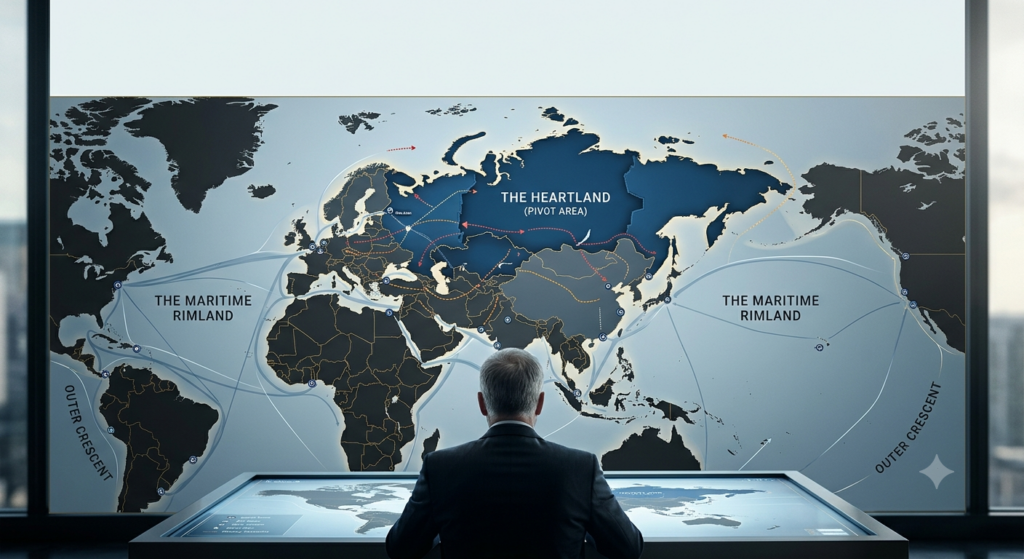
British geographer Halford Mackinder presented his central geopolitical argument in 1904. He believed that the age of uncontested maritime expansion was ending and that railways could allow large continental powers to mobilise people, resources and armies across Eurasia more effectively than before.
Mackinder identified the central Eurasian interior as the “Heartland.” In broad terms, this referred to the territory stretching across much of Russia and Central Asia. He later connected control of Eastern Europe with access to this wider strategic core.
The theory’s core idea was simple: a power that gained decisive influence over Eastern Europe could strengthen its position in the Eurasian interior; a dominant continental power could then potentially challenge the maritime powers surrounding Eurasia.
Mackinder’s original work remains important because it shifted strategic thinking away from maps focused only on oceans and colonies. It argued that geography, transport networks, resources and territorial depth shape the choices available to states. Mackinder’s original 1904 paper, The Geographical Pivot of History
Why the Theory Still Matters
The Heartland Theory has survived because Eurasia remains the world’s largest connected landmass. It contains major energy reserves, industrial centres, agricultural regions, critical transport routes and several nuclear-armed states.
Its relevance today comes from four enduring factors.
1. Strategic Depth
Large land powers can absorb pressure, relocate industry and sustain military operations across long distances. Russia’s geography has historically given it strategic depth, even though distance alone does not guarantee military success.
2. Resources
The broader Eurasian region contains oil, gas, minerals, grain-producing land and industrial infrastructure. Access to these assets can affect military endurance, economic resilience and diplomatic leverage.
3. Transport Corridors
Railways, pipelines, roads, ports and digital infrastructure are now strategic assets. Control over territory matters partly because it shapes how goods, energy, data and military equipment move.
4. The Position of Eastern Europe
Eastern Europe sits between major centres of power: Russia, the European Union and NATO. It is not merely a buffer zone. It is a region with sovereign states whose political choices affect the wider balance of power.
Ukraine and the Return of Continental Geopolitics
Russia’s war against Ukraine has made the strategic importance of Eastern Europe impossible to ignore. Ukraine’s geography links the Black Sea, Central Europe, Russia and the wider Eurasian interior. Its agricultural output, industrial legacy, population and access to maritime routes add to its significance.
However, it would be a mistake to present the war as a simple attempt to “control the Heartland.” Modern conflicts have multiple causes, including national identity, regime security, alliance politics, historical narratives, military calculations and domestic political interests.
The Heartland framework is more useful for explaining why Ukraine’s orientation matters so much to competing strategic visions:
- For Ukraine, sovereignty means the ability to choose its own political, economic and security relationships.
- For Russia, Ukraine’s alignment affects its military posture, Black Sea access and perceived strategic depth.
- For European states, Ukraine’s survival and security shape the future balance of power on NATO’s eastern flank.
NATO’s 2022 Strategic Concept identifies Russia as the most significant and direct threat to Allied security and to peace and stability in the Euro-Atlantic area. This illustrates how the war has transformed European security planning beyond Ukraine itself. NATO Strategic Concept
China, Connectivity and Eurasian Competition
China’s Belt and Road Initiative also demonstrates why continental connectivity still matters. Rail links, ports, energy corridors and infrastructure projects are tools of economic statecraft. They can reduce transport risk, deepen commercial ties and create political influence.
China’s official description of the Belt and Road Initiative places connectivity at the centre of its strategy, including infrastructure, trade, finance and people-to-people links. China’s 2023 Belt and Road white paper
From a Heartland perspective, these projects matter because they connect China more deeply to Central Asia, Russia, Europe and the Middle East. Yet the modern reality is more complex than Mackinder’s map:
- Land corridors are useful, but sea routes still carry most global trade.
- Infrastructure does not automatically create political control.
- States along these routes retain their own interests and can balance among competing powers.
- Sanctions, war, debt concerns and domestic instability can interrupt connectivity projects.
China is therefore not “conquering the Heartland.” It is competing for access, influence and resilient supply routes across a strategically important region.
The Limits of Heartland Thinking
The Heartland Theory has clear limitations.
Maritime Power Still Matters
Mackinder’s argument emerged partly as a challenge to British naval dominance. But the modern global economy still depends heavily on maritime trade, naval access and chokepoints such as the Strait of Hormuz, the Malacca Strait, the Suez Canal and the Turkish Straits.
The United States remains a major global power not because it controls Eurasia, but because it combines military alliances, naval reach, technological leadership, financial power and access to two oceans.
Technology Has Changed Geography
Long-range missiles, satellites, drones, cyber operations and space-based communications have reduced the protective value of distance. A state can no longer assume that a vast interior automatically provides security.
At the same time, technology has created new strategic geography:
- Semiconductor supply chains.
- Undersea cables.
- Satellite networks.
- Data centres.
- Rare-earth minerals.
- Energy grids.
These networks can matter as much as land frontiers.
Political Legitimacy Is Essential
Territory cannot be controlled indefinitely through military power alone. A state also needs institutions, economic capacity, legitimacy and local cooperation. The experience of modern conflicts repeatedly shows that occupying territory can impose enormous political and military costs.
Heartland, Rimland and the Modern Balance of Power
Mackinder’s theory should also be compared with Nicholas Spykman’s Rimland concept. Spykman argued that the coastal edges of Eurasia — Western Europe, the Middle East, South Asia and East Asia — were more important than the continental interior.
Modern geopolitics suggests that both perspectives contain part of the truth.
The Heartland matters because of strategic depth, resources and continental connectivity. The Rimland matters because it contains many of the world’s major economies, ports, population centres and maritime chokepoints.
This is why contemporary competition is visible in both regions:
- Eastern Europe and the Black Sea.
- The Middle East and energy routes.
- The Indo-Pacific and maritime trade.
- Central Asia and transport corridors.
- The Arctic and emerging access routes.
Strategic Outlook
The Heartland Theory will remain relevant because geography does not disappear. But its meaning has changed.
In the twenty-first century, influence over Eurasia is unlikely to come from territorial conquest alone. More often, it will depend on a combination of:
- Military deterrence.
- Industrial capacity.
- Energy security.
- Infrastructure finance.
- Technology leadership.
- Alliance networks.
- Maritime access.
- Political legitimacy.
The most successful powers will not be those that merely control land. They will be those that connect geography to economic strength, innovation and durable partnerships.
Conclusion
The Heartland Theory is neither obsolete nor sufficient. It remains valuable because it explains why Eurasia, Eastern Europe and continental infrastructure matter strategically.
But it should not be used as a simplistic formula for predicting world domination. Modern power is not determined by territory alone. It is shaped by the interaction of land, sea, technology, economics, institutions and alliances.
The real lesson of Mackinder’s theory is not that geography controls destiny. It is that geography creates strategic constraints and opportunities — and that states ignore those realities at their own risk.