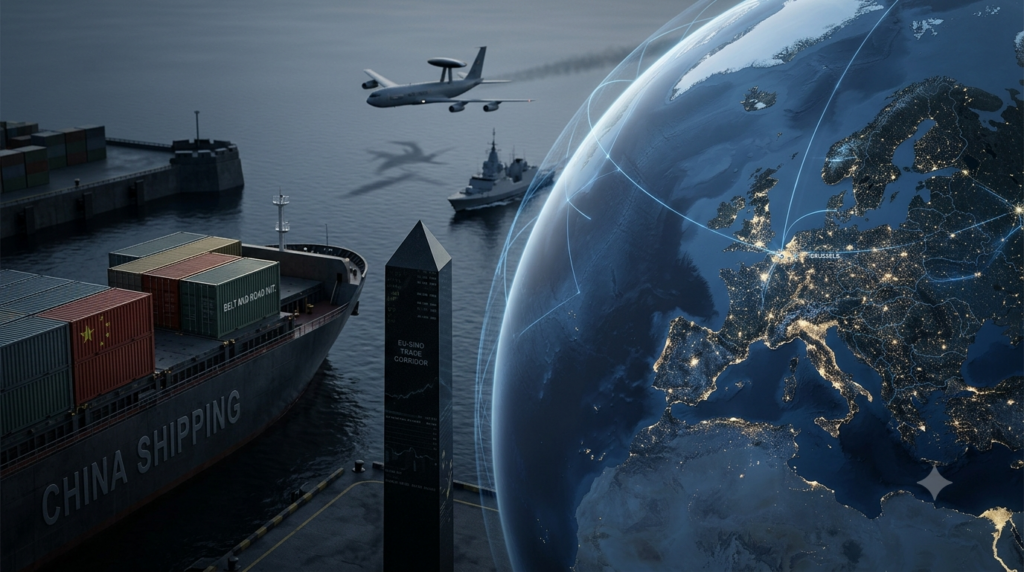
The Impact of Sino-European Relations on NATO’s Future
Sino-European relations are reshaping NATO’s approach to economic security, defence production, supply-chain resilience, Russia and the wider Indo-Pacific strategic environment.
Executive Summary
Sino-European relations will not determine NATO’s future on their own, but they will strongly shape the Alliance’s priorities, industrial capacity and internal cohesion.
Europe is unlikely to adopt full economic separation from China. Its preferred approach is to reduce critical vulnerabilities while maintaining trade and dialogue. This creates a permanent strategic challenge for NATO: how to strengthen resilience against Chinese coercion, cyber threats and supply-chain dependence without treating every economic relationship as a military confrontation.
The most consequential issue is the relationship between China and Russia. NATO argues that China’s support for Russia’s defence-industrial base has direct implications for European security. As a result, Europe’s China policy is becoming increasingly connected to NATO’s deterrence posture, defence production and support for Ukraine.
Key Judgments
- NATO will remain a Euro-Atlantic alliance, but it will increasingly address security developments linked to China.
- European dependence on Chinese inputs in critical supply chains will make economic security a NATO-relevant issue.
- China’s relationship with Russia connects the Indo-Pacific and European theatres more closely than before.
- European governments will continue to favour “de-risking” rather than full economic decoupling from China.
- NATO’s greatest challenge will be maintaining unity among allies with different levels of economic exposure to China.
A Changing Strategic Environment
For most of its history, NATO focused primarily on the Soviet Union and then Russia. China was not central to European defence planning.
That has changed. China’s military modernisation, economic reach, cyber capabilities, influence over supply chains and growing partnership with Russia have made it increasingly relevant to European security.
NATO’s 2022 Strategic Concept stated that China’s ambitions and coercive policies challenge Allied interests, security and values. It did not describe China as a direct military adversary in the same way that NATO describes Russia. Instead, it recognised that China has become a long-term strategic challenge with implications for the entire Alliance. NATO Strategic Concept
This distinction matters. Russia remains NATO’s most direct military threat in Europe. China, however, affects the environment in which NATO must prepare for that threat.
The China–Russia Connection
The strongest link between Sino-European relations and NATO’s future is China’s relationship with Russia.
NATO’s 2024 Washington Summit Declaration described China as a decisive enabler of Russia’s war against Ukraine through political support and large-scale assistance to Russia’s defence-industrial base. The declaration argued that this support increases the threat that Russia poses to Ukraine and to wider Euro-Atlantic security. NATO Washington Summit Declaration
This does not mean that China and Russia form a formal military alliance. Their interests are not identical, and both retain strategic autonomy. But their relationship creates a serious problem for Europe: Russia can sustain a prolonged war effort more effectively when it has access to foreign markets, dual-use goods, industrial inputs and diplomatic support.
For NATO, the implication is clear. European security can no longer be analysed only through a regional lens. The war in Ukraine has shown that security in Europe can be influenced by industrial, technological and political relationships extending into Asia.
Europe’s “De-Risking” Strategy
Europe faces a difficult balancing act.
China is one of the European Union’s largest economic partners. European companies are deeply involved in trade, investment, manufacturing, pharmaceuticals, automotive industries and advanced technologies connected to China.
At the same time, European governments are increasingly concerned about critical dependencies. These include rare-earth materials, batteries, solar components, telecommunications equipment, medical supplies, advanced electronics and data infrastructure.
The European Union’s official position is to “de-risk, not decouple.” This means reducing vulnerabilities in critical sectors while preserving commercial engagement and diplomatic communication. European Commission: EU trade relations with China
This approach will shape NATO indirectly but profoundly. If European states cannot secure reliable access to key industrial inputs, their ability to manufacture weapons, sustain military operations and protect critical infrastructure may be weakened during a crisis.
Economic policy is therefore becoming part of defence policy.
Supply Chains and Defence Industrial Capacity
Modern military power depends on more than tanks, aircraft and soldiers. It also depends on microelectronics, machine tools, batteries, sensors, communications systems, specialised metals and software.
Many of these supply chains involve China.
This creates a strategic vulnerability for NATO members. A crisis involving China, Russia or both could disrupt access to components needed for civilian industry and defence production at the same time. A country may possess advanced weapons designs but still struggle to manufacture systems quickly if it lacks secure access to critical inputs.
The future NATO agenda will therefore include:
- Protecting critical supply chains.
- Diversifying sources of rare materials and components.
- Expanding European defence production.
- Improving cyber security for industrial networks.
- Screening strategic investments.
- Protecting ports, undersea cables, energy systems and logistics hubs.
The Alliance itself does not control European trade policy. But NATO can identify risks, improve resilience standards and coordinate security planning among allies.
NATO Will Not Become an Asian Alliance
Growing concern about China does not mean NATO will transform into an Indo-Pacific alliance.
NATO’s core mission remains the collective defence of Europe and North America. Its primary military responsibility is to deter threats against Allied territory.
However, NATO increasingly recognises that events in the Indo-Pacific can have direct consequences for Europe. A major disruption in East Asia could affect shipping, technology supply chains, energy markets and the availability of United States military assets.
This is why NATO has expanded dialogue with Australia, Japan, New Zealand and South Korea. The purpose is not to create a global NATO. It is to improve political coordination, information-sharing and resilience among countries facing interconnected challenges.
NATO also continues to maintain limited channels of dialogue with China. In 2026, NATO and Chinese military representatives held their ninth annual Military Staff Talks, discussing the security environment, military modernisation and arms-control issues. NATO-China Military Staff Talks
The Risk of Allied Division
The biggest political challenge may be maintaining unity within NATO.
The United States generally views China as its principal long-term strategic competitor. Many European governments share concerns about China but often face greater immediate pressure from Russia, energy security, migration, economic growth and domestic political constraints.
European countries also differ in their economic exposure to China. Some depend heavily on Chinese trade or investment. Others are more focused on supply-chain security and strategic competition.
China may seek to exploit these differences through selective economic incentives, diplomatic pressure or targeted trade restrictions. NATO’s response cannot be based on forcing all members into identical China policies. Instead, it must build common standards around resilience, transparency, critical infrastructure and defence-related supply chains.
A unified NATO does not require identical views on every issue. It requires agreement on the risks that could undermine collective security.
Three Possible Futures
1. Managed Competition
This is the most likely scenario.
Europe continues trade and diplomatic engagement with China while reducing dependence in critical sectors. NATO strengthens resilience, cyber defence, industrial capacity and cooperation with Indo-Pacific partners. Dialogue with China remains limited but continues.
2. Strategic Fragmentation
In this scenario, pressure from China, Russia or an economic crisis divides NATO members. Some states prioritise commercial ties with China, while others demand tougher restrictions. NATO remains intact but becomes less coherent on technology, industrial policy and China-related security risks.
3. Systemic Crisis
A major conflict or blockade in the Indo-Pacific disrupts global trade and forces the United States to concentrate military assets in Asia. Europe must then take greater responsibility for its own defence against Russia. This would accelerate European defence integration and make industrial self-reliance far more urgent.
Strategic Outlook
The future of NATO will depend partly on whether Europe can become more resilient without becoming economically isolated.
China’s role in the international system means that Europe cannot simply ignore Beijing. China is too important as a market, manufacturer, technology actor and diplomatic power.
But Europe also cannot treat economic dependence as politically neutral. When supply chains, data systems, critical infrastructure and defence production are vulnerable to coercion, economic exposure becomes a security issue.
The result will be a more strategic Europe and a broader NATO agenda. The Alliance will continue to focus on Russia as its direct military threat, while treating China as a factor that shapes the global conditions of Euro-Atlantic security.
Conclusion
Sino-European relations will not turn NATO into a global alliance, but they will make NATO more concerned with global interdependence.
The central question is no longer whether China matters to European security. It clearly does. The question is whether Europe and North America can develop a shared approach that protects critical interests without abandoning diplomacy, trade and cooperation where these remain possible.
NATO’s future will depend on its ability to link military deterrence with economic resilience, industrial capacity, technological security and political unity.