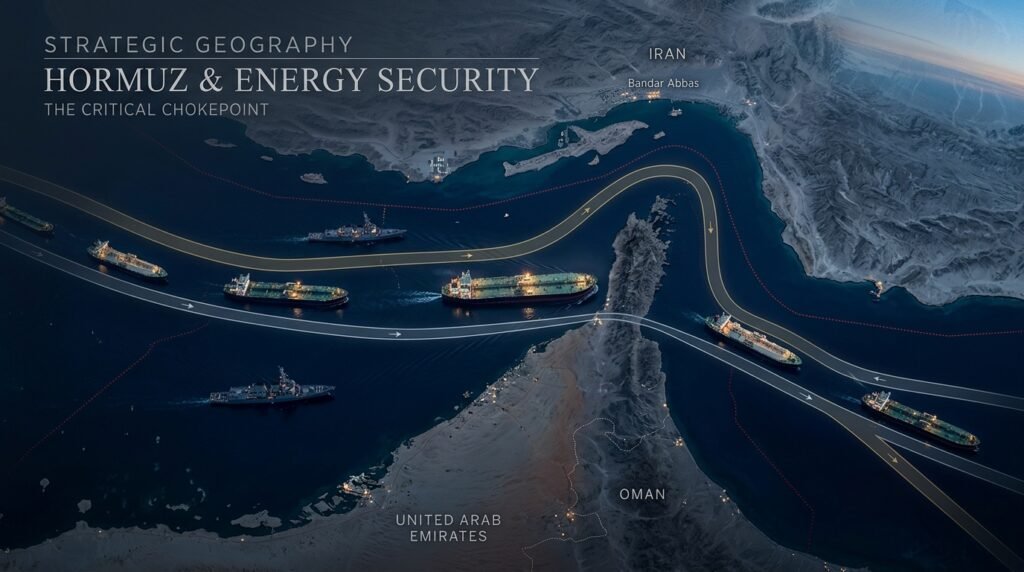
The Strait of Hormuz and the Strategic Geography of Global Energy Security
How the 2026 Iran war turned the Strait of Hormuz into the epicenter of global energy security, oil markets, and great-power maritime strategy.
A Strategic Intelligence Assessment | StratReview.com | August 2026
Executive Summary
The Strait of Hormuz has moved from a textbook chokepoint into the active center of gravity of a live great-power and regional conflict. Since United States and Israeli strikes on Iran began on February 28, 2026 — an operation that killed Supreme Leader Ali Khamenei and triggered a succession crisis, a regional war, and a still-unresolved contest over control of the Strait — the waterway that normally carries roughly one-fifth of the world’s oil and about one-fifth of its liquefied natural gas (LNG) has operated at a fraction of its pre-war throughput for six consecutive months. This assessment examines the military, political, economic, technological, and legal dimensions of the crisis as it stands in late August 2026, situates it within the longer strategic history of the Strait, and offers a probability-weighted outlook for the remainder of 2026 and into 2027.
The core finding is structural rather than episodic: even under the most optimistic near-term diplomatic scenarios, the physical geography of the Strait — a 21-nautical-mile-wide passage whose territorial waters are shared entirely between Iran and Oman, with no neutral corridor and only 3.5–5.5 million barrels per day (mb/d) of alternative pipeline capacity against normal Hormuz throughput of roughly 20 mb/d — means that no diplomatic settlement can fully substitute for physical control of, or free passage through, the Strait itself. The crisis has therefore functioned as a live demonstration of classical chokepoint theory: the actor that can credibly threaten or deny passage through a narrow sea lane gains coercive leverage disproportionate to its underlying military or economic weight, a dynamic long anticipated by realist strategic thought but rarely tested at this scale in the era of globalized energy markets.
Six months in, the situation remains genuinely unresolved. A Pakistan- and Qatar-brokered ceasefire framework (the Islamabad Memorandum) has repeatedly stabilized and then collapsed; Iran has asserted a unilateral permit-and-fee regime over the Strait through a newly created Persian Gulf Strait Authority that is widely assessed as inconsistent with the international law of the sea; the United States has alternated between a naval blockade of Iranian ports and renewed strikes; and, as of this writing, Iran and Oman are negotiating a temporary managed shipping corridor even as isolated attacks on tankers continue. This report assesses that the current pattern of intermittent, low-intensity disruption is more likely to persist through the remainder of 2026 than either a durable resolution or a full-scale resumption of major war — but that the tail risks in both directions remain significant.
Key Judgments
- High confidence. The Strait of Hormuz’s throughput has fallen by roughly 75–90 percent from pre-war levels for most of the past six months, from an estimated 20–21 mb/d of combined crude oil, condensate, and petroleum products to as little as 4.9 mb/d in the second quarter of 2026, based on U.S. Energy Information Administration (EIA) estimates.
- High confidence. No combination of existing pipeline bypass routes — principally Saudi Arabia’s East-West (Petroline) system and the UAE’s Habshan-Fujairah pipeline — can absorb more than roughly 25–30 percent of normal Hormuz volumes, meaning sustained closure imposes an irreducible physical constraint on global supply that financial markets and strategic reserves can only partially offset.
- Moderate-to-high confidence. Iran’s assertion of a licensing and fee authority over the Strait through the Persian Gulf Strait Authority (PGSA) is unlikely to be internationally recognized as lawful, but Tehran’s demonstrated willingness to enforce it kinetically has made the legal question strategically secondary to the operational one.
- Moderate confidence. China has managed the crisis more successfully than any other major importer, drawing on strategic reserves estimated at over a billion barrels and diversified sourcing to insulate its domestic price environment, while maintaining formal neutrality that has satisfied neither Iran nor the Gulf Arab states.
- Moderate confidence. The Pakistan-Qatar-Oman mediation architecture (the Islamabad Talks and subsequent Islamabad Memorandum) represents the most viable near-term de-escalation channel, but it has already failed to hold on two prior occasions (April and July 2026) and faces a further test around the extended ceasefire deadline.
- Moderate confidence. The August 2026 Iran-Oman talks on a temporary managed shipping corridor are a genuine, if narrow, opening for partial normalization of traffic, but Iranian officials continue to insist publicly that the Strait remains under Tehran’s control even as this negotiation proceeds — a signal of unresolved internal positioning within Iran’s decision-making structure.
- Low-to-moderate confidence. The succession of Mojtaba Khamenei as Iran’s third Supreme Leader, engineered rapidly under IRGC pressure, has not yet produced visible fractures in the regime’s cohesion, but the historically unprecedented and contested nature of the transition is a latent source of political risk that outside analysts cannot fully assess given restricted access to internal Iranian deliberations.
- High confidence. The macroeconomic transmission of the crisis — the World Bank has characterized it as the largest oil market shock on record — has measurably slowed global growth and raised inflation forecasts for 2026, with the effects concentrated in Europe and Asia rather than the United States, whose direct Hormuz-sourced import exposure was already the lowest in four decades before the war began.
Introduction
Geography rarely announces its strategic significance until it is tested. For nearly half a century, the Strait of Hormuz has been described in almost identical language by successive generations of energy analysts and military planners: a narrow channel between Iran and Oman through which a fifth of the world’s oil must pass, with no substitute route capable of carrying more than a fraction of that volume. The description was accurate and, for most of that period, largely theoretical — a risk to be modeled rather than a condition to be lived through. Tehran had threatened closure repeatedly since the 1980s Tanker War, and each time backed away short of a sustained blockade.
That changed on February 28, 2026. The joint U.S.-Israeli military campaign against Iran — codenamed Operation Epic Fury by Washington — did not merely strike Iranian nuclear and missile infrastructure; it killed the Supreme Leader, triggered an unprecedented succession crisis, and provoked an Iranian response that, for the first time in the modern history of the waterway, combined sustained attacks on commercial shipping with an explicit, institutionalized claim to regulatory authority over the Strait itself. Six months later, the crisis has evolved through several distinct phases — full closure, a fragile ceasefire, a U.S. naval blockade, a negotiated memorandum of understanding, its collapse, and now a fragile Oman-brokered corridor negotiation — without reaching a stable equilibrium.
This assessment treats the 2026 Strait of Hormuz crisis as both a discrete case study and a broader test of the chokepoint logic that has underpinned energy-security planning for decades. It draws on data from the EIA, the International Energy Agency (IEA), the World Bank, the International Monetary Fund (IMF), the U.S. Congressional Research Service, and specialist maritime and legal analysis, while explicitly flagging the areas — particularly Iranian internal politics and real-time shipping data — where the available evidence remains partial or contested.
Historical Background
The Strait of Hormuz’s strategic salience predates the current crisis by more than four decades. During the Iran-Iraq War (1980–1988), both belligerents attacked tankers in the Gulf in what became known as the Tanker War, drawing the United States into direct naval escort operations and culminating in Operation Praying Mantis in April 1988 — the largest U.S. surface naval engagement since the Second World War, fought explicitly to preserve freedom of navigation through the Strait. That episode established a template that has recurred with variations ever since: Iran using asymmetric maritime pressure against a numerically and technologically superior U.S. Navy presence, calibrated to inflict cost and demonstrate resolve without inviting a war it could not win.
Successive episodes reinforced the pattern without fundamentally altering it. Periodic tanker seizures and near-miss incidents through the 2010s, including a wave of attacks and seizures in 2019 attributed to Iran’s Islamic Revolutionary Guard Corps (IRGC), kept the closure threat credible without ever producing a sustained interruption of flows. The relationship between Iran and Israel, meanwhile, shifted from proxy confrontation toward direct exchanges of fire over the course of 2024, culminating in the twelve-day war of June 2025 — a shorter, more contained exchange that damaged Iranian air defenses and nuclear infrastructure but ended in a ceasefire rather than a change of regime or a Strait closure.
The immediate trigger for the 2026 war was the breakdown of indirect nuclear negotiations, mediated by Oman, in February 2026. Despite reported Iranian willingness to make concessions, the talks collapsed, and on February 28 the United States and Israel launched a coordinated campaign against Iranian nuclear facilities, ballistic missile infrastructure, and senior leadership, killing Khamenei within the opening phase of the operation. What distinguishes 2026 from every prior episode is that Iran’s retaliatory closure of the Strait was not primarily rhetorical or episodic but sustained, doctrinally organized around IRGC Navy asymmetric tactics, and — critically — eventually formalized through a claimed administrative authority over passage, a qualitatively new development in the Strait’s history.
Strategic Context
Classical strategic thought offers a coherent lens for the crisis, even if the specific technologies and market structures involved are modern. Alfred Thayer Mahan’s emphasis on the command of maritime chokepoints as a determinant of relative power finds direct application in the Strait: a state need not possess the capacity to defeat a rival’s navy outright to exercise strategic leverage, only the capacity to credibly threaten denial of a corridor on which the rival — or, in this case, the global economy as a whole — depends. Nicholas Spykman’s rimland thesis, which identified the maritime periphery of Eurasia as the decisive zone of great-power contest, is similarly legible in the way the crisis has drawn in actors far beyond the immediate belligerents: China’s strategic reserve posture, Russia’s diplomatic and energy alignment with Tehran, and Pakistan’s emergence as the principal mediating power all reflect the Gulf’s position at the intersection of multiple major powers’ vital interests.
Among the world’s maritime chokepoints, Hormuz occupies a distinctive position. It is narrower and more exposed than the Strait of Malacca, which carries a comparable or larger volume of oil but benefits from multiple approach routes and a less concentrated set of adversarial claimants. It is far more consequential than the Bab-el-Mandeb Strait, which has itself been a site of Houthi-led disruption in recent years but carries a smaller baseline volume and possesses at least a partial pipeline bypass. Crucially, and unlike most other global chokepoints, Hormuz has no neutral high-seas corridor: because the territorial waters of Iran and Oman meet and overlap at the Strait’s narrowest point, any vessel transiting it must pass through the territorial sea of one or both states, a geographic fact that gives Iran’s claims — however legally contested — a physical purchase that pure diplomatic pressure cannot easily dislodge.
This structural reality is the analytical foundation for the crisis’s persistence. In realist terms, the Strait functions less as a piece of infrastructure than as an instrument of coercive bargaining: Iran’s capacity to impose costs on the global economy, disproportionate to its conventional military standing after months of degrading strikes, constitutes one of the few forms of leverage remaining to a regime whose nuclear and missile programs have been substantially set back and whose regional proxy network has been weakened by the parallel Lebanon front. The security dilemma this creates is acute — U.S. and allied efforts to guarantee freedom of navigation through blockade and naval escort operations are, from Tehran’s perspective, themselves a further constriction of Iranian sovereignty and economic survival, reinforcing rather than resolving the underlying confrontation.
Detailed Analysis
Military Dimension
The military campaign that precipitated the crisis was, by most measures, one of the most intensive short-duration air campaigns of the past several decades. U.S. and Israeli forces conducted approximately 900 strikes within the first twelve hours of Operation Epic Fury on February 28, targeting Iranian air defenses, missile infrastructure, nuclear sites, and senior leadership, including Khamenei himself. Iran’s retaliation was correspondingly broad, involving hundreds of ballistic missiles and thousands of drones directed at Israel, U.S. military installations across the region, and, notably, Gulf Arab states — including Bahrain and Kuwait, both hosts to U.S. Fifth Fleet infrastructure — that had sought to deepen relations with Tehran in preceding years. A parallel front opened in Lebanon in early March, as Hezbollah launched projectiles at Israel in a further sign of the conflict’s regional spread, though Hezbollah’s declared framing of this as a defensive response to prior Israeli operations reflects a contested narrative rather than an agreed fact.
Iran’s maritime response has followed a recognizably asymmetric doctrine, consistent with decades of IRGC Navy planning: fast inshore attack craft conducting swarm-style harassment, sea mines, and missile and drone strikes on commercial vessels rather than direct engagement with U.S. carrier and destroyer groups. Cumulative damage over the six-month period includes at least one tugboat sunk, more than seventeen merchant vessels damaged (of which several were reportedly abandoned by their crews), two vessels captured, and at least a dozen seafarers killed or reported missing — figures compiled from open-source tracking that should be treated as a minimum rather than a comprehensive count, given restricted access and reporting gaps in the conflict zone.
The United States, for its part, imposed a formal naval blockade of Iranian ports from April 13 to May 29, 2026, resumed it on July 14, and has maintained it intermittently since, involving more than twenty warships and, at points, over ten thousand personnel under U.S. Central Command (CENTCOM). The blockade’s stated design — enforced through Arleigh Burke-class destroyers and supported by carrier air wings — deliberately distinguished between vessels bound to or from Iranian ports, which were interdicted, and vessels transiting to non-Iranian destinations, which CENTCOM stated it would not impede, a calibration intended to apply pressure on Tehran without triggering a systemic shock to global shipping. In practice, CENTCOM has reported intercepting or redirecting well over one hundred vessels and disabling several that attempted to breach the blockade.
A significant, still-unfolding development came on August 25, when President Trump announced that the U.S. Navy had cleared all naval mines from the Strait’s main shipping lane, coupling the announcement with a warning that any future mining would be met with immediate destruction of the responsible vessel. This mine-clearance claim has not been independently verified by third-party sources at the time of writing, and it coincided with a UKMTO report of a tanker being struck by an unidentified projectile in the Strait on August 27 — a reminder that even as large-scale kinetic operations have eased since the July peak, the Strait remains an active low-intensity threat environment rather than a secured corridor.
Political Dimension
The assassination of Ali Khamenei produced the most consequential leadership transition in the Islamic Republic’s history since 1989, and the first ever conducted under conditions of active war and assassination rather than natural succession. Within roughly a week, Iran’s Assembly of Experts named Khamenei’s son, Mojtaba Khamenei, as the third Supreme Leader — a decision reportedly driven by concentrated pressure from the IRGC, with which Mojtaba has long-standing personal ties, rather than through the kind of extended deliberative process the constitutional process envisions. This is notable given that hereditary succession sits uneasily with the Islamic Republic’s own founding ideology, and the appointment proceeded without any public vote or prior formal designation. In the interim, a provisional council comprising President Masoud Pezeshkian, judiciary chief Gholamhossein Mohseni Ejei, and senior cleric Ali Reza Arafi bridged the immediate leadership vacuum. Outside analysts have limited visibility into internal elite bargaining, and this assessment treats the succession’s long-term stability as a genuine open question rather than a settled fact.
Internationally, reactions to the initial February 28 strikes split along familiar but not entirely predictable lines. Most Muslim-majority and Arab states condemned the attack, and some international legal bodies characterized the Israeli strikes as a violation of international law; several Western governments, along with a small number of others including Argentina and Ukraine, framed the strikes as justified counter-proliferation. Russia’s President Vladimir Putin pledged what was described as unwavering support for Iran, a relationship that has continued into the diplomatic and energy domains — Iranian and Russian officials held further discussions on gas-sector cooperation, including the transfer of Russian natural gas to Iran, as recently as August 26.
The most consequential diplomatic actor, however, has been Pakistan. Islamabad brokered the initial two-week ceasefire in April 2026 and hosted the subsequent Islamabad Talks, a twenty-one-hour, three-round negotiation involving a three-hundred-member U.S. delegation led by Vice President JD Vance and a seventy-member Iranian delegation led by parliamentary speaker Mohammad Bagher Ghalibaf — talks that ultimately failed to resolve the core disputes over the Strait and Iran’s nuclear program. Pakistan’s mediation nonetheless culminated in the Islamabad Memorandum, signed by Prime Minister Shehbaz Sharif, President Pezeshkian, and President Trump on June 17, alongside Qatari co-mediation. That memorandum established a sixty-day ceasefire extension window, due to expire on August 17, which sources close to the process indicate has been informally extended pending final terms. Pakistan’s capacity to sustain this role is itself constrained: Islamabad has conducted this mediation while simultaneously managing a domestic energy crisis linked to the conflict, public protests, and a parallel armed conflict along its Afghan border, a combination that limits the bandwidth it can devote to shuttle diplomacy.
Oman occupies a structurally distinct position, as the only state other than Iran whose territorial waters constitute the Strait itself. This has made Muscat an indispensable, if lower-profile, party to nearly every phase of negotiation, from organizing the International Maritime Organization-backed evacuation of stranded mariners in late June to the temporary shipping-corridor talks with Tehran that intensified through late August, explicitly invoking Article 5 of the Islamabad Memorandum as their legal basis. Qatar, meanwhile, has combined its own exposure — as the operator of the Ras Laffan facility, the target of the conflict’s most damaging attack on energy infrastructure — with an active mediating role, including a prime ministerial visit to Tehran on August 27. At the multilateral level, UN Secretary-General António Guterres has repeatedly called on Iran to end attacks on shipping and restore navigational freedoms, but the Security Council has been structurally unable to act, with China vetoing a Bahrain-sponsored, Gulf-backed resolution aimed at protecting shipping through the Strait.
Economic Dimension
The economic transmission of the crisis has been severe, rapid, and — unusually for a modern oil shock — concentrated in a chokepoint disruption rather than a broader supply-side production loss. The EIA’s Short-Term Energy Outlook estimated that combined crude oil and petroleum liquids transiting the Strait fell to approximately 14.6 mb/d in the first quarter of 2026, a decline of nearly 30 percent year-on-year, and then to just 4.9 mb/d in the second quarter — down from roughly 21.6 mb/d in the fourth quarter of 2025, immediately before the war. Independent estimates of the pre-war baseline vary modestly (from roughly 20 mb/d to just under 21 mb/d depending on the source and time period measured), reflecting normal methodological differences among tracking services such as Kpler and Vortexa rather than any substantive disagreement about the scale of the subsequent collapse.
Gulf Arab producers — Iraq, Saudi Arabia, Kuwait, the UAE, Qatar, and Bahrain — were forced to shut in an estimated 7.5 mb/d of crude production in March, rising to roughly 9.1 mb/d in April, as storage filled and export routes closed. Rerouting via the Bab-el-Mandeb Strait, using Saudi Arabia’s East-West (Petroline) pipeline to the Red Sea port of Yanbu, partially offset this, with volumes through that corridor rising from about 5.4 mb/d before the war to roughly 8.1 mb/d in the second quarter. But the ceiling on this workaround is hard: the IEA estimates that only Saudi Arabia and the UAE possess operating bypass pipelines, with a combined spare capacity of somewhere between 3.5 and 5.5 mb/d — sufficient to offset perhaps a quarter to a third of normal Hormuz flows, leaving the substantial majority of the region’s export capacity structurally dependent on the Strait itself. This asymmetry between the scale of disruption and the scale of available workarounds is the single most important economic fact of the crisis.
Natural gas markets absorbed a comparably severe, if somewhat differently structured, shock. Iranian strikes on Qatar’s Ras Laffan complex — the world’s largest LNG export facility — on March 18–19 damaged two production trains and a gas-to-liquids unit, removing an estimated 17 percent of Qatar’s LNG export capacity (roughly 12.8 million tonnes per year), with QatarEnergy declaring force majeure on several long-term contracts and officials estimating repair timelines of three to five years. Combined LNG shipments from Qatar and the UAE through the Strait fell by more than 300 million cubic meters per day at the disruption’s height — the UN’s International Trade Centre later calculated a 95 percent year-on-year decline in LNG export volumes specifically. Approximately three-quarters of this loss has been offset by increased supply from other producing regions, softening the global impact, though buyers in South Korea, China, Italy, and Belgium were named among those directly affected by the Ras Laffan force majeure declarations.
Broader commodity markets were also affected: the Persian Gulf accounts for more than 30 percent of global urea trade and roughly 20 percent of ammonia and phosphate trade, and the UN’s International Trade Centre found that export volumes across a basket of twelve affected products fell by 54 percent between April 2025 and April 2026, with the largest absolute losses concentrated in crude and refined petroleum.
Oil price behavior has tracked the conflict’s phases closely. Brent crude rose by roughly 65 percent (an increase of about $46 per barrel) by the end of March 2026, according to the World Bank’s Commodity Markets Outlook, before easing somewhat around the April ceasefire. The signing of the U.S.-Iran memorandum of understanding in mid-June drove prices down sharply, to as low as $69 per barrel by early July, before renewed tanker attacks pushed Brent back up to roughly $105 per barrel by July 23. By mid-August, prices had settled into a lower but still elevated range around $83–88 per barrel, with a single-day gain of 9.59 percent on August 24 — described by market trackers as the largest one-day move in over six years — reflecting renewed uncertainty around the blockade and sanctions escalation before easing again on news of the Iran-Oman corridor talks. Some analysts, including those cited by The Diplomat and The National Interest, have floated a scenario in which Brent could approach $200 per barrel should the Strait remain effectively closed into 2027, though this represents a tail-risk projection rather than a central case, and should be read with appropriate caution given the historical unreliability of extreme oil-price forecasts.
The macroeconomic consequences have been substantial but unevenly distributed. The IMF’s April 2026 assessment cut its global growth forecast for the year to 3.1 percent (from a pre-conflict projection of 3.4 percent) and raised its headline inflation forecast to 4.4 percent, describing the shock’s transmission through higher energy-intensive input costs and disrupted supply chains. The Federal Reserve Bank of Chicago’s modeling estimated the shock could reduce 2026 U.S. GDP growth by 81 to 166 basis points, with a partial rebound the following year. European exposure has been more acute: Allianz Research’s March 2026 outlook projected the eurozone would experience a technical recession, with annual growth of roughly 0.2 percent, driven by both direct energy costs and weaker external demand. Exposure is sharply asymmetric across regions — the United States imported only about 0.5 mb/d of crude via the Strait in 2024, roughly 8 percent of its crude imports and under 2 percent of total petroleum consumption, the lowest exposure in four decades due to the scale of domestic shale production, whereas Japan sources an estimated 70–74 percent of its total crude imports through Hormuz and China had been the single largest destination for Hormuz-transiting crude before the war, at roughly 5.3–5.4 mb/d.
China’s management of the shock stands out analytically. Beijing entered the crisis with an estimated strategic petroleum reserve of approximately 1.2 to 1.5 billion barrels — by some estimates more than three times the comparable U.S. figure in absolute terms and equivalent to well over a hundred days of import cover — built up in part through discounted purchases of sanctioned Iranian, Russian, and Venezuelan crude in preceding years. This buffer, combined with demand-side flexibility in a slowing, deflation-prone economy, allowed Chinese domestic oil prices to move with roughly a fifth of the volatility seen in international benchmarks even as Brent spiked in March. China’s diplomatic posture has been described by Brookings as “high on diplomacy, low on risk”: Beijing has publicly urged all parties to keep the Strait open, condemned Iranian attacks on Gulf state sovereignty, and vetoed the Bahrain-sponsored UN Security Council resolution on protecting shipping, resulting in a balancing position that has left neither Tehran nor the Gulf Arab states satisfied. A parallel, harder-to-quantify channel persists through China’s independent (“teapot”) refineries, which multiple analysts estimate have continued to import over a million barrels per day of discounted, sanctions-evading Iranian crude despite the absence of any such flows in official trade statistics — a reminder that headline compliance figures understate the full picture of sanctions-era energy flows.
Technological Dimension
The crisis has showcased both old and new technological dimensions of chokepoint warfare. On the kinetic side, Iran’s reliance on naval mines and fast inshore attack craft represents a continuation of Tanker War-era doctrine, but executed with more precise missile and drone systems than were available in the 1980s, extending the reach and lethality of attacks on individual vessels and, in the case of the Ras Laffan strikes, fixed energy infrastructure far from the Strait itself.
On the information side, the conflict has been fought as much through shipping data as through weapons. Automatic Identification System (AIS) transponder manipulation — vessels “going dark” to avoid detection, a practice long associated with sanctions-evading “shadow fleets” carrying Iranian, Russian, or Venezuelan crude — has become pervasive, complicating real-time assessment of actual transit volumes. Specialist trackers such as Lloyd’s List Intelligence, Kpler, Vortexa, and the IMF’s PortWatch initiative have become de facto primary sources for policymakers and markets alike, but their figures diverge meaningfully depending on methodology and reporting lag; readers of any single data feed on Strait activity should treat point-in-time transit counts as indicative rather than definitive; recent brief-form daily reporting services have themselves flagged single-source, unverified claims (for instance around the precise extent of an asserted Iranian “control” of the Strait in mid-August) that independent outlets have been unable to corroborate.
The naval mine-clearance operation announced on August 25 is itself a notable technological and operational undertaking, requiring sustained minesweeper and explosive ordnance disposal deployment in an active threat environment; its durability will depend on whether Iran retains and is willing to redeploy mining capability, a question this assessment cannot resolve with the information available at the time of writing. Looking forward, the growing role of autonomous and remotely piloted maritime systems — both for surveillance and, potentially, for future harassment or interdiction operations — represents an assessed rather than yet-observed risk factor that should be monitored in subsequent reporting.
Legal / Diplomatic Dimension
The legal architecture governing the Strait is genuinely contested, and this contestation has had direct operational consequences. The relevant framework, the UN Convention on the Law of the Sea (UNCLOS), establishes a “transit passage” regime under Articles 37 through 44 for straits used for international navigation, under which passage “shall not be impeded” and “there shall be no suspension” of transit — a deliberately strong protection reflecting the 1982 negotiators’ judgment that coastal states bordering strategically vital straits should not be permitted to use them as leverage. Complicating matters, neither Iran, Israel, nor the United States is a party to UNCLOS (though Oman is), meaning the U.S. position — that the transit passage regime nonetheless reflects binding customary international law, enforced through its long-standing Freedom of Navigation program — rests on a doctrinal argument rather than treaty membership, an argument most international law scholars and states have historically accepted but that Iran has not.
Legal analysts have drawn an important distinction that is frequently conflated in public commentary: the initial U.S.-Israeli strikes on Iran are widely assessed by international law scholars as a prima facie violation of Article 2(4) of the UN Charter’s prohibition on the use of force, a separate legal question from whether Iran’s subsequent response — closing the Strait to shipping and later erecting a licensing and fee regime through the Persian Gulf Strait Authority — is itself lawful. On the latter question, the weight of expert legal opinion is considerably more one-sided: UNCLOS Article 26 prohibits any charge on foreign ships by reason only of passage through the territorial sea, and Article 44 prohibits suspension of transit passage; Iran’s establishment of the PGSA in May, its August parliamentary approval of a “Strategic Action Plan” explicitly authorizing shipping fees, and its threats of fines, detention, or confiscation for noncompliant vessels sit uneasily with both provisions, regardless of one’s view of the war’s initial legality. Iranian officials have countered that the June memorandum of understanding itself grants Tehran a right to administer Strait shipping — an interpretation the geography of the Strait, and most outside legal analysis, does not straightforwardly support, given that Oman’s territorial waters are equally implicated.
This legal ambiguity has produced a genuine commercial paralysis for shipowners: U.S. sanctions authorities issued a general license in March 2026 permitting certain Hormuz-related transactions, which expired on April 19 without a clear extension or guidance addressing whether payment of Iranian-imposed tolls would itself trigger sanctions exposure — leaving vessel owners, charterers, and cargo interests navigating simultaneously incompatible international law, U.S. sanctions law, and commercial contract obligations, a situation legal commentators have described as a compliance trap with no clean solution under current guidance.
Diplomatically, the crisis has been managed almost entirely outside formal multilateral institutions, through an ad hoc Pakistan-Qatar-Oman mediation architecture rather than through the UN Security Council, which has been rendered largely inert by the China veto described above. This is itself a notable structural feature of the crisis: the states most functionally central to de-escalation — Pakistan by virtue of trusted-broker relationships with both Washington and Tehran, and Oman and Qatar by virtue of direct territorial and infrastructural stakes — are middle powers operating through bilateral shuttle diplomacy rather than through any standing multilateral security mechanism, a pattern with implications for how future chokepoint crises elsewhere might be managed in the absence of Security Council consensus.
Scenario Analysis
Scenario A — Negotiated Stabilization via Corridor Formalization. The Iran-Oman temporary shipping-corridor framework, invoking Article 5 of the Islamabad Memorandum, is formalized and gradually expanded, allowing traffic to recover toward — though probably not fully to — pre-war levels over a period of several months, while the underlying disputes over Iran’s nuclear program and the PGSA’s legal status remain unresolved but are effectively shelved. This resembles the pattern seen briefly after the June MOU before its July collapse, suggesting the mechanism is plausible but historically fragile.
Scenario B — Persistent Low-Intensity Disruption (“New Normal”). Neither full closure nor full reopening occurs; traffic continues at a fraction of pre-war volumes (broadly in the range seen through most of July and August 2026), punctuated by periodic attacks, sanctions escalations, and diplomatic initiatives that partially succeed and then partially unravel, without a decisive break in either direction. This scenario is consistent with the pattern actually observed for the majority of the past several months.
Scenario C — Renewed Major Escalation. Iran resumes sustained attacks at a scale comparable to the June–July peak, or the United States and Israel conduct a further major strike campaign — potentially in response to evidence of Iranian nuclear program reconstitution or a significant attack on U.S. forces or a Gulf partner — reopening a phase of intensive military operations and a further, more severe collapse in Strait traffic and a sharper oil price spike.
Scenario D — Structural Bypass Acceleration. Independent of the immediate crisis’s trajectory, Saudi Arabia and the UAE accelerate investment in pipeline capacity and Red Sea/Gulf of Oman export infrastructure over a multi-year horizon, meaningfully expanding the 3.5–5.5 mb/d bypass ceiling identified above. This is a slower-moving, longer-horizon structural response rather than a near-term resolution, and would not eliminate Hormuz dependency but would reduce its severity in any future crisis.
Scenario E — Iranian Political Fragmentation. Internal strain from the succession crisis, economic pressure from sanctions and blockade, and continued military losses produce a visible fracture within Iran’s leadership structure — whether through elite defection, IRGC-clerical tension, or broader unrest — materially altering the regime’s capacity or willingness to sustain its current Strait posture. This scenario is the hardest to assess from outside sources and carries the widest uncertainty band of the five.
Probability Assessment
| Scenario | Next 90 Days | 12–24 Month Horizon |
|---|---|---|
| A — Negotiated stabilization / corridor formalization | Moderate | Moderate |
| B — Persistent low-intensity disruption (“new normal”) | High | Moderate-to-High |
| C — Renewed major escalation | Low-to-Moderate | Moderate |
| D — Structural bypass acceleration | Low (near-term) | Moderate-to-High (structural, slow-moving) |
| E — Iranian political fragmentation | Low | Low-to-Moderate |
These assessments should be read as qualitative and directional rather than precise forecasts. The base rate established over the past six months — repeated cycles of partial de-escalation followed by renewed attacks — weighs most heavily toward Scenario B as the modal near-term outcome, with Scenario A representing an optimistic but not implausible variant contingent on the Iran-Oman corridor talks holding longer than the June MOU did. Scenario C’s probability rises materially if the current corridor negotiations fail outright or if evidence emerges of Iranian nuclear reconstitution, a trigger that was central to the war’s original onset and would likely be treated similarly by Washington and Jerusalem a second time. Scenario D is best understood not as an alternative to the others but as a parallel, longer-term structural trend that will unfold regardless of which near-term scenario materializes, given the clear economic incentive Gulf Arab states now have to reduce their Hormuz dependency. Scenario E carries the greatest epistemic uncertainty of the five, reflecting the genuine limits of external visibility into Iranian elite politics following an unprecedented, contested succession.
Strategic Outlook
The 2026 Strait of Hormuz crisis is likely to be studied for years as the clearest post-Cold War demonstration of chokepoint coercion operating at full scale against a globalized energy market. Several implications extend beyond the immediate conflict. First, the gap between the scale of potential disruption (roughly 20 mb/d) and the scale of physical bypass capacity (3.5–5.5 mb/d) is not primarily a market failure but a multi-decade underinvestment in redundancy, and Gulf Arab states’ economic incentive to close that gap — through expanded pipeline capacity, additional Red Sea and Gulf of Oman export terminals, and diversified LNG liquefaction sites less exposed to a single chokepoint — is now considerably stronger than before the war, even though building such capacity operates on a multi-year timeline that cannot address the present crisis.
Second, the crisis has clarified a widening asymmetry in strategic energy resilience between the United States, whose direct Hormuz exposure was already marginal before the war, and Asian demand centers — China, India, Japan, and South Korea — whose exposure remains structural and, in Japan’s case in particular, severe. China’s comparatively successful management of the shock, built on a large strategic reserve and diversified, sanctions-tolerant sourcing, is likely to be studied and partially emulated by other import-dependent states, while Japan and South Korea’s greater reliance on uninterrupted Gulf and Qatari LNG flows leaves them structurally more exposed to any recurrence.
Third, the diplomatic pattern that has emerged — resolution led by regionally trusted middle powers (Pakistan, Qatar, Oman) rather than by the UN Security Council, which China’s veto has rendered largely inert on this file — may prove to be a template for future chokepoint crises more broadly, reflecting both the Council’s structural limitations in disputes involving a permanent member’s close partner and the practical value of mediators with credible access to all sides. Finally, the legal contest over Iran’s PGSA framework, even if it is not internationally recognized, has demonstrated that a state controlling one shore of a critical strait can impose real-world costs and force commercial adaptation even absent legal legitimacy — a lesson unlikely to be lost on other states positioned near comparable chokepoints, from the Bab-el-Mandeb to the South China Sea.
Conclusion
Six months after the outbreak of the 2026 Iran war, the Strait of Hormuz remains what classical strategic theory long predicted it would become under sufficiently intense conflict conditions: a corridor whose control confers leverage far exceeding the conventional military balance between the parties contesting it. The human, economic, and diplomatic costs of the crisis have been substantial and are not fully resolved by the partial de-escalation of recent weeks. Traffic through the Strait remains a fraction of pre-war levels; the legal status of Iran’s claimed regulatory authority remains contested; the succession that placed Mojtaba Khamenei in Iran’s highest office remains untested by time; and the Pakistan-Qatar-Oman mediation framework, for all its achievements in avoiding a wider war, has yet to produce a settlement that has held for more than a few months at a stretch. The most defensible near-term expectation is neither a clean resolution nor a return to full-scale war, but a continuation of the unstable equilibrium that has characterized most of 2026 — a condition analysts and policymakers should plan for as a durable feature of the strategic landscape rather than a transitional phase awaiting resolution.
Frequently Asked Questions
How much oil and gas normally passes through the Strait of Hormuz? Before the 2026 crisis, an estimated 20–21 million barrels per day of crude oil, condensate, and petroleum products transited the Strait, representing roughly a quarter of the world’s seaborne oil trade, alongside about a fifth of global LNG trade, according to EIA and IEA data.
Can oil-exporting Gulf states bypass the Strait of Hormuz entirely? Only partially. Saudi Arabia’s East-West (Petroline) pipeline and the UAE’s Habshan-Fujairah pipeline together provide an estimated 3.5 to 5.5 million barrels per day of alternative capacity — enough to offset roughly a quarter to a third of normal Hormuz volumes, but not to replace the Strait as the primary export route.
What is Iran’s Persian Gulf Strait Authority (PGSA)? Established by Iran in May 2026, the PGSA claims authority to issue passage permits and, since August, to levy fees on shipping transiting the Strait, backed by threats of fines, detention, or confiscation for noncompliant vessels. Most international legal analysts assess this regime as inconsistent with the UN Convention on the Law of the Sea’s prohibitions on tolling and suspending transit passage through international straits.
How has the crisis affected global oil prices and the world economy? Brent crude prices rose by as much as 65 percent in the initial weeks of the war and have fluctuated between roughly $70 and $118 per barrel depending on the conflict’s phase, with the World Bank characterizing the episode as the largest oil market shock on record. The IMF has cut its 2026 global growth forecast and raised its inflation forecast, with the eurozone facing particular recession risk, while the United States’ direct exposure has remained comparatively limited.
Who is mediating an end to the crisis, and what has been agreed so far? Pakistan, alongside Qatar and Oman, has led mediation efforts, producing the June 2026 Islamabad Memorandum of Understanding between the United States and Iran. That agreement has repeatedly stabilized and then broken down amid renewed attacks; as of late August 2026, Iran and Oman are negotiating a temporary managed shipping corridor under Article 5 of the memorandum, even as isolated attacks on shipping continue.
Sources
- U.S. Energy Information Administration, Short-Term Energy Outlook: Global Oil Markets, August 2026, and EIA press releases (April and July 2026), eia.gov
- International Energy Agency, “Strait of Hormuz” topic page and “The Middle East and Global Energy Markets,” iea.org
- World Bank, Commodity Markets Outlook, April 2026, and related blog analysis, worldbank.org
- International Monetary Fund, “War Darkens Global Economic Outlook and Reshapes Policy Priorities,” April 2026, imf.org
- Federal Reserve Bank of Chicago, “The Aftermath of the 2026 Oil Shock: Some Alternative Macroeconomic Scenarios,” Chicago Fed Letter, chicagofed.org
- U.S. Congress, Congressional Research Service, “The Strait of Hormuz: Security Developments and Impacts on Oil, Gas, and Other Commodities,” congress.gov
- Council on Foreign Relations, “Iran’s War With Israel and the United States,” Global Conflict Tracker, cfr.org
- Center for Strategic and International Studies, “No One, Not Even Beijing, Is Getting Through the Strait of Hormuz” and “The Battle for Hormuz Will Reshape the Global LNG Market,” csis.org
- Brookings Institution, “Beijing’s Approach to the Conflict in Iran and Its Implications for China,” brookings.edu
- Baker Institute for Public Policy, Rice University, “China’s Strait of Hormuz Oil Security and Escalation Playbook,” May 2026, bakerinstitute.org
- Chatham House, “The Strait of Hormuz, Shipping, and Law,” April 2026, chathamhouse.org
- Lawfare, “The Strait of Hormuz and the Limits of Maritime Law,” lawfaremedia.org
- Opinio Juris and EJIL:Talk!, legal analyses of the closure of the Strait of Hormuz under the law of the sea, April–May 2026
- United Kingdom House of Commons Library, “Israel/US-Iran Conflict 2026: Background and UK Response,” commonslibrary.parliament.uk
- United Nations News, “Strait of Hormuz Disruption Hits Energy, Fertilizer and Industrial Trade,” August 2026, news.un.org
- Lloyd’s List Intelligence, “Strait of Hormuz Brief,” August 2026, lloydslistintelligence.com
- U.S. Central Command, official public releases on the naval blockade of Iran, centcom.mil
- Reporting from Reuters, Al Jazeera, CNN, ABC News, CBS News, and Just Security’s Early Edition, August 2026, on real-time developments in the Strait of Hormuz crisis and Islamabad Memorandum mediation track