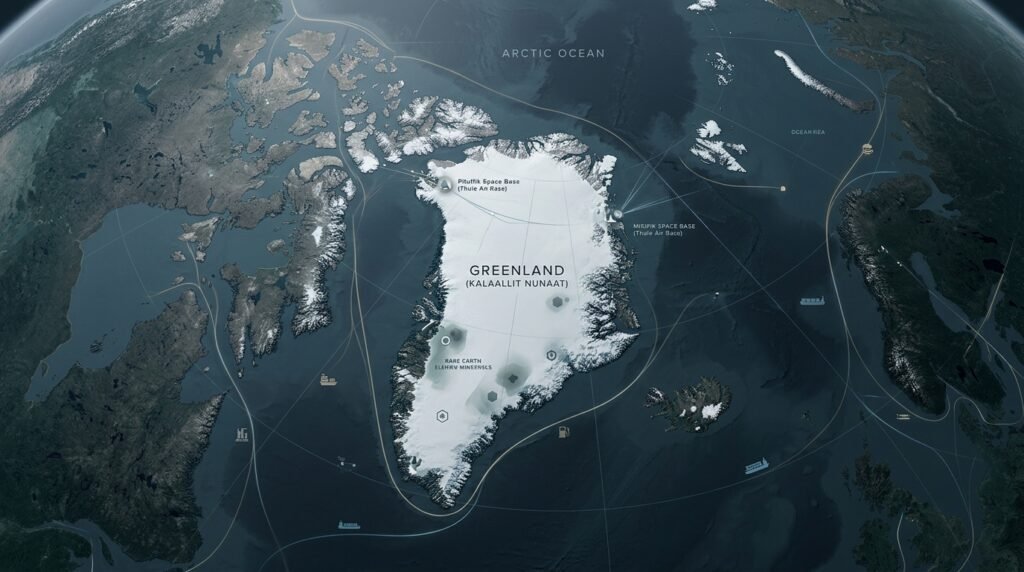
Why the United States Wants Greenland: Missile Defence, Minerals, and the Contest for the Arctic Approaches
Why does the United States want Greenland? An assessment of missile defence, rare earths, the GIUK gap and the fracture lines inside NATO.
Executive Summary
The United States has spent two years pursuing sovereignty over territory to which it already enjoys effectively unlimited military access. That paradox is the analytical core of the Greenland question, and it is why conventional security explanations — early warning, sea lanes, minerals — are necessary but insufficient accounts of American behaviour.
Washington’s stated rationale rests on three pillars: Greenland’s position beneath the polar trajectories that any intercontinental or hypersonic attack on North America must traverse; its command of the maritime approaches through which the Russian Northern Fleet must transit to reach the Atlantic; and its endowment of heavy rare earth elements at a moment of acute Western supply-chain anxiety. Each pillar is real. None of them requires a change of sovereignty, because the 1951 Defense of Greenland Agreement, amended in 1981 and 2004, already authorises the American presence that the security case demands.
The residual explanations are anticipatory and ideological. The anticipatory argument holds that Danish guarantees are a wasting asset: Greenlandic independence, which a majority of Greenlanders favour in principle, would dissolve the legal architecture underwriting American access, and Washington wants that access locked in irrespective of who governs Nuuk. The ideological argument holds that territorial acquisition serves a hemispheric doctrine articulated in the 2025 National Security Strategy, in which the Western Hemisphere is reasserted as an American sphere and formal ownership is preferred to treaty rights.
The 2026 coercion campaign failed. It produced European counter-deployment, Danish rearmament, a collapse in Greenlandic goodwill and no sovereignty concession. The most probable outcome through 2029 is an expanded American military footprint negotiated within existing legal frameworks — the outcome available in 2025 at a fraction of the alliance cost incurred.
Key Judgments
- The security case for Greenland is genuine; the sovereignty case is not derived from it. The capabilities Washington cites — missile warning, space surveillance, maritime domain awareness, forward basing — are all available under the 1951 agreement. Confidence: High.
- The strongest coherent rationale for pursuing ownership is anticipatory: insuring American access against a future independent Greenland. This logic is rarely stated publicly but is consistent with reported negotiating positions seeking access of unlimited duration. Confidence: Moderate.
- The coercion campaign of January 2026 was strategically counterproductive. It triggered the first multinational European deployment to Greenland directed implicitly against a NATO ally, accelerated Danish Arctic rearmament, and hardened Greenlandic opinion. Confidence: High.
- The Russian and Chinese threat to Greenland specifically has been overstated relative to the evidence. Denmark has consistently blocked Chinese infrastructure and mining access; Chinese Arctic military capability remains limited. Confidence: Moderate to High.
- Military seizure is effectively off the table; economic coercion is not. Domestic opinion, congressional resistance across both parties, and operational difficulty foreclose the military option. Tariff and inducement instruments remain available. Confidence: High.
- Greenland’s own trajectory — not American or Danish preference — is the decisive long-term variable. A Greenlandic independence process would reopen every question the 2026 talks attempted to close. Confidence: Moderate.
- Most probable outcome through 2029: a renegotiated defence framework with expanded basing and minerals screening, without transfer of sovereignty. Likelihood: High (approximately 50–55%).
Introduction
Strategic assessments of Greenland routinely begin with geography and end with resources. That sequence obscures the more interesting question. If the United States has held basing rights in Greenland since 1941, operated its northernmost installation there continuously since 1951, and retains the treaty right to expand that presence with notification rather than permission, why did an American administration expend substantial alliance capital in an attempt to acquire the island outright?
Answering that requires separating three things that public debate has fused: what Washington needs, what Washington says it needs, and what Washington has tried to obtain. The gap between the first and the third is where the strategic logic — and its limits — becomes visible.
This assessment examines the drivers, constraints and second-order effects of American Greenland policy, weighs competing interpretations of American intent against their underlying assumptions, and offers scenario-based forecasts through 2030.
Historical Background
From recognition to basing
American recognition of Danish sovereignty over Greenland is old, repeated and unambiguous. It appears in the 1916 treaty transferring the Danish West Indies, in the 1941 wartime defence agreement, in the 1951 Defense of Greenland Agreement, and again in the 2004 amendment, which acknowledged Greenland’s status within the Danish Realm under home rule.The United States recognised Danish sovereignty over Greenland in the 1916 Treaty of the Danish West Indies, reiterated it in the 1941 US–Danish agreement, again in the 1951 Greenland Defense Agreement, and in the 2004 amendment acknowledged Greenland as an equal part of the Kingdom of Denmark with wide-ranging home rule. Wikipedia
The operational relationship began during the Second World War, when Danish and Greenlandic officials invited American forces while metropolitan Denmark was under German occupation. Cold War expansion followed: at its peak the American presence approached ten thousand personnel across seventeen installations, concentrated at what was then Thule.The United States once had over 10,000 troops and 17 military installations in Greenland; today it maintains one base, the Space Force-operated Pituffik Space Base, supporting missile warning, missile defense, and space surveillance. Post-Cold War drawdown reduced that footprint to roughly 150 personnel by 2026.After the Cold War, Greenland became a lower strategic priority for the United States, which gradually reduced its presence to roughly 150 personnel by 2026. Congress.govWikipedia
The purchase tradition
Acquisition proposals are not novel. President Truman offered $100 million for the island in 1946; Denmark declined but granted long-term basing rights through the 1951 agreement.One of the boldest offers came in 1946 under President Truman, who proposed $100 million for the island; Denmark declined but granted long-term US military basing rights via the 1951 defense agreement. The idea resurfaced in 2019 and again after the 2024 election, this time with an intensity and a coercive register the earlier episodes lacked. yahoo
The 2025–2026 escalation
The second Trump administration moved through escalating instruments: a vice-presidential visit to Pituffik in March 2025 conducted without invitation; the transfer of Greenland from European Command to Northern Command in June 2025, framed as an Arctic security measure;In June 2025 Trump directed the shift of Greenland from United States European Command to United States Northern Command, which the Pentagon framed as reflecting a focus on Arctic security and strengthening homeland defence. the appointment of a special envoy for Greenland in December 2025; and, in January 2026, a tariff ultimatum against eight European states demanding Denmark sell the territory.On January 17, 2026, Trump said he would impose tariffs beginning February 1 on Denmark, Norway, Sweden, France, Germany, the United Kingdom, the Netherlands, and Finland until a deal was reached for the purchase of Greenland. NaadsnCongress.gov
That campaign peaked and collapsed within a fortnight. After European counter-deployments and an emergency EU response, the President ruled out force at Davos and announced a “framework” with the NATO Secretary General, dropping the tariff threat.On 21 January 2026 Trump reversed course, first ruling out military force and then abandoning tariff threats after talks with NATO Secretary-General Mark Rutte produced what he called a framework of a future deal. NATO officials clarified that alliance discussions concerned Arctic security rather than control of the island. Wikipedia
Strategic Context
Greenland sits at the intersection of four systemic trends: the return of homeland missile defence as an organising concept in American strategy; the re-emergence of the North Atlantic as a contested theatre; the securitisation of critical mineral supply chains following Chinese export controls; and a doctrinal shift in Washington toward hemispheric primacy.
The 2025 National Security Strategy does not name Greenland, but it reorients American policy toward the Western Hemisphere and articulates what it terms a corollary to the Monroe Doctrine.The 2025 National Security Strategy mentions neither Greenland nor Denmark directly, but outlines a reorientation toward the Western Hemisphere and describes a “Trump Corollary” likened to the 1823 Monroe Doctrine as a restoration of American power and priorities. Read alongside the January 2026 intervention in Venezuela, that framing supplies the ideational context in which Greenland became a target rather than a partner. Naadsn
It matters that these trends are not equally weighted in Washington’s own internal logic. Missile defence is a genuine capability requirement with a defined architecture. Hemispheric doctrine is a preference. Conflating them — as public advocacy has done — makes a contingent political project look like a necessity.
Detailed Analysis
Military Dimension
The polar geometry problem. Every intercontinental ballistic missile, submarine-launched ballistic missile, and hypersonic glide vehicle directed at North America from Eurasia transits Arctic airspace. Greenland occupies the shortest great-circle corridor between Russian launch areas and the continental United States. This is not a matter of strategic preference; it is spherical geometry.
Pituffik Space Base hosts the 12th Space Warning Squadron and its AN/FPS-132 Upgraded Early Warning Radar, a solid-state phased array that detects and characterises ballistic missile launches and supports space domain awareness.The 12th Space Warning Squadron operates the Upgraded Early Warning Radar, a phased-array system that detects and reports attack assessments of sea-launched and intercontinental ballistic missile threats for strategic missile warning and missile defense, while also tracking objects in orbit. The radar’s two faces each cover 120 degrees, giving 240 degrees of coverage with millisecond beam steering.The UEWR is a solid-state active antenna radar with two faces covering 120° each, or 240° in total, with the beam directed in milliseconds, increasing responsiveness and multi-target tracking capability. Yahoo NewsWar Wings Daily
Why this matters for Golden Dome. The decisive variable in missile defence is not detection but usable warning time. An intercontinental trajectory allows roughly twenty-five to thirty-five minutes of flight, within which a track must be confirmed, classified, resolved into a firing solution and transmitted.On an intercontinental trajectory, flight time can be around 25 to 35 minutes depending on route and profile, and the useful window is shorter still because a track must be confirmed, classified, estimated, calculated, transmitted and then engaged. Under the Golden Dome architecture, Pituffik functions not as an interceptor site but as a northern node that refines and confirms tracks generated by space-based sensors, closing Arctic blind spots in the detection-to-engagement chain.Under the proposed Golden Dome homeland defense concept, Pituffik is not intended to serve as a missile interceptor base; it operates as a critical node in which space-based sensors detect and track threats globally while forward nodes such as Pituffik refine and confirm tracks over the Arctic. War Wings DailySmall Wars Journal
Hypersonic glide vehicles sharpen this requirement. Because they fly lower and manoeuvre unpredictably, they exploit gaps in upward-looking sensor coverage, increasing the value of forward Arctic radars that can hold custody of a track across its trajectory.
The maritime dimension. Greenland anchors the western end of the Greenland–Iceland–United Kingdom gap, the chokepoint through which Russian submarines must pass to reach North Atlantic patrol areas. It also flanks both polar shipping corridors — the Northwest Passage through the Canadian archipelago and the Northeast Passage along Russia’s coast — giving surveillance from Greenland unusual coverage of Arctic maritime movement.
The expansion question. Reporting in April 2026 indicated that the United States was negotiating to add three installations, including Narsarsuaq in the south, which offers a deepwater port, and Kangerlussuaq in the west, which has a major airfield.The New York Times reported on 1 April 2026 that the US was actively negotiating to expand its military presence in Greenland with three additional bases, with Northern Command examining Narsarsuaq, which offers a deepwater port, and Kangerlussuaq, which already has a major airport. This is the substantive military objective. It is achievable under the 1951 agreement, which permits expanded deployment subject to notification of Danish and Greenlandic authorities.The 1951 defence pact, last updated in 2004, already allows Washington to increase troop deployments on the island as long as authorities in Denmark and Greenland are informed in advance. Naadsnyahoo
The vulnerability nobody discusses. Pituffik’s ground defence is oriented toward raid and intrusion scenarios rather than air and missile threats. Analysts have argued for a layered Arctic air defence combining medium-range and short-range systems around the installation — a requirement that grows more urgent as the site becomes more central to continental defence.In a Small Wars Journal essay, analysts advocated a layered air defence for Pituffik using short- and medium-range systems adapted to Arctic operations, potentially including Patriot batteries, NASAMS, and short-range air defence systems. A more valuable node is a more attractive target; the acquisition debate has consistently displaced this operational problem. yahoo
Political Dimension
Greenland. The island’s 57,000 residents have responded to American pressure by consolidating against it. Polling in January 2025 found 85 per cent opposed to leaving Denmark for the United States, with 6 per cent in favour — while 56 per cent supported eventual independence.A Verian poll conducted in Greenland in January 2025 found that 85% said no when asked whether Greenland should leave the Danish realm and become part of the United States, with 6% saying yes; on independence from the Kingdom of Denmark, 56% said yes. That distribution is the single most important political fact in the file: Greenlanders want sovereignty, not a change of metropole. Naadsn
The 2025 election returned a parliament in which every party favours independence but differs on pace, with Demokraatit taking ten seats and Naleraq, which seeks an accelerated process, taking eight.Five parties entered the 31-seat Greenlandic Parliament: Demokraatit with 10 seats, Naleraq with 8, Inuit Ataqatigiit with 7, Siumut with 4, and the unionist Atassut with 2. American pressure paused rather than accelerated that agenda; the Prime Minister stated that forced to choose immediately between Washington and Copenhagen, Greenland chooses Denmark.On January 13, Greenland Prime Minister Jens-Frederik Nielsen stated that if forced to choose between the United States and Denmark, Greenland chooses Denmark, and that Greenland does not want to be governed by the United States. NationaliaCongress.gov
Denmark. Copenhagen’s response combined rearmament with alliance mobilisation. By January 2026 more than 88 billion kroner — roughly $13.7 billion — had been committed to Arctic and North Atlantic defence.By 19 January 2026, over kr. 88 billion (US$13.7 billion) had been committed to strengthening defence and security in the Arctic, with kr. 29 billion for F-35 fighter jets and kr. 27.8 billion for anti-aircraft warfare. The Danish Defence Intelligence Service listed the United States as a national security concern for the first time in its history.The official Danish threat assessment published by the Danish Defence Intelligence Service in 2025 mentioned the United States as a threat to national security for the first time, alongside Russia and China. WikipediaWikipedia
The domestic political return was smaller than expected. Frederiksen called a snap election citing the need to define Denmark’s relationship with Washington, then saw her Social Democrats fall to 21.85 per cent and 38 seats — a loss of twelve — with neither bloc securing a majority.In the 24 March 2026 Danish general election the Social Democrats under Mette Frederiksen won 21.85% and 38 seats, down 12, with the government after the election being Frederiksen III, a coalition of the Social Democrats, Green Left, Moderates and Social Liberals. Voters prioritised domestic concerns over the Greenland crisis.Denmark’s election ended inconclusively after a campaign that focused on bread-and-butter issues rather than the prime minister’s handling of the crisis over Trump’s ambitions toward Greenland. This is a useful corrective to assumptions that external threat reliably produces rally effects. WikipediaCNN
The United States. Domestic support for the project was never established. An AP-NORC survey in February 2026 found 72 per cent of Americans disapproving of the administration’s handling of Greenland, including 48 per cent of Republicans.A poll conducted by the AP-NORC Center for Public Affairs Research found that 72% of Americans disapproved of President Trump’s handling of the Greenland situation, including 48% of Republicans. Earlier polling found 8 per cent supporting military acquisition against 73 per cent opposed, and only 28 per cent supporting purchase.A YouGov poll in mid-January found only 8% of Americans supported using military force to take Greenland from Denmark, with 73% opposition; buying Greenland had 28% support with 45% opposition. NaadsnWikipedia
Congressional resistance was bipartisan and institutional, producing legislation to bar funding for operations against NATO members and protected territories.Democratic and Republican senators introduced the bipartisan No Funds for NATO Invasion Act, prohibiting federal funds for the invasion of any NATO member state or NATO-protected territory, as well as the NATO Unity Protection Act. Wikipedia
Economic Dimension
The scale problem. Greenland’s economy is small and structurally dependent. GDP is approximately $3–3.6 billion, fisheries account for roughly 90 per cent of exports, and the Danish block grant — DKK 4.45 billion in Denmark’s 2025 finance act — supplies just over half of treasury revenue and just under 20 per cent of GDP.Danmarks Nationalbank describes the block grant as DKK 4.45 billion in Denmark’s 2025 Finance Act, accounting for just over half of Greenland’s national treasury revenue and just under 20 percent of GDP, roughly DKK 80,000 per person per year, while seafood exports account for over 90 percent of total exports. Denmark additionally funds policing, courts, defence and environmental functions worth roughly €204 million annually.Beyond the block grant, Denmark maintains direct fiscal responsibility for services totaling approximately €204 million annually as of 2023, covering police, military and defense operations, prisons, courts, research and environmental protection. Spreadsheet Point–
Any external power assuming Greenland’s governance inherits that subsidy structure. The fiscal transfer is not large by American standards; the political obligation is.
Critical minerals. Greenland ranks eighth globally in rare earth reserves at roughly 1.5 million tons and hosts two of the world’s largest deposits, Kvanefjeld and Tanbreez.Greenland ranks eighth in the world for rare earth reserves, with 1.5 million tons, and is home to two rare earth deposits among the largest in the world: Kvanefjeld and Tanbreez. American policy has pursued Tanbreez directly: the Export-Import Bank issued a letter of interest for a $120 million loan in June 2025,In June 2025, the U.S. Export-Import Bank sent a letter of interest to Critical Metals Corp for a $120 million loan to fund the company’s Tanbreez rare earth mine in Greenland, which if approved would be the administration’s first overseas investment in a mining project. and by April 2026 Critical Metals Corp held 92.5 per cent of the project following Greenlandic government approval.On April 17, 2026, Critical Metals Corp announced that the Government of Greenland had approved the transfer of the remaining 50.5% interest in Tanbreez Mining Greenland A/S, bringing total ownership to 92.5%. First ore is targeted for late 2028 or early 2029.First ore production is targeted for Q4 2028 or Q1 2029, with commercial concentrate exports expected around Q3 2029. Greenland, Rare Earths, and Arctic Security | CSIS +3
Two observations follow. First, the commercial objective was being achieved through ordinary market and regulatory processes under Danish sovereignty — the annexation campaign was not required to secure it. Second, the timelines are long: no Greenlandic rare earth production will materially affect supply balances before the end of the decade.
The coercion effect on capital. Paradoxically, American pressure has increased Greenland’s bargaining position. Brussels announced a €200 million package in September 2026 and proposed doubling direct aid to €530 million in the 2028–2034 budget.European Commission President Ursula von der Leyen offered a €200 million ($231.9 million) package for climate, connectivity and fisheries over two years, while Brussels proposed doubling direct aid to Greenland to €530 million under the bloc’s 2028-2034 budget. Private capital has followed, with one American venture seeking up to $200 million by 2027 for aviation, shipping, data centre and tourism infrastructure.Greenland Energy chairman Larry Swets is aiming to raise up to $200 million by the end of 2027 to build out aviation, maritime shipping, data centres and tourism infrastructure in Greenland. Nuuk now arbitrages Washington against Brussels — an outcome no one in Washington intended. The NationalThe National
Persistent obstacles. Greenland has blocked an Australian company’s mine over uranium content, Kvanefjeld remains suspended on environmental grounds, and a drilling campaign has faced permitting delays.Greenland has blocked Australian company Energy Transition Minerals’ plans to establish a mine because of uranium at the site, the Kvanefjeld rare earth project has been on hold over environmental concerns, and Greenland Energy’s drilling campaign is facing permitting delays. Greenlandic regulatory sovereignty is the binding constraint on resource extraction — which is precisely why it became an object of American attention. The National
Technological Dimension
The Arctic is being reconstituted as a sensor environment rather than a manoeuvre theatre. Value accrues to fixed infrastructure — radars, satellite ground stations, undersea cables, communications relays — and to the integration layer connecting them.
Denmark has invested accordingly, funding coastal radars, satellite surveillance, a new undersea cable to Greenland, and Arctic-capable special operations units.The October 2025 agreement provided kr. 27.4 billion for upgrades including Kangerlussuaq Airport, a new specialised Arctic unit under the Jaeger Corps, radar capability in East Greenland, a Greenlandic reconnaissance unit, and construction of a new undersea cable connecting Greenland to mainland Denmark. These are complementary to, not competitive with, American sensor requirements — which strengthens the case that a cooperative architecture was always available. Wikipedia
The proposition that Greenland could host large-scale data centre capacity, occasionally floated in investment commentary, faces severe constraints in transmission infrastructure, construction logistics and workforce availability. It should be treated as speculative rather than as a driver of policy.
Legal and Diplomatic Dimension
The treaty position. Denmark’s title is not seriously contestable in law. It rests on effective administration, an interwar ruling of the Permanent Court of International Justice affirming Danish sovereignty over the whole island, and repeated American recognition in binding instruments. Senior administration figures have addressed this not by disputing the law but by subordinating it: the deputy chief of staff argued the question should turn on power relations and security needs rather than legal niceties.Trump has suggested Denmark’s claim to Greenland is doubtful, reflecting the public musings of Deputy Chief of Staff Stephen Miller, who added that rather than the niceties of international law, the issue should be determined according to power relations among nations and their security needs. Chatham House
The self-determination counterweight. Greenland was recognised in 2009 as a people entitled to external self-determination, and the Self-Government Act provides a pathway to independence subject to Greenlandic decision.In 2009, Greenland was recognised by the Kingdom of Denmark and under international law as a people entitled to external self-determination. Any transfer of sovereignty without a free Greenlandic choice would violate this framework — which is why even sympathetic American proposals have shifted toward inducement of Greenlandic secession rather than purchase from Denmark. Wikipedia
The alliance-law problem. Denmark’s position is that an attack on the Kingdom triggers Article 5, and its defence committee chair stated Copenhagen would invoke it against the United States if attacked.The Danish Ministry of Defence said Danish troops would immediately respond to an invasion of Greenland with force, and the chairman of the Defence Committee, Rasmus Jarlov, said Denmark would invoke Article 5 if attacked by the US. The scenario is legally incoherent — the alliance has no mechanism for one member attacking another — and its mere articulation constituted serious damage to deterrence credibility. Wikipedia
The sovereign base proposal. Analysts floated a Cyprus-style arrangement in which specified installations would be held under American sovereignty without broader territorial transfer.Anonymous Western security officials said a proposed framework could be modelled after a “sovereign base area” agreement in Cyprus, where British military bases are regarded as sovereign British territory. Both Copenhagen and Nuuk rejected it as a red line.On 26 January, Greenland’s government said transferring sovereignty of any Greenlandic land, including bases, is not possible and described it as a red line. The Danish defence minister stated the same limit while welcoming expanded Arctic cooperation.Danish Defence Minister Troels Lund Poulsen said it was very positive that NATO wanted to strengthen Arctic security but warned of a clear red line: Denmark will not cede sovereignty over parts of the kingdom. Recent Developments of Greenland-US Relations – NAADSN +2
Competing Interpretations
Three readings of American intent circulate among serious analysts. Each rests on different assumptions and generates different predictions.
The anticipatory-realist reading. Washington is not securing access it lacks; it is insuring access it expects to lose. Greenlandic independence would void Danish guarantees and create a micro-state with immense strategic real estate and a $3 billion economy — an obvious target for external inducement. On this reading, the demand for access of unlimited duration is the substantive American objective, and reported negotiating positions support it.A US official said the main facets of a possible deal involve giving the United States total access to parts of Greenland for an unlimited amount of time, including updating the 1951 agreement so access is not curbed under any circumstances, for example if Greenland were to gain independence. Assumption: Greenlandic independence is probable within two decades and would be strategically destabilising. This is the most analytically defensible account. ABC News
The mercantilist reading. Policy is driven by resource capture and commercial access for American firms, consistent with the administration’s approach elsewhere. Assumption: economic extraction is the organising motive of foreign policy. This explains the minerals emphasis but not the willingness to risk the alliance, since commercial access was already being obtained.
The doctrinal-expansionist reading. Greenland is an instance of a hemispheric programme in which formal territorial control is preferred to treaty rights, and in which acquisition serves domestic legitimation. Assumption: territorial expansion carries intrinsic political value independent of security return. This best explains the insistence on ownership over leasing and the rejection of arrangements delivering equivalent capability.
Structural theory applied. Offensive realists would predict exactly this behaviour: a regional hegemon eliminating potential footholds on its approaches. Balance-of-threat theorists would predict the observed outcome — that coercing allies generates balancing against the coercer, evidenced by the first multinational European deployment to Greenland, EU consideration of its anti-coercion instrument, and accelerated European defence integration. Institutionalists note the sharpest irony: the alliance framework had already delivered, at near-zero cost, what coercion failed to obtain.
Scenario Analysis
Scenario A — Negotiated Arctic framework (baseline). The 1951 agreement is updated or supplemented. The United States gains additional facilities at Narsarsuaq and Kangerlussuaq, formalised long-duration access, and screening provisions excluding non-NATO states from strategic mineral rights. Sovereignty is untouched. NATO’s Arctic posture is institutionalised. Drivers: mutual interest in de-escalation; genuine convergence on Russian and Chinese exclusion; Danish willingness to expand basing. Indicators: continued working-group meetings; announcement of new facility agreements; congressional treaty action.
Scenario B — Managed drift. Talks continue without a concluding instrument. Periodic rhetorical escalation recurs around summits. The American footprint expands incrementally through existing authorities. Alliance relations remain strained but functional. Drivers: Danish coalition fragility; American attention diverted by other theatres; absence of a deal acceptable to all three capitals.
Scenario C — Independence pathway opens. Greenland advances toward a referendum, catalysed by resource revenues or by a constitutional process. Washington pivots to a free-association arrangement modelled on the Pacific compacts. Denmark’s block grant becomes the central negotiating variable. Drivers: a self-government report on independence alternatives expected by end-2026;A report is expected from the Greenlandic self-government by the end of 2026 that will point out possible alternatives for independence; the majority of Greenlanders want independence from Denmark, but only when it is economically feasible. Naleraq’s referendum commitment; mining revenue growth. The Arctic Institute
Scenario D — Coercive escalation redux. Tariffs, sanctions or direct financial inducements to Greenlanders are revived, possibly linked to electoral incentives. Drivers: midterm politics; frustration at negotiation pace. Constraints: demonstrated European willingness to retaliate; American business opposition; the failure of the January 2026 attempt.
Scenario E — Military seizure. Forcible acquisition or occupation. Constraints: overwhelming domestic opposition; bipartisan congressional prohibition; Danish standing orders to resist; the alliance-destroying consequence; and the reported outcome of options briefings, which led to a decision against.Trump had asked the chairman of the Joint Chiefs of Staff to present potential options and impacts of using military force to seize Greenland, ultimately resulting in Trump deciding against an invasion, administration officials told NBC News. Wikipedia
Probability Assessment
| Scenario | Horizon | Likelihood | Principal reasoning |
|---|---|---|---|
| A — Negotiated Arctic framework | 2026–2029 | High (≈50–55%) | Delivers American capability objectives at acceptable cost to all parties; negotiating track already established; both Copenhagen and Nuuk have signalled openness to expanded security cooperation short of sovereignty transfer |
| B — Managed drift | 2026–2029 | Moderate (≈25–30%) | Danish coalition arithmetic is unstable; American attention is contested by other theatres; no party bears acute cost from non-agreement |
| C — Independence pathway | 2028–2035 | Low–Moderate (≈10–15% by 2029; higher thereafter) | Greenlandic majorities favour independence in principle but condition it on fiscal viability; resource revenues will not reach material scale before 2030 |
| D — Coercive escalation redux | 2026–2028 | Low (≈5–10%) | Instrument demonstrably failed; European retaliation capability established; domestic political cost high |
| E — Military seizure | Any | Very Low (<2%) | Foreclosed by domestic opinion, congressional action, operational difficulty and alliance consequences |
These are qualitative judgments derived from observable behaviour, stated positions and structural constraints. They are not derived from a formal model and should be revised against the indicators listed above.
Strategic Outlook
For the United States. The capability objectives are attainable and probably will be attained. The cost has been the depreciation of an asset that took seventy-five years to build: the presumption among allies that American power is exercised within agreed rules. European leaders now openly discuss reducing reliance on Washington, and Arctic partners that had voluntarily excluded Chinese investment did so on the assumption of a common security framework. That assumption has been damaged in ways that expanded basing rights do not repair.
For Denmark. Copenhagen has purchased credibility through rearmament and alliance mobilisation, but its structural position is unchanged: it cannot defend Greenland unilaterally and cannot indefinitely finance a territory whose political trajectory points away from the Realm. Its optimal strategy is to make the Kingdom the framework within which Greenlandic aspirations are realised — the approach visible in the September 2026 trilateral declaration with Brussels and Nuuk.Von der Leyen signed a new joint declaration with leaders in Greenland and Denmark, stating that Greenland’s future is for the people of Greenland and Denmark to decide, and no one else. The National
For Greenland. Nuuk has gained leverage it did not seek and has used it competently. The risk is that competing external suitors distort domestic politics, that resource expectations outrun geological and commercial reality, and that the independence question is decided under external pressure rather than on Greenlandic timelines.
For Russia and China. Moscow’s return is asymmetric and cheap: alliance division at no cost, with a stated readiness to respond to Arctic militarisation with military-technical countermeasures.Russian Foreign Minister Sergey Lavrov stated that in the event of the militarisation of Greenland and the creation of military capabilities aimed at Russia, Moscow would take adequate counter-measures, including military-technical ones. Beijing benefits rhetorically from an American precedent for territorial revisionism, while its actual Arctic position remains constrained: Arctic states have blocked Chinese investment in sensitive sectors including Greenlandic infrastructure, and near-term military capability remains limited.Several Arctic states have blocked or restricted proposed Chinese investments in strategically sensitive sectors, including infrastructure projects in Greenland, and China’s near-term military capabilities in the Arctic remain limited. Anticipated Chinese investment in polar port infrastructure did not materialise.The expected massive Chinese investment in polar ports and infrastructure never materialised. Recent Developments of Greenland-US Relations – NAADSN +2
The central watchpoint. Whether Washington converts the September 2026 equilibrium — expanded allied exercises, European economic engagement, quiet technical talks — into a durable instrument, or allows it to erode through renewed rhetorical escalation. NATO’s Arctic Shield exercise in September 2026 brought roughly 400 personnel from eleven allied nations to Narsarsuaq and the Kangerlussuaq fjord system,NATO’s Arctic Shield exercise, running from September 7 to 18, brings together about 400 personnel from 11 allied nations to train near Narsarsuaq in southern Greenland and the Kangerlussuaq fjord system in the west. demonstrating that the multilateral alternative is operationally live. The National
Conclusion
The United States wants Greenland because Greenland sits beneath the shortest path between Eurasian missile fields and North American cities, because it flanks the corridor through which Russian submarines reach the Atlantic, and because it holds heavy rare earths at a moment when Western supply chains are exposed. These reasons are sound.
They do not explain the campaign of 2025–2026, because none of them required a change of sovereignty. That campaign is better explained by a combination of anticipatory hedging against Greenlandic independence and a doctrinal preference for ownership over treaty rights — a preference that treats alliance arrangements as inferior to possession even when they deliver identical capability.
The result was a demonstration of the limits of coercion applied to allies. Washington ends the episode with the same set of options it held at the outset, minus a considerable stock of trust. The strategic question for the coming decade is not whether the United States will hold military access to Greenland — it will — but whether that access rests on consent or on a residue of resentment. The first configuration is durable. The second is not.
Frequently Asked Questions
Does the United States already have military access to Greenland?
Yes. The 1951 Defense of Greenland Agreement, amended in 1981 and 2004, permits the United States to operate defence areas in Greenland and to expand its presence with advance notification to Danish and Greenlandic authorities. It currently operates one installation, Pituffik Space Base.
Can Denmark legally sell Greenland?
No. Greenland’s status is protected by the Danish constitution and by Greenland’s recognised right to external self-determination under the 2009 Self-Government Act. Any change of status requires Greenlandic consent expressed through its own institutions.
Is there a genuine Chinese or Russian threat to Greenland?
The Russian threat is regional rather than territorial, concerning Arctic maritime and air approaches. Chinese activity in Greenland has repeatedly been blocked by Danish and Greenlandic authorities, and Chinese Arctic military capability remains limited. Some analysts assess that threats to Greenland specifically have been overstated.A US Naval Institute Proceedings analysis argued that Russian and Chinese threats to Greenland and the new Arctic sea routes are low, and that while the Arctic security situation bears close monitoring, it is important not to overhype it. U.S. Naval Institute
What is Golden Dome and how does Greenland fit?
Golden Dome is a proposed layered homeland missile defence architecture. Greenland’s role is sensing rather than interception: the radar at Pituffik confirms and refines tracks over the Arctic, closing coverage gaps in the detection-to-engagement sequence.
Will Greenland become independent?
A majority of Greenlanders support independence in principle but condition it on economic viability. A self-government report examining independence pathways was expected by the end of 2026. Independence within the next decade is possible but not currently probable.
Sources
- Congressional Research Service, Greenland, Denmark, and U.S. Relations (IN12643), congress.gov
- Defense of Greenland: Agreement Between the United States and the Kingdom of Denmark, 27 April 1951 — Avalon Project, Yale Law School
- North American and Arctic Defence and Security Network (NAADSN) and Canadian Maritime Security Network, Recent Developments of Greenland–US Relations timeline
- Center for Strategic and International Studies, Greenland, Rare Earths, and Arctic Security
- United States Department of Defense, Arctic Strategy 2024
- The White House, National Security Strategy 2025
- Joint Statement by the Nordic Foreign Ministers on Greenland, 6 January 2026 — Government of Norway
- Joint Statement on Greenland by France, Germany, Italy, Poland, Spain, the United Kingdom and Denmark, 6 January 2026 — Danish Prime Minister’s Office
- Danmarks Nationalbank and Statistics Greenland — national accounts, block grant and fisheries data
- European Parliamentary Research Service — Greenland briefing papers
- Danish Ministry of Defence — Arctic and North Atlantic agreements, 2025–2026
- Danish Defence Intelligence Service — annual threat assessment, 2025
- Greenland’s Foreign, Security and Defence Policy 2024–2033: An Arctic Strategy, Government of Greenland
- UK House of Commons Library, President Trump and Greenland: Frequently Asked Questions (CBP-10472)
- US Naval Institute Proceedings, January 2026 — Arctic threat assessment
- Small Wars Journal (Arizona State University) — Greenland and North American strategic defence; Arctic missile and air defence
- RAND Corporation — Is the Polar Silk Road a Highway or Is It at an Impasse?
- Chatham House — Who Owns Greenland?
- Danish Institute for International Studies (DIIS) — Greenland, decolonisation and free association
- The Arctic Institute — Polar Silk Road and Greenland analyses
- Verian (January 2025), YouGov, Pew Research Center and AP-NORC (2026) opinion surveys
- Critical Metals Corp corporate disclosures, 2026; Export-Import Bank of the United States
- NATO — Arctic Sentry and allied Arctic exercise announcements
- European Commission — Greenland funding package and joint declaration, September 2026