Great Power Competition, Geopolitics
Rimland Theory: Why Eurasia’s Periphery Still Matters in Global Power Competition
For much of the twentieth century, geopolitical strategy was shaped by a deceptively simple question: where is the decisive geography of global power?
Halford Mackinder placed the answer in the Eurasian interior. His Heartland Theory argued that control of the continental core could provide the foundation for wider domination of the Eurasian “World-Island.” Nicholas Spykman reached a different conclusion. He argued that the decisive zone was not the inaccessible continental core but the vast coastal belt surrounding it—the Rimland.
Nearly a century later, the debate remains relevant.
The geography has not disappeared. Eurasia still contains the world’s largest concentrations of population, industrial capacity, energy resources, economic markets and military power. Its western, southern and eastern margins also contain the principal maritime routes through which much of that economic power moves.
What has changed is the character of competition.
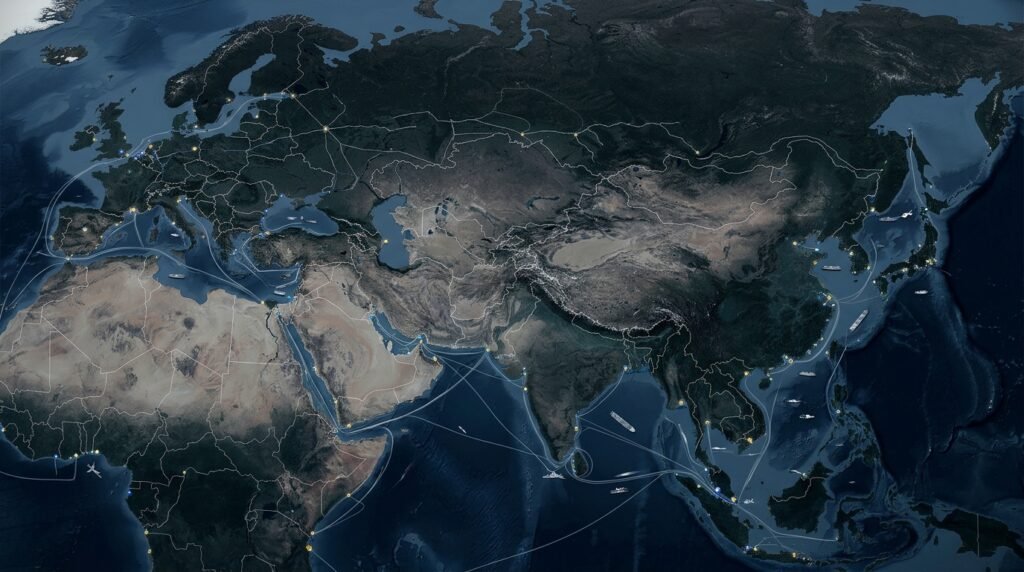
The modern Rimland is no longer simply a geographic belt that armies must occupy. It is a strategic system of ports, sea lanes, industrial corridors, alliances, technological networks, energy infrastructure and military access. Europe, the Middle East, South Asia and East Asia are connected through this system.
This makes Spykman’s theory useful—but only if it is updated rather than treated as a rigid geopolitical law.
Mackinder’s Heartland vs. Spykman’s Rimland
Mackinder and Spykman shared an important assumption: Eurasia is the central geographic arena of global power competition.
Their disagreement concerned where within Eurasia the decisive struggle would occur.
Mackinder’s Heartland centred on the interior of Eurasia, particularly the vast continental spaces of Eastern Europe and Central Asia. He believed that technological changes in land transportation could reduce the traditional advantage enjoyed by maritime powers and allow a continental power to mobilize the resources of the Eurasian interior.
Spykman accepted the importance of Eurasia but rejected the idea that its interior alone determined global power.
For him, the Rimland—the coastal and near-coastal regions surrounding the Eurasian landmass—was more important because it combined population, industrial capacity, resources, transportation networks and access to the surrounding seas.
In simplified form:
Mackinder: control of the Heartland could lead to control of Eurasia.
Spykman: control of the Rimland could determine who controls Eurasia.
The distinction remains useful because contemporary competition increasingly occurs at the intersection of continental and maritime power.
Recent scholarship has explicitly revisited the Heartland-Rimland debate in the context of China’s rise and the relationship between Central Asia and Indo-Pacific strategy.
What Is the Rimland?
Spykman’s Rimland roughly describes the populated and economically significant belt along the periphery of Eurasia.
It includes, in broad strategic terms:
- Western Europe
- The Mediterranean and Middle East
- South Asia
- Southeast Asia
- East Asia
This is not a precise political boundary. The value of the concept lies less in drawing a perfect line on a map than in identifying a strategic pattern.
The Rimland contains many of the geographic zones where continental power meets maritime power.
The Mediterranean connects Europe to the Middle East. The Persian Gulf connects the energy-producing interior of the Middle East to global markets. The Indian Ocean links the Middle East with South and East Asia. The South China Sea connects East Asian manufacturing centres with global maritime commerce.
The result is a continuous strategic arc surrounding much of Eurasia.
That arc is also where many of the world’s most consequential strategic rivalries are concentrated.
Why the Rimland Matters More Than Geography Alone
The strongest argument for the continued relevance of Rimland theory is not that geography determines political outcomes.
It does not.
Geography creates constraints and opportunities; states determine how they use them.
The contemporary Rimland matters because several forms of power overlap there.
First is population.
A large share of the world’s population lives along Eurasia’s southern and eastern margins.
Second is economic production.
Europe, China, Japan, South Korea, India and other Rimland economies contain enormous concentrations of industrial and technological capacity.
Third is maritime commerce.
Modern economic systems depend heavily on shipping. NATO itself describes maritime security, sea lines of communication and freedom of navigation as central to alliance security. Its 2025 Maritime Strategy explicitly emphasizes maritime power, access, sea lines of communication and protection of critical infrastructure.
Fourth is military access.
Ports, naval bases, airfields, logistics hubs and strategic waterways allow powers to project military force across enormous distances.
Finally, the Rimland contains many of the world’s most important chokepoints.
That makes it strategically valuable even when no major power seeks direct territorial control.
The Indo-Pacific Is a Modern Rimland Contest
Nowhere is Spykman’s logic more visible than in the Indo-Pacific.
The region contains the world’s most consequential concentration of maritime trade, manufacturing capacity, naval competition and great-power rivalry.
China is simultaneously a continental and maritime power.
It possesses enormous land depth and borders Central Asia, Russia and South Asia. At the same time, it has developed increasingly capable naval forces and seeks greater influence across the Western Pacific and Indian Ocean.
That creates a strategic problem for China’s competitors.
A purely continental strategy cannot contain Chinese maritime expansion.
A purely maritime strategy cannot fully address China’s influence across the Eurasian interior.
The result is a growing effort to connect the European, Middle Eastern, South Asian and Indo-Pacific theatres into a broader strategic framework.
This is one reason contemporary Indo-Pacific strategies increasingly intersect with developments far beyond the Pacific Ocean.
Recent academic work argues that Central Asia can no longer be treated as strategically separate from the Indo-Pacific because China’s continental position and its maritime ambitions reinforce one another.
Europe Is Part of the Rimland Equation
The western end of the Rimland is equally important.
Europe is not merely an American alliance platform or a secondary theatre in Eurasian competition. It is itself one of the world’s major concentrations of economic, technological and military power.
The war in Ukraine has demonstrated how European security remains connected to the broader Eurasian balance.
Russia’s position illustrates the complexity of the Heartland-Rimland relationship.
Russia possesses enormous continental depth and resource wealth, but its strategic objectives repeatedly intersect with the European Rimland.
Ukraine is therefore important not simply because of its territory.
Its position connects Eastern Europe, the Black Sea and the Eurasian interior.
The strategic significance of the region cannot be understood purely through the lens of land warfare. It also involves ports, energy infrastructure, logistics networks, economic corridors and access to maritime routes.
This is precisely where the Heartland and Rimland models begin to overlap.
The Middle East: Rimland as Strategic Infrastructure
The Middle East is another crucial part of the Rimland.
Its significance is not limited to oil.
The region sits between Europe, Africa and Asia and contains several strategic maritime gateways.
The Persian Gulf connects energy producers to global markets.
The Red Sea connects the Indian Ocean to the Mediterranean through the Suez Canal.
The eastern Mediterranean links European and Middle Eastern security systems.
The Gulf of Oman connects the Persian Gulf to the wider Indian Ocean.
A power that can influence these geographic systems does not necessarily control Eurasia, but it can affect the movement of energy, commerce and military forces across it.
That is the modern meaning of Rimland power.
It is often less about occupying territory than about influencing the connective tissue of Eurasia.
India and the Problem of Strategic Alignment
India demonstrates one of the limitations of using Rimland theory too mechanically.
Spykman’s framework might suggest that states on the Eurasian periphery will naturally align against a rising continental hegemon.
Reality is more complicated.
India has deep strategic concerns about China’s rise, particularly along their disputed land border and across the Indian Ocean.
Yet India has also maintained strategic autonomy and has resisted becoming a formal component of an American-led alliance system.
This matters because geography does not automatically produce alliances.
States calculate interests through domestic politics, economic dependence, historical relationships and perceptions of threat.
India can cooperate with the United States, Japan and Australia in the Indo-Pacific while maintaining relationships with Russia and other powers.
The Rimland therefore should be understood as a zone of strategic bargaining, not a predetermined alliance structure.
China and the Eurasian Rimland
China presents the most important test of Spykman’s theory.
China is unusual because it is simultaneously:
- a major continental power;
- a major manufacturing power;
- a nuclear power;
- an increasingly capable maritime power;
- a major trading state;
- and an important actor in Central Asia.
Its position allows Beijing to operate across both the Heartland and Rimland.
The Belt and Road Initiative illustrates this dual strategy.
Railways, pipelines, ports, industrial zones and logistics corridors can connect China to Europe and the Middle East through continental routes while Chinese maritime networks connect the same economic system through the Indian Ocean and beyond.
This does not mean China is automatically approaching Eurasian hegemony.
That conclusion would go beyond the evidence.
It does mean that China is increasingly capable of operating across the geographic divide that separated classical continental and maritime power.
That is one of the most important changes to the geopolitical environment since Spykman’s time.
The Rimland Is Becoming a Network
The classical Rimland was primarily geographical.
The contemporary Rimland is increasingly networked.
Power now moves through:
- ports;
- railways;
- pipelines;
- undersea cables;
- semiconductor supply chains;
- satellite networks;
- energy infrastructure;
- financial systems;
- military bases;
- logistics hubs.
This changes the strategic meaning of geography.
A country does not necessarily need physical control over a port to benefit from it.
It may obtain access through investment, commercial agreements, military partnerships or political influence.
Likewise, a state can disrupt a strategic network without occupying territory.
Cyber operations, sanctions, maritime coercion and attacks on infrastructure can affect the functioning of the Rimland without conventional conquest.
The result is a more complex form of geopolitical competition.
From Territorial Control to Strategic Access
This may be the most important modification required to Spykman’s theory.
In the twentieth century, strategic competition often revolved around territorial control.
In the twenty-first century, strategic access can be equally important.
The critical question is increasingly not:
Who owns this territory?
but:
Who can reliably move forces, goods, energy, information and capital through this territory?
That distinction changes the meaning of alliances.
Military partnerships can provide access without formal control.
Economic investment can create influence without sovereignty.
Infrastructure can create strategic dependence without occupation.
And maritime power can shape the behaviour of continental powers without controlling their territory.
Why the Theory Still Matters—and Where It Fails
Rimland theory remains useful because it directs attention toward a geographic fact that technological optimism sometimes obscures:
The physical structure of Eurasia still matters.
Ships still need ports.
Energy still needs routes.
Armies still require logistics.
Undersea cables still cross physical seas.
Industrial supply chains still depend on geographic infrastructure.
And states still compete for access to strategically located territories.
But Rimland theory should not be treated as a deterministic prediction.
It cannot explain every alliance.
It cannot predict state behaviour by geography alone.
It also emerged in an era before nuclear deterrence, satellites, cyber warfare, precision strike, global financial networks and digital infrastructure transformed the meaning of strategic power.
Its greatest value therefore lies not in predicting exactly what states will do but in identifying where competing forms of power are likely to intersect.
The Emerging Eurasian Strategic System
The contemporary geopolitical environment is producing something more complex than either a purely continental or purely maritime order.
China’s rise links the Eurasian interior to the Western Pacific.
Russia’s power connects the European theatre to the Arctic and Eurasian interior.
India links South Asia to the Indian Ocean and Central Asian strategic environment.
Europe remains a major economic and military centre on the western Rimland.
The United States remains the world’s most geographically capable offshore power, with alliance networks extending across both the Atlantic and Pacific.
The result is a strategic system in which the Heartland and Rimland are increasingly interconnected.
This is why Central Asia matters even to states primarily concerned with the Indo-Pacific.
It is also why developments in Europe can affect Asian strategic calculations, while events in the South China Sea can influence European security planning.
The geographic theatres are no longer isolated.
The Strategic Implication
The most important lesson from Rimland theory is not that whoever controls the Eurasian coast automatically controls the world.
That formulation is too deterministic for contemporary geopolitics.
The deeper lesson is that the balance of power in Eurasia is shaped heavily by the interaction between its continental core and its maritime periphery.
Any state seeking Eurasian influence must therefore solve two problems simultaneously.
It must develop sufficient continental reach to protect its strategic depth and resources.
And it must secure sufficient access to the maritime networks through which global commerce, technology and military power flow.
China is attempting to solve both problems simultaneously.
The United States and its partners are attempting to prevent any single power from dominating either side of the equation.
Europe, India, Japan and Southeast Asian states are attempting to preserve strategic autonomy while avoiding excessive dependence on any one major power.
That is why the Rimland remains strategically relevant.
Not because Spykman predicted the twenty-first century in detail, but because he identified a persistent feature of Eurasian power politics: the struggle for the balance of power is concentrated where continental depth meets maritime access.
And in an era of renewed great-power competition, that boundary is once again becoming one of the most consequential strategic spaces on Earth.