Great Power Competition, Geopolitics
The Arctic Frontier: Why the High North Is Becoming a New Arena of Great-Power Competition
Executive Summary
The Arctic is undergoing a structural transformation that is reshaping it from a zone of low-tension, rules-based cooperation into a theater of strategic competition among the United States, Russia, and China. Three forces are converging to drive this shift. First, accelerating climate change is physically opening the region: the National Snow and Ice Data Center recorded the Arctic’s winter sea-ice maximum tying a record low for the second consecutive year in March 2026, part of a documented decline of roughly 2.5 percent per decade since 1979. Second, the region’s resource endowment — an estimated 13 percent of the world’s undiscovered oil and 30 percent of its undiscovered natural gas, alongside globally significant deposits of rare-earth elements in Greenland — has become entangled with the broader contest over critical-minerals supply chains and energy security. Third, the institutional architecture that once insulated the Arctic from geopolitical rivalry, chiefly the Arctic Council, has been paralyzed since Russia’s 2022 invasion of Ukraine, removing the primary forum through which Arctic states managed disputes.
These trends have produced concrete flashpoints. Russia has sustained and, in places, expanded a Cold War-derived Northern Fleet military infrastructure on the Kola Peninsula and across its Arctic archipelagos, even as the war in Ukraine draws down other conventional forces. China, despite possessing no Arctic territory, has formalized a “Polar Silk Road” strategy, expanded its icebreaker fleet beyond that of the United States, and in 2024–2025 conducted Coast Guard and naval activity in Arctic waters that U.S. officials have characterized as unprecedented. NATO’s Arctic geography was transformed by the 2023–2024 accession of Finland and Sweden, giving the alliance continuous coastline along the approaches to the Barents Sea. And the United States, under the Trump administration, has pursued an assertive posture toward Greenland that in January 2026 produced an intra-alliance diplomatic crisis without precedent in NATO’s history — a dispute that, as of this writing, remains unresolved and continues to reverberate through Nordic security politics, including in Iceland’s August 29, 2026 referendum on resuming European Union accession talks.
This assessment examines the military, political, economic, technological, and legal-diplomatic dimensions of Arctic competition; develops forward-looking scenarios; and offers a probability-weighted outlook through 2030. The central judgment is that the Arctic is more likely to become a persistent, managed rivalry punctuated by periodic crises than either a return to pre-2022 cooperative “Arctic exceptionalism” or an active military conflict. Physical, economic, and infrastructural constraints — thin populations, extreme cost, short shipping seasons, and limited basing — will continue to cap the pace and intensity of militarization even as the underlying strategic logic intensifies.
Key Judgments
- [High confidence] Arctic sea ice will continue its long-term decline through 2030, incrementally expanding the operational season for shipping, resource extraction, and naval activity, though year-to-year variability will remain significant.
- [High confidence] Russia will retain the Arctic’s dominant conventional military position through the decade, anchored in the Kola Peninsula bastion that shelters its sea-based nuclear deterrent, even as the Ukraine war constrains resources available for further Arctic buildup.
- [Moderate confidence] China will continue deepening its Arctic presence through commercial shipping, icebreaker construction, and periodic naval and coast guard activity, but will remain a secondary military actor in the region relative to Russia and NATO through 2030.
- [Moderate confidence] The Arctic Council will remain functionally paralyzed at the political level for as long as the Ukraine war continues, with cooperation confined to technical, non-Russian-inclusive projects among the seven Western Arctic states.
- [Moderate confidence] The Greenland dispute will most likely be resolved through a negotiated arrangement that preserves nominal Danish sovereignty while expanding U.S. security and economic access, rather than through annexation or the status quo ante.
- [Low confidence] Northern Sea Route cargo volumes will grow steadily but will not approach Russia’s original 2018 target of 80 million tons by mid-decade, remaining a niche, largely Russia-China corridor rather than a mainstream alternative to the Suez Canal.
- [Very high confidence] Direct military conflict between NATO and Russia in the Arctic, or between the United States and China in Arctic waters, is unlikely in the near term; the region’s strategic significance lies overwhelmingly in deterrence postures, resource access, and infrastructure competition rather than in active combat risk.
Introduction
For most of the post-Cold War era, the Arctic occupied a peculiar place in international affairs: a region of undeniable strategic weight, given its role as the shortest flight path for intercontinental ballistic missiles between Russia and North America and as home to Russia’s principal sea-based nuclear deterrent, yet one governed by a norm sometimes called “Arctic exceptionalism” — the idea that circumpolar states could cooperate on science, environmental protection, and search-and-rescue even while competing or openly opposing one another elsewhere. The Arctic Council, founded in 1996, institutionalized this norm, bringing together the eight Arctic states and six indigenous permanent participant organizations around consensus-based, security-excluded cooperation.
That framework has come under sustained pressure since the mid-2010s and has effectively collapsed at the political level since 2022. The proximate cause was Russia’s full-scale invasion of Ukraine, after which the seven other Arctic Council members suspended participation in any forum chaired by Moscow. But the underlying drivers are structural and will outlast the war in Ukraine: the physical retreat of sea ice, the emergence of China as a self-declared “near-Arctic state” with commercial and strategic interests in circumpolar shipping and minerals, and a broader return of great-power competition to a region long treated as peripheral to it.
This assessment situates the Arctic within that broader competitive dynamic. It is written for policymakers, military planners, diplomats, researchers, and business leaders seeking a comprehensive, evidence-based understanding of why the High North has moved from the margins of strategic analysis toward its center.
Historical Background
Arctic geopolitics has passed through several distinct phases. During the Cold War, the region was a militarized frontier by necessity rather than choice: the shortest bomber and missile trajectories between the Soviet Union and North America crossed the pole, and the Kola Peninsula became the home of the Soviet Northern Fleet, including a substantial share of Moscow’s ballistic-missile submarine force. The Greenland-Iceland-United Kingdom (GIUK) gap emerged as one of NATO’s most closely monitored naval chokepoints, through which Soviet submarines had to transit to reach the open Atlantic.
The end of the Cold War produced a genuine, if partial, thaw in Arctic relations. The 1996 Ottawa Declaration established the Arctic Council, and for roughly two decades the region became a showcase for functional cooperation even between otherwise rival powers. Russia and Norway settled a four-decade maritime boundary dispute in the Barents Sea through a 2010 treaty, widely cited by proponents of Arctic exceptionalism as evidence that the region operated by different rules than the rest of the international system.
Two developments in the late 2000s began to erode that consensus. In 2007, a Russian expedition planted a titanium flag on the seabed beneath the North Pole, a largely symbolic act that nonetheless captured growing interest in Arctic sovereignty. The following year, the U.S. Geological Survey published its Circum-Arctic Resource Appraisal, the first comprehensive public estimate of the region’s undiscovered oil and gas — a figure large enough to reframe the Arctic in the minds of many governments as an energy frontier rather than a scientific preserve.
Russia’s 2014 annexation of Crimea introduced the first serious geopolitical strain into Arctic Council relations, though cooperation continued in a limited form. China’s 2018 Arctic Policy white paper, which declared Beijing a “near-Arctic state” and introduced the Polar Silk Road concept tying Arctic shipping routes to the Belt and Road Initiative, added a third major power to a competitive dynamic that had previously been bilateral between Russia and the West. Russia’s full-scale invasion of Ukraine in February 2022 then triggered the suspension of Arctic Council cooperation, and the subsequent accession of Finland and Sweden to NATO in 2023–2024 fundamentally altered the alliance’s Arctic geography, giving NATO members control of roughly half the Arctic Ocean coastline north of the Bering Strait, excluding Russia.
Most recently, the Trump administration’s renewed and escalated pursuit of Greenland — a campaign that began rhetorically in 2019, resumed in December 2024, and reached crisis intensity in January 2026 with threats of tariffs and an unwillingness to rule out the use of force — has introduced an unprecedented dynamic: strategic pressure exerted by one NATO member against the sovereign territory of another.
Strategic Context
Understanding the Arctic’s re-emergence as a competitive arena requires situating it within two analytical traditions that offer competing interpretations of the same events.
The liberal-institutionalist reading, historically dominant in Arctic studies, holds that the region’s functional cooperation on science, environmental management, and indigenous welfare created durable habits of restraint that could survive even severe bilateral tensions elsewhere. Proponents of this view point to the persistence of some technical-level Arctic Council cooperation even after 2022, and to the continued, if diminished, dialogue on fisheries and search-and-rescue, as evidence that institutionalized cooperation retains residual value and could be revived once the Ukraine war concludes.
The realist counter-reading holds that Arctic exceptionalism was always a function of relatively low stakes rather than a distinct normative order: the Arctic Council succeeded because it deliberately excluded hard-security questions, and cooperation persisted only so long as no great power judged the costs of defection to be low. On this reading, the convergence of physical accessibility, resource value, and a broader deterioration in Russia-West and U.S.-China relations was always likely to erode Arctic cooperation once any of the underlying constraints loosened. The Ukraine war did not create Arctic competition; it removed the diplomatic cover that had obscured a rivalry already building beneath the surface.
Both readings illuminate part of the picture. The Arctic Council’s technical working groups have in fact continued some non-Russian-inclusive work, supporting the institutionalist observation that cooperative habits have not vanished entirely. At the same time, the pace and breadth of militarization, the entry of a non-Arctic great power (China) as a systemic competitor, and the emergence of an intra-NATO sovereignty dispute over Greenland all indicate that the region’s insulation from broader geopolitics has substantially eroded, supporting the realist expectation. This assessment treats the Arctic neither as an exception to great-power politics nor as a coming battlefield, but as a region where general international competition is now expressed through region-specific instruments: icebreaker fleets, continental-shelf claims, mineral concessions, and basing arrangements.
Three structural drivers underpin this shift and recur throughout the analysis below:
Climate-driven accessibility. NASA and NSIDC data show the Arctic warming at roughly four times the global average rate, with the 2026 winter sea-ice maximum statistically tied with 2025 for the lowest in the 48-year satellite record at 14.29 million square kilometers. Declining ice extent and thickness incrementally lengthens navigable shipping seasons and improves access to offshore resources, even though multi-year, thick ice and unpredictable regional variability continue to limit reliable year-round operations.
Resource and shipping-route value. The USGS’s 2008 assessment — still the most comprehensive public estimate available — found that areas north of the Arctic Circle may hold approximately 90 billion barrels of undiscovered technically recoverable oil (13 percent of the global undiscovered total) and roughly 1,669 trillion cubic feet of undiscovered natural gas (30 percent of the global undiscovered total), the large majority located offshore. Separately, Greenland has been assessed to host 24 to 25 of the 34 minerals the European Union classifies as critical raw materials, including rare-earth deposits estimated at 36 to 42 million metric tons of rare-earth oxides — the second-largest known reserve after China, which currently supplies roughly 90 percent of global rare-earth output.
Institutional erosion. The suspension of Arctic Council political-level cooperation since March 2022, Russia’s complete withdrawal from the Barents Euro-Arctic Council in September 2023, and the general breakdown of Russia-NATO military-to-military dialogue have removed the primary channels through which Arctic disputes were historically managed, leaving bilateral deterrence and ad hoc coalition-building as the dominant modes of interaction.
Detailed Analysis
Military Dimension
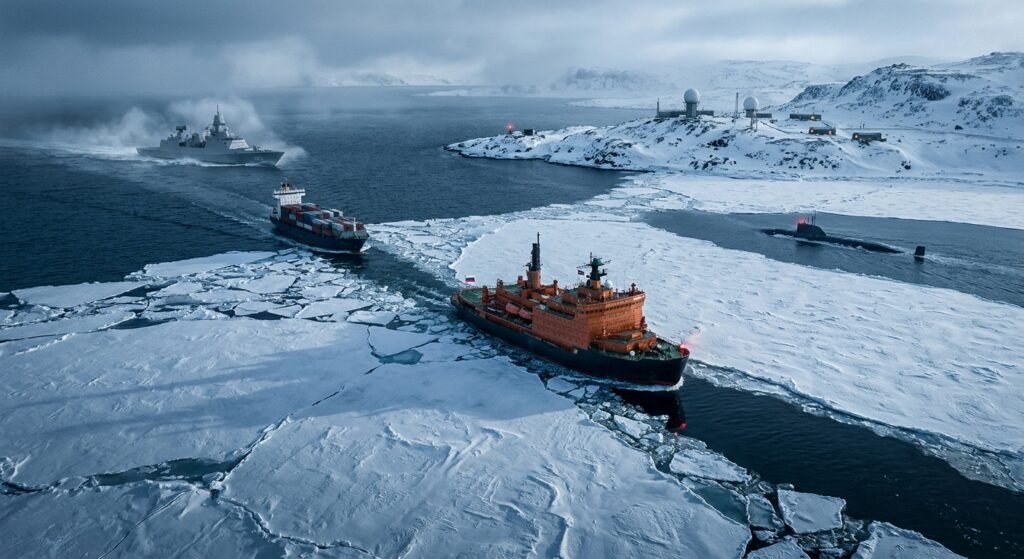
Russia possesses the Arctic’s most developed military infrastructure by a considerable margin, a position built over roughly two decades and only partially affected by the diversion of resources to the war in Ukraine. The Northern Fleet, elevated to the status of a distinct military district, is headquartered on the Kola Peninsula and comprises, according to defense-analytical estimates published in early 2026, on the order of thirty-two surface warships and more than thirty active submarines, supported by a nuclear-powered icebreaker fleet unmatched by any other state. The Kola bastion shelters a significant share of Russia’s sea-based nuclear deterrent and gives Moscow the ability to contest NATO’s access to the Greenland-Iceland-United Kingdom-Norway (GIUK-N) gap, the corridor through which reinforcement and resupply from North America to Europe would have to pass in a major conflict. Russia has continued modernizing this force even during the Ukraine war: in July 2026 it launched the Ulyanovsk, a new Yasen-M-class nuclear-powered cruise-missile submarine intended to join the Northern Fleet by year’s end. Physical infrastructure additions over the past decade — including the “Arctic Trefoil” base on Franz Josef Land, facilities on Novaya Zemlya, and installations on Kotelny Island — have given Russia a continuous chain of Arctic outposts supporting air defense, over-the-horizon radar, and basing for its ballistic-missile submarine force.
NATO’s Arctic posture has been transformed by the accession of Finland and Sweden, which gives the alliance an unbroken coastline along the approaches to the Barents Sea and substantially improves its ability to conduct coordinated maritime surveillance. The alliance has responded to Russian submarine activity with expanded exercises: the May 2026 Dynamic Mongoose anti-submarine warfare exercise brought together nine nations in the Norwegian Sea, while NATO’s Task Force X-Arctic, launched in June 2026, is testing uncrewed maritime sensors and data-sharing tools ahead of a full demonstration planned for 2027. A persistent capability gap nonetheless constrains the alliance’s — and particularly the United States’ — ability to sustain Arctic operations: as of 2024, the U.S. Coast Guard operated only one heavy polar icebreaker, the more than forty-year-old Polar Star, and one medium icebreaker, against a Russian fleet that multiple assessments place at more than forty vessels, including several nuclear-powered ships. Washington has moved to close this gap through the trilateral Canada-Finland-U.S. “ICE Pact,” announced in 2024 to coordinate construction of up to ninety icebreakers collectively, and through an October 2025 bilateral agreement under which Finland will sell the United States up to four icebreakers in a deal valued at 6.1 billion dollars.
China’s military and paramilitary footprint in the Arctic remains far smaller than Russia’s but has grown in visibility. Beijing operates more icebreakers than the United States despite having no Arctic coastline, and in October 2024 Chinese Coast Guard vessels entered Arctic Ocean waters for the first time on record, operating farther north than previously observed. The U.S. Department of Homeland Security characterized 2025 Chinese naval and research-vessel activity in or near U.S. Arctic waters as unprecedented, and China and Russia have expanded joint military and coast guard operations in the region, including patrols near Alaska. The Pentagon’s 2024 Arctic Strategy — the first update to U.S. Arctic defense policy since 2019 — notably lists Chinese activities as the primary element of the region’s strategic threat environment, ahead of Russian activities and Russia-China collaboration, reflecting Washington’s broader prioritization of long-term competition with Beijing even in a theater where Russia remains the more immediately capable military actor.
Political Dimension
The Arctic’s political landscape has been reorganized around a widening split between a Western-aligned bloc of seven Arctic states and an isolated Russia increasingly dependent on Chinese partnership. This split has been most visible in the paralysis of the Arctic Council, but its most consequential recent manifestation has been the Greenland crisis, which erupted into a full-scale trans-Atlantic dispute in January 2026. Building on rhetoric first raised in 2019 and renewed after his re-election, President Trump intensified pressure on Denmark to cede Greenland beginning in late December 2025, and on January 17, 2026 threatened tariffs of 10 percent — rising to 25 percent by June 1 — on Denmark and seven other European countries unless a deal was reached. The announcement triggered the largest protests in Greenland’s history, drew condemnation from the European Union, the United Kingdom, Norway, and Canada in support of Denmark, and produced what analysts described as an unprecedented situation for the alliance: a scenario in which one NATO member appeared to threaten the sovereign territory of another. Trump reversed the tariff threat and ruled out the use of military force at the World Economic Forum in Davos on January 21, 2026, but as of this writing the underlying dispute over Greenland’s status remains unresolved, with the Trump administration continuing to press for expanded U.S. security and economic access.
The Greenland dispute has had measurable spillover effects across the Nordic region. Iceland’s government scheduled a referendum, held on August 29, 2026, on whether to resume long-frozen negotiations to join the European Union — a vote explicitly framed by Icelandic and European commentators as shaped by anxiety over U.S. security commitments and the precedent set by pressure on Greenland, alongside longstanding domestic debates over fisheries and sovereignty. Pre-referendum polling showed the outcome close to even, illustrating how Arctic security anxieties are now feeding directly into mainstream Nordic electoral politics rather than remaining confined to defense-specialist discussion.
Politically, the Arctic Council’s paralysis has not produced full institutional collapse but rather a bifurcation: the seven non-Russian members have sustained limited technical cooperation since a June 2022 agreement to resume “projects that do not involve the participation of the Russian Federation,” while formal ministerial and Senior Arctic Official meetings have not been held in person since 2022, with Denmark having assumed the Council’s rotating chairship for 2025–2027 without any resolution of Russia’s status. Russia, for its part, withdrew entirely from the separate Barents Euro-Arctic Council in September 2023, formalizing its exclusion from regional sub-state cooperation as well.
Economic Dimension
The Arctic’s economic significance rests on three pillars: hydrocarbon and mineral resources, shipping-route competition, and the broader critical-minerals contest tied to the global energy transition and defense-industrial supply chains.
On shipping, Russia’s Northern Sea Route (NSR) has posted mixed but generally rising activity. Total NSR cargo volumes — dominated by Russian energy exports rather than international transit — reached 37.02 million metric tons in 2025, a 2.3 percent decline from the prior year according to Russian industry data, but Rosatom, the state operator, reported cargo running 15 percent above the prior year through the first half of 2026 and projected the route would exceed 40 million tons for the first time by year’s end. International transit traffic, while still a small fraction of total NSR volume, has grown steadily: the route recorded 103 transit voyages by 88 vessels in 2025, carrying roughly 3.2 million tons, with a record 15 container-ship transits, most connecting Russian and Chinese ports. Chinese-Russian bilateral cargo on the NSR exceeded 5 million tons in the first half of 2026 alone. These figures nonetheless fall well short of the 80-million-ton target Russia set for 2024 under a 2018 presidential decree, underscoring that the NSR — while a genuine and growing niche corridor, particularly for Russia-China trade — remains marginal relative to the roughly 20,000 vessel transits the Suez Canal handles annually, constrained by short navigable seasons, sparse port infrastructure, and insurance premiums that multiple shipping analyses place at five to ten times those for comparable conventional-route voyages.
On minerals, Greenland has emerged as a focal point of Western efforts to diversify critical-minerals supply chains away from China. The island’s Tanbreez project, developed by the U.S.-listed Critical Metals Corp, began construction of pilot-plant facilities in early 2026, with a first phase targeted for operation by mid-2026 and commercial rare-earth-oxide production of up to 85,000 metric tons annually envisioned from 2028. Other prospective projects, including the Kuannersuit (Kvanefjeld) rare-earth deposit, remain stalled following Greenland’s 2021 ban on uranium mining, which halted development given the deposit’s associated uranium content — illustrating that Greenland’s mineral wealth, however large in principle, faces substantial regulatory, environmental, infrastructure, and indigenous-consent constraints on near-term extraction regardless of which flag flies over the territory. Oil and gas extraction, meanwhile, remains formally banned in Greenland for environmental reasons, meaning the island’s strategic value to outside powers currently rests primarily on minerals and geography rather than hydrocarbons.
On hydrocarbons more broadly, most Arctic coastal states other than Russia have imposed moratoria or exercised extreme caution around new offshore drilling, reflecting both environmental sensitivity and the substantial capital costs and technical risk of Arctic extraction. The USGS’s decade-old resource estimate, while still analytically significant for understanding the region’s long-run potential, should therefore be read as an estimate of geological endowment rather than a forecast of near-term production; commercial extraction at scale for the majority of Arctic hydrocarbon resources remains constrained by economics, regulation, and infrastructure rather than primarily by geology.
Technological Dimension
Icebreaker capacity has become one of the clearest and most quantifiable indicators of relative Arctic capability, and the current asymmetry favors Russia decisively. Estimates compiled by the International Institute for Strategic Studies placed Russia’s fleet of icebreakers and ice-capable patrol vessels at 57 in 2022, versus a combined NATO total of 47 that year (a figure that has since risen with Finnish and Swedish accession); more recent reporting cites a Russian fleet in excess of 40 vessels, including nuclear-powered ships that no other nation currently operates. China’s fleet, while smaller in absolute terms, has grown from two vessels in 2022 toward parity with or beyond current U.S. numbers, prompting sustained concern among American defense officials about a widening “icebreaker gap.” The U.S. response — the trilateral ICE Pact and the 2025 Finnish procurement deal — represents the most concrete near-term technological catch-up effort, though delivery timelines for new heavy icebreakers typically run several years, meaning the capability gap is likely to persist through at least the late 2020s.
Beyond surface vessels, domain awareness represents a second major technological constraint, particularly for the United States. The Pentagon’s 2024 Arctic Strategy explicitly identifies gaps in communications, intelligence, surveillance, and reconnaissance infrastructure across the Arctic as a priority investment area, reflecting the region’s historically sparse satellite coverage, limited undersea cable and fiber infrastructure, and reliance on aging radar networks originally built for Cold War-era missile warning. NATO’s Task Force X-Arctic initiative, testing autonomous maritime sensors and shared data architectures, is a direct response to this gap and is scheduled for a fuller operational demonstration in 2027. Space-based infrastructure has also become more central to Arctic strategy: the U.S. Space Force operates high-latitude installations including Clear Space Force Station in Alaska and Pituffik Space Base on Greenland’s northern coast — the latter underscoring one of the concrete strategic rationales cited by Washington for its interest in expanded access to Greenland, independent of the territory’s mineral wealth.
Legal / Diplomatic Dimension
Arctic legal disputes center on two distinct but related bodies of law: the United Nations Convention on the Law of the Sea (UNCLOS) provisions governing extended continental shelves, and the 1920 Svalbard Treaty governing a specific and long-contested Norwegian archipelago.
Under UNCLOS Article 76, coastal states may claim sovereign rights over the seabed and subsoil of their continental shelf beyond the standard 200-nautical-mile exclusive economic zone if they can demonstrate geological continuity, subject to review by the UN Commission on the Limits of the Continental Shelf. Russia, Canada, and Denmark (on behalf of Greenland) have filed overlapping submissions concerning the Lomonosov Ridge, an 1,800-kilometer underwater ridge spanning the Arctic Ocean, each arguing that the ridge constitutes a natural extension of its own continental margin. Russia’s most recent submissions claim seabed rights extending close to the boundary of Canada’s exclusive economic zone; analysts have characterized this as close to a maximalist position, encompassing nearly the entire central Arctic Ocean seabed as claimed continental shelf. Notably, these disputes concern only seabed and subsoil resource rights, not the water column or surface navigation, and all three claimant states have publicly committed to resolving the overlaps through the UNCLOS process and eventual bilateral negotiation rather than through unilateral assertion — a meaningful point of continuity with the cooperative Arctic order even amid broader deterioration.
The Svalbard archipelago presents a more actively contested diplomatic problem. Under the 1920 treaty, Norway holds full and unqualified sovereignty, but the treaty’s roughly forty-six other signatories, including Russia, the United States, and China, retain equal rights to conduct certain commercial and scientific activities. Russia has maintained a coal-mining and research presence on the islands for decades and has, with increasing sharpness since the late 2010s, accused Norway of using environmental and security regulations to unlawfully restrict Russian activity in violation of the treaty; Norway maintains that its regulatory measures apply without nationality-based discrimination and are consistent with its sovereign authority. Norway has progressively tightened administrative control over Svalbard in recent years, including restrictions on foreign land purchases, even as some regional analysts assess that Russia currently has limited near-term appetite for escalation given its preoccupation with Ukraine — while noting rising, if still speculative, concern in Oslo about the precedent an aggressive U.S. posture toward Greenland could set for Svalbard.
A further legal-diplomatic friction concerns the basis for non-Arctic states’ involvement in regional governance. China’s self-designation as a “near-Arctic state,” first articulated in its 2018 white paper, has no formal grounding in the Arctic Council’s founding instruments, which restrict full membership to the eight states with Arctic territory; China holds only Permanent Observer status, obtained in 2013. Chinese state media has characterized Western scrutiny of Polar Silk Road activities as reflecting outdated confrontational thinking, while U.S. and allied analysts have generally treated the “near-Arctic” framing as a deliberate effort to establish a rhetorical and diplomatic basis for expanded influence disproportionate to China’s formal legal standing in the region.
Scenario Analysis
Scenario 1: Managed Competition (Continuity). Arctic militarization, resource competition, and institutional fragmentation continue along broadly current trajectories through 2030. Russia sustains but does not dramatically expand its Northern Fleet posture given continued Ukraine-related resource constraints; NATO gradually closes the icebreaker and domain-awareness gap without matching Russian numbers; China deepens commercial and scientific engagement without becoming a primary Arctic military actor; the Arctic Council remains politically frozen but technically alive; and the Greenland dispute is resolved through negotiated accommodation rather than crisis escalation. This scenario assumes no major exogenous shock, such as a Ukraine war settlement or a new Taiwan crisis, that would sharply redirect resources or attention toward or away from the Arctic.
Scenario 2: Institutional Fragmentation (“Cold Peace”). The Arctic Council’s political paralysis becomes effectively permanent, replaced by parallel, non-overlapping governance tracks: an informal “Arctic Seven” coalition coordinating Western policy, and a Russia-China axis pursuing resource development and shipping largely outside multilateral frameworks. Legal disputes over the continental shelf remain unresolved for years, absent negotiation forums that included Russia. This scenario is broadly compatible with continued low-intensity military competition but implies a more thoroughly bifurcated Arctic order than Scenario 1, with fewer functioning channels for crisis management should an incident occur.
Scenario 3: Crisis Escalation. A specific flashpoint — a renewed and more severe Greenland dispute, a Svalbard incident involving Russian or Chinese assets, or a naval or submarine incident in the GIUK-N gap or Barents Sea — escalates into a serious NATO-Russia or U.S.-Denmark diplomatic crisis, potentially invoking Article 5 consultations or producing a visible rupture in alliance cohesion. This scenario does not require or imply direct combat, but rather a sustained, high-visibility political-military crisis comparable in intensity to the January 2026 Greenland episode, with material effects on alliance unity, defense spending, and regional deployments.
Scenario 4: Cooperative Renewal. A negotiated settlement to the Ukraine war, combined with a shift in U.S. policy priorities, enables a partial restoration of Arctic Council functionality and a resumption of more substantial Russia-West technical and scientific cooperation, alongside a de-escalation of the Greenland dispute. This scenario would represent a partial return toward, though not a full restoration of, pre-2022 Arctic exceptionalism, and would likely require political developments largely exogenous to the Arctic itself.
Probability Assessment
| Proposition | Probability (through 2030) | Rationale |
|---|---|---|
| Continued long-term Arctic sea-ice decline, with periodic record or near-record lows | Very High | Consistent, multi-decade trend confirmed by NSIDC and NASA across independent datasets; short-term year-to-year variability does not alter the underlying trajectory. |
| Arctic Council restored to full pre-2022 political functionality (including Russia) by 2028 | Low | Contingent on a broader Russia-West rapprochement tied to the Ukraine war’s resolution, which shows no near-term sign of occurring; technical-level cooperation among the seven is likely to continue regardless. |
| Northern Sea Route cargo volumes reach Russia’s original 80-million-ton 2024/mid-decade target | Low | Volumes are growing but remain roughly half the original target even in 2026; insurance costs, short seasons, and sanctions-driven financing constraints are structural rather than cyclical. |
| Negotiated redefinition of Greenland’s status expanding U.S. security/economic access while preserving nominal Danish sovereignty | Moderate to High | Consistent with the trajectory of the crisis to date, structural U.S. leverage, and the preferences expressed by most parties to avoid outright annexation or prolonged rupture; timing remains uncertain. |
| China achieves a militarily significant, sustained Arctic naval presence | Low | Current activity is overwhelmingly coast guard, research, and commercial in nature; Beijing’s broader naval priorities remain concentrated in the Indo-Pacific. |
| Direct NATO-Russia military confrontation in the Arctic | Very Low | No party has an incentive for direct conflict in a theater of secondary priority relative to Ukraine, Taiwan, or the Baltic; deterrence postures on both sides are designed to avoid, not provoke, escalation. |
| U.S. closes the icebreaker “gap” with Russia to rough numerical parity by 2030 | Low to Moderate | ICE Pact and Finnish procurement represent real progress, but Russian numbers are large and shipbuilding timelines for heavy icebreakers typically span years; parity is unlikely, though the gap will likely narrow. |
| Greenland achieves full political independence from Denmark within the assessment period | Low | Greenlandic self-government has expressed independence aspirations, but economic dependency on Danish subsidies and the current geopolitical spotlight make a rapid, unilateral move unlikely without a broader negotiated settlement. |
Strategic Outlook
Over the medium term, the Arctic is likely to consolidate into a persistent but bounded arena of great-power competition rather than either a fully cooperative or a fully militarized space. Several trend lines support this assessment. Russia’s Arctic military posture, while formidable, is constrained by the ongoing demands of the Ukraine war and by underlying economic pressure from Western sanctions, limiting the pace at which Moscow can further expand its Northern Fleet or Arctic basing infrastructure, even as it retains its existing qualitative and quantitative advantages, particularly in icebreakers and submarine forces. NATO’s response, anchored in the accession of Finland and Sweden and in slowly maturing initiatives such as the ICE Pact and Task Force X-Arctic, is likely to narrow — but not close — the most consequential capability gaps by decade’s end.
China’s trajectory bears close monitoring but should be assessed with calibrated rather than alarmist expectations: Beijing’s Arctic interests are predominantly commercial and diplomatic, oriented toward securing a long-term option on Arctic shipping routes and resource access rather than establishing a near-term military presence that would divert resources from its primary strategic focus on the Indo-Pacific. The steady growth in Chinese-flagged and Chinese-linked container shipping on the Northern Sea Route, however, illustrates a durable economic logic — shorter transit times between East Asian and European ports — that is likely to persist and slowly compound regardless of the broader political climate, making China a growing economic stakeholder in Arctic governance questions even without formal Arctic status.
The Greenland dispute represents the most acute near-term political risk to alliance cohesion, precisely because it inverts the Arctic’s traditional dynamic: rather than a Russia-versus-NATO contest, it places two NATO allies in direct tension over sovereignty, testing the alliance’s internal cohesion in a manner with few historical precedents. The most probable resolution pathway involves a negotiated expansion of U.S. security and economic access — potentially including expanded basing rights, minerals investment frameworks, and defense cooperation agreements — that stops short of a change in formal sovereignty, allowing all parties a face-saving outcome. However, the unresolved nature of the dispute as of this writing, and the volatility it has already introduced into Nordic politics, including Iceland’s closely contested EU referendum, means this remains a live source of alliance friction that could resurface with limited warning.
Finally, the interplay between Arctic institutional fragmentation and legal ambiguity over continental-shelf claims creates a structural, if currently low-probability, risk of future disputes over seabed resource rights, particularly as extraction technology and market economics evolve. The fact that Russia, Canada, and Denmark have thus far pursued their overlapping claims through the UNCLOS process rather than unilateral action is a meaningfully positive indicator, suggesting that even amid broader Russia-West estrangement, the legal architecture governing seabed rights has retained more resilience than the political architecture governing Arctic Council cooperation.
Conclusion
The Arctic’s transformation from a zone of exceptional cooperation into a more conventional arena of great-power competition reflects the convergence of physical, economic, and institutional changes that are unlikely to reverse in the foreseeable future. Melting ice is expanding access; resource and mineral wealth is drawing sustained commercial and strategic interest; and the collapse of Arctic Council political cooperation since 2022 has removed the primary mechanism through which circumpolar states once managed disputes below the threshold of open rivalry. Russia retains the region’s dominant military position, built on decades of investment in its Kola Peninsula bastion, even as the Ukraine war constrains further expansion. China, while a secondary military actor, has established itself as a durable commercial and diplomatic stakeholder through its Polar Silk Road strategy and growing icebreaker fleet. The United States and its NATO allies are engaged in a multi-year effort to close longstanding capability gaps, complicated in the near term by the unresolved and historically unusual dispute over Greenland.
None of this indicates that the Arctic is on a trajectory toward armed conflict. The region’s forbidding geography, sparse population, extreme infrastructure costs, and short operational seasons will continue to impose real limits on the pace and intensity of militarization, and all major parties to date have shown a clear preference for competition conducted through legal claims, economic investment, and deterrence posturing rather than direct confrontation. The more realistic and consequential risk is one of accumulating friction: a steady erosion of the cooperative habits that once distinguished the Arctic from other theaters, producing a region that is, by the early 2030s, governed less by consensus-based institutions and more by the same balance-of-power logic that characterizes the rest of the international system. For policymakers, the most useful indicators to track going forward are the pace of icebreaker fleet construction on both sides of the widening capability gap, the resolution — or non-resolution — of Greenland’s status, and whether the Arctic Council’s political-level functions show any sign of revival, each of which will offer an early signal of whether the region is moving toward Scenario 1’s managed continuity, Scenario 2’s deeper fragmentation, or a more acute Scenario 3 crisis.
Frequently Asked Questions
Why is the Arctic becoming strategically important now, rather than in previous decades? The convergence of three trends explains the timing: accelerating sea-ice loss is physically opening the region to shipping and resource access at a pace not seen in the historical record; the 2022 Russian invasion of Ukraine collapsed the Arctic Council’s political cooperation, removing the primary channel for managing disputes; and China’s emergence as a self-declared “near-Arctic state” with a formal Polar Silk Road strategy has added a third major power to what was historically a largely Russia-West dynamic.
What is the Northern Sea Route, and how significant is it for global trade? The Northern Sea Route is a Russian Arctic shipping corridor that can cut the sailing distance between East Asia and Europe by roughly a third compared with the Suez Canal. It carried about 37 million tons of cargo in 2025, the large majority Russian energy exports rather than international transit, with international transit volumes around 3.2 million tons. Despite recent growth, high insurance costs, short navigable seasons, and limited port infrastructure mean it remains a niche corridor rather than a near-term substitute for established global shipping lanes.
Is Russia or the United States currently ahead in Arctic military capability? Russia holds a substantial advantage in most measures of hard Arctic capability, particularly icebreakers (a fleet of roughly 40-plus vessels, including several nuclear-powered ships, versus one heavy and one medium U.S. icebreaker) and permanent Arctic basing infrastructure. The United States and its NATO allies retain broader global military superiority and are pursuing initiatives such as the ICE Pact and new Finnish icebreaker purchases to narrow the specific Arctic capability gap, but most assessments expect that gap to persist, in a reduced form, through at least the end of the decade.
Why does China matter in the Arctic when it has no Arctic territory? China holds Permanent Observer status at the Arctic Council rather than full membership, but has pursued substantial commercial, scientific, and diplomatic engagement through its Polar Silk Road strategy, an icebreaker fleet larger than that of the United States, and a growing share of Northern Sea Route container shipping, mostly in partnership with Russia. Its interest is driven primarily by long-term access to shorter shipping routes and potential resource and mineral opportunities rather than by near-term military ambitions in the region.
Could the dispute over Greenland lead to conflict within NATO? The January 2026 crisis, in which the Trump administration threatened tariffs and did not initially rule out the use of force to acquire Greenland from Denmark, produced a diplomatic rupture without precedent in NATO’s history, though it did not approach armed conflict and de-escalated after the administration ruled out force and tariffs later that month. Most analysts assess that a negotiated arrangement expanding U.S. security and economic access while preserving nominal Danish sovereignty is the more probable outcome than either annexation or a full return to the pre-crisis status quo, though the dispute remains unresolved and retains the potential to resurface.
Sources
Government and Official Sources
- U.S. Department of Defense, 2024 DoD Arctic Strategy (July 22, 2024)
- U.S. Geological Survey, Circum-Arctic Resource Appraisal: Estimates of Undiscovered Oil and Gas North of the Arctic Circle (2008)
- National Snow and Ice Data Center (NSIDC), Sea Ice Today and related analyses (2026)
- NASA Science, Arctic Winter Sea Ice Ties Record Low (2026)
- Government of Iceland, official referendum information (2026)
- Government of Norway (regjeringen.no), The Arctic Council (2025)
- UK House of Commons Library, President Trump and Greenland: Frequently Asked Questions (2026)
- Government of Canada (Global Affairs Canada), Arctic Council joint statements (2022)
Think Tanks and Research Institutes
- Center for Strategic and International Studies (CSIS), The Ice Curtain: Russia’s Arctic Military Presence; China Launches the Polar Silk Road
- RAND Corporation, Is the Polar Silk Road a Highway or Is It at an Impasse? China’s Arctic Policy Seven Years On (2025)
- Wilson Center, China: The New “Near-Arctic State”
- Institut français des relations internationales (Ifri), Russia’s Arctic Policy and the Northern Fleet Modernization
- The Arctic Institute, Russia’s Arctic Strategy: Military and Security; China’s Adaptive Diplomacy and Economic Statecraft in a Fragmented Arctic Order
- International Centre for Defence and Security (ICDS), Iceland’s Small Referendum with Big Consequences for the EU
- Foundation for Defense of Democracies (FDD), Russia Is Expanding Its Arctic Submarine Fleet (2026)
- U.S. Naval Institute Proceedings, War in the Arctic? (January 2026)
Data, Scientific, and Industry Sources
- Centre for High North Logistics (CHNL), Main Results of NSR Transit Navigation in 2025
- Rosatom / Atomflot public statements on Northern Sea Route cargo volumes (2026)
- International Institute for Strategic Studies (IISS) icebreaker fleet data, as compiled by Statista
News and Media Sources
- The Moscow Times, Russia’s Northern Sea Route Cargo Volumes Fall for Second Straight Year (2026)
- Reuters/CNBC, various 2026 reporting on the Greenland crisis and Iceland’s EU referendum
- CNN, NATO Faces a Major Crisis Over Greenland (2026)
- Al Jazeera, reporting on Greenland-Denmark-U.S. negotiations and Greenland’s mineral resources (2026)
- Euronews, Iceland’s EU Referendum: What to Know and Mining, Climate and Smokescreens (2026)
- China Media Project, Polar Silk Road (2026)
- S&P Global, Extreme Climate Limits Extractive Projects in Greenland to a Handful (2026)
- Wikipedia, Greenland Crisis, Lomonosov Ridge, and 2026 Icelandic European Union Membership Negotiations Referendum (used for factual chronology cross-referencing only)
This assessment reflects publicly available information as of August 29, 2026. The Greenland dispute, the Iceland EU referendum, and related developments remain fluid; readers should consult current reporting for subsequent developments.